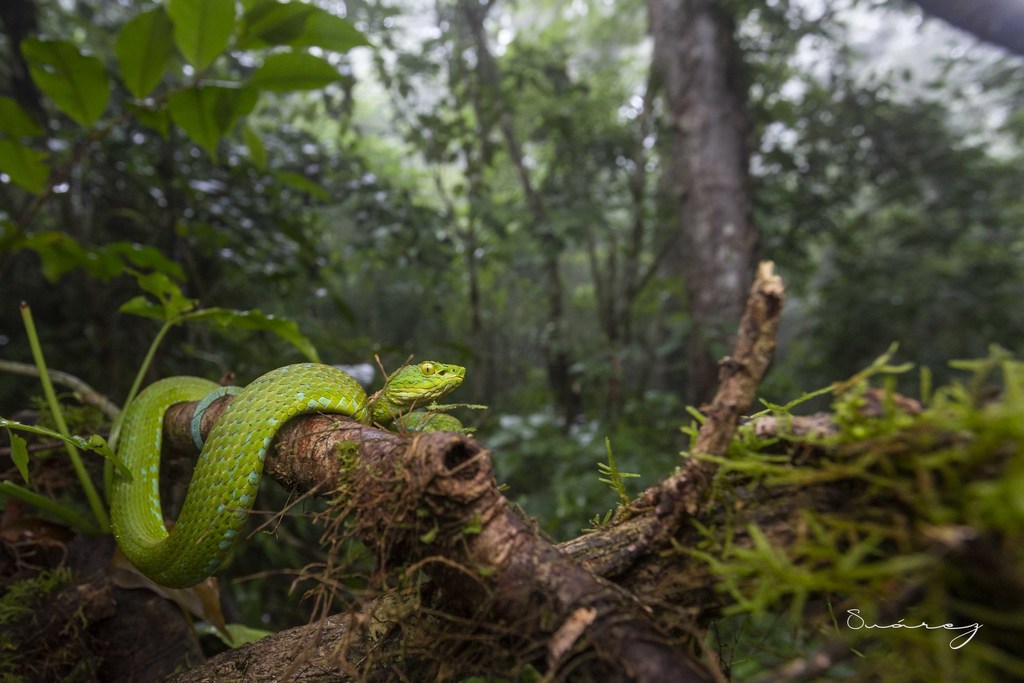
Rowley's Palm Pit Viper
Bothriechis rowleyi
 SnakeViperidaemedium⚠ VENOMOUSVery Rare
Quick ID
Field Notes
A small, slender pit viper typically measuring 16–24 inches (41–61 cm) in total length. Body is extremely slender and gracile, well-adapted for an arboreal existence. Head is small, slightly flattened, and distinctly set off from the narrow neck. Dorsal coloration is typically bright green, though some individuals may display yellowish-green or olive tinges. The body is generally uniform in color with minimal patterning, though some specimens may exhibit faint darker markings along the vertebral region or subtle banding on the tail. The distinctive prehensile tail is often a contrasting color, ranging from yellow to orange or reddish, which may serve a caudal luring function. Scales are heavily keeled, giving the body a distinctly ridged appearance. The head is covered with small, irregular scales. Vertical elliptical pupils are present. Prominent loreal pits are well-developed for heat detection. Ventral surface is yellowish-green to pale green, occasionally with darker mottling. This species is endemic to the cloud forests of central Guatemala, where it inhabits palm trees and dense vegetation at high elevations. It is strictly arboreal and rarely descends to the ground. Diet consists primarily of small lizards, tree frogs, and small mammals, such as mice and shrews, subdued via envenomation.
Similar species: Eyelash Pit Viper (Bothriechis schlegelii) has prominent supraocular scales resembling eyelashes and occurs at lower elevations in a wider geographic range; Green Pit Viper (Trimeresurus albolabris) is more robust with a larger head and lacks the distinctly prehensile, contrasting-colored tail; Palm Pit Viper (Bothriechis marchi) has a more triangular head shape and typically displays more pronounced patterning on the dorsal surface.
Photos
Click any photo to expand · Photos via iNaturalist
Range
Range data © iNaturalist contributors (CC BY 4.0)