ID Help
Hyper-similar species pairs and groups that trip up even experienced herpers
Slimy Salamander Complex
SalamandersKey mark: locality
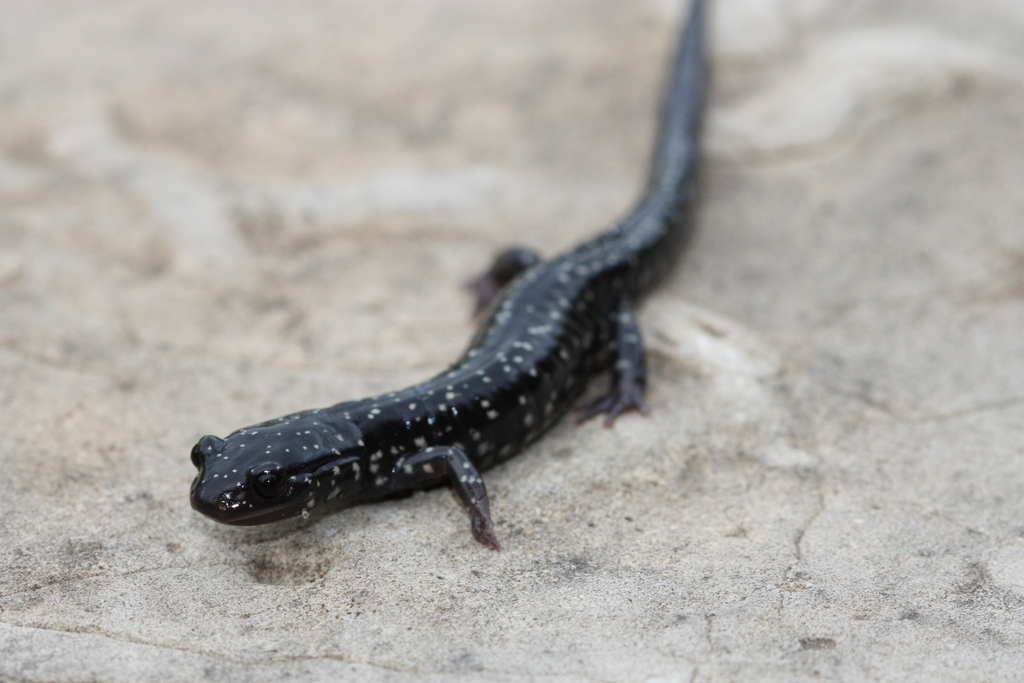
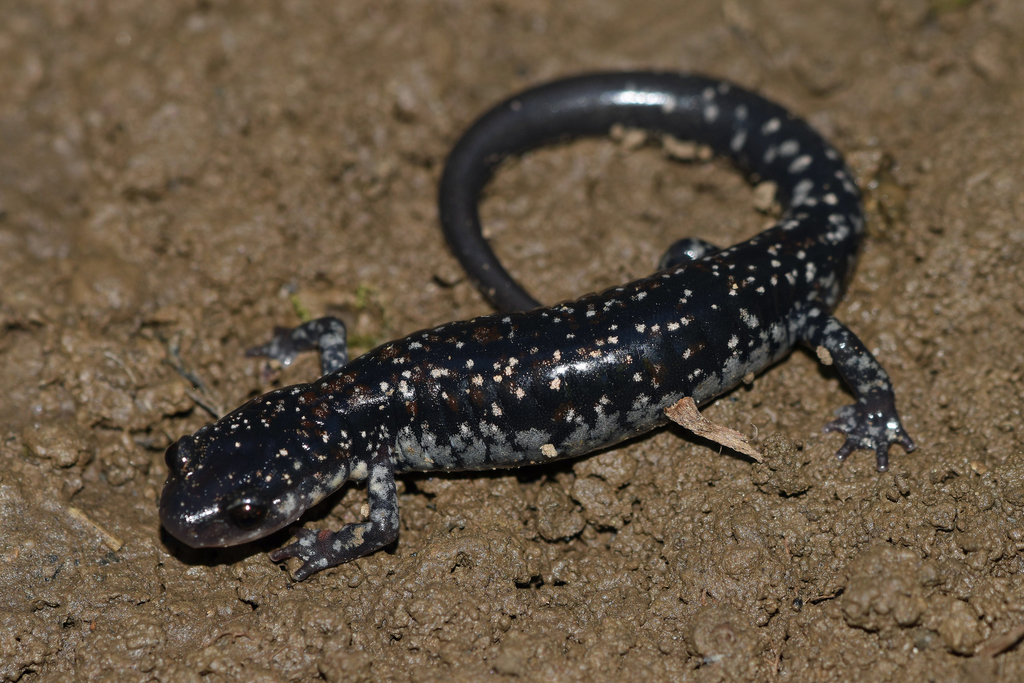
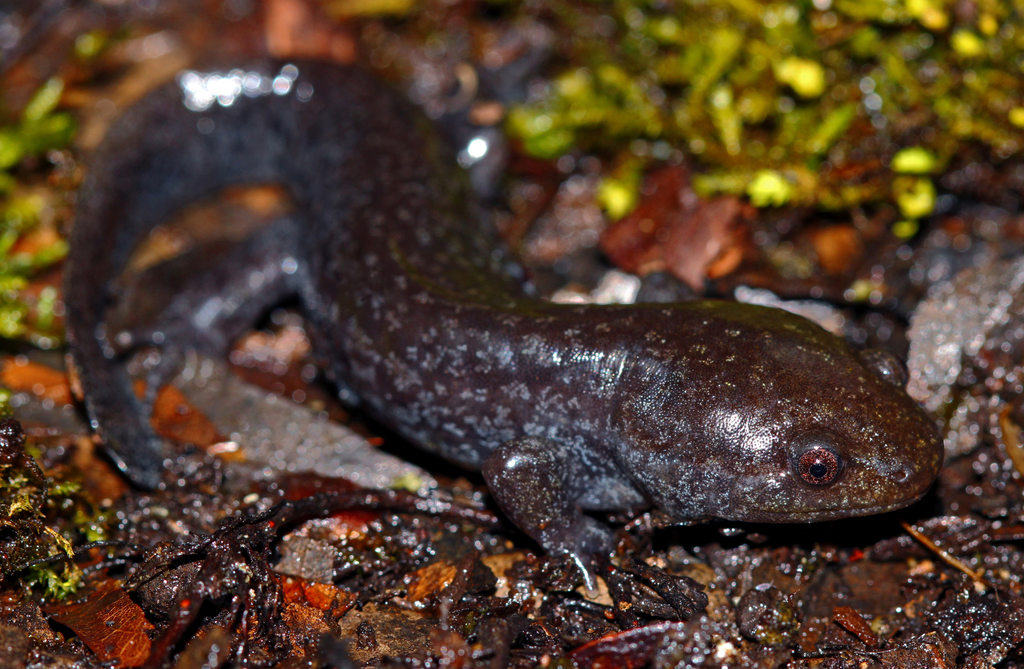
Three cryptic species in Arkansas's Interior Highlands — Western Slimy, Kiamichi Slimy, and Louisiana Slimy. All are large, dark lungless salamanders with silvery-white flecks and sticky skin. Cannot be reliably separated without locality data or genetics. Western Slimy (P. albagula) is the statewide generalist.

Marbled Salamander vs. Ringed Salamander
SalamandersKey mark: band width & breeding season
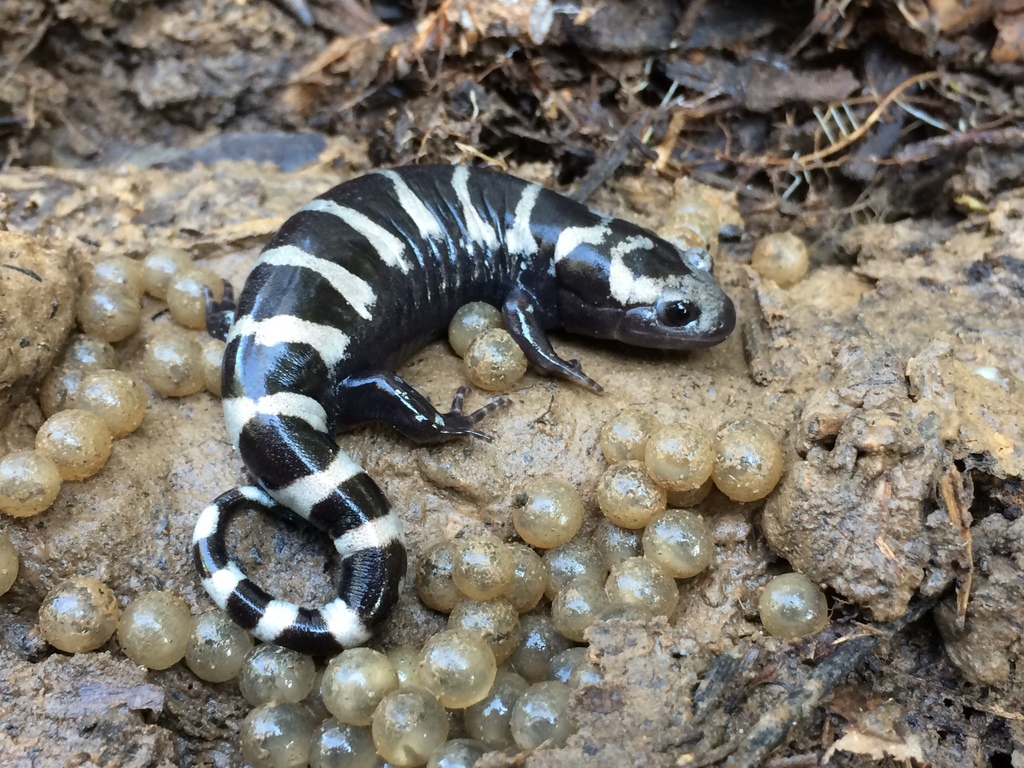
Both are stocky mole salamanders with pale crossbands on a dark body, and both breed in fall. Marbled Salamander has broader, more irregular white (male) or gray (female) bands. Ringed Salamander has narrower, more complete rings and a more slender build. Ringed is less common and prefers cooler, spring-fed seeps.
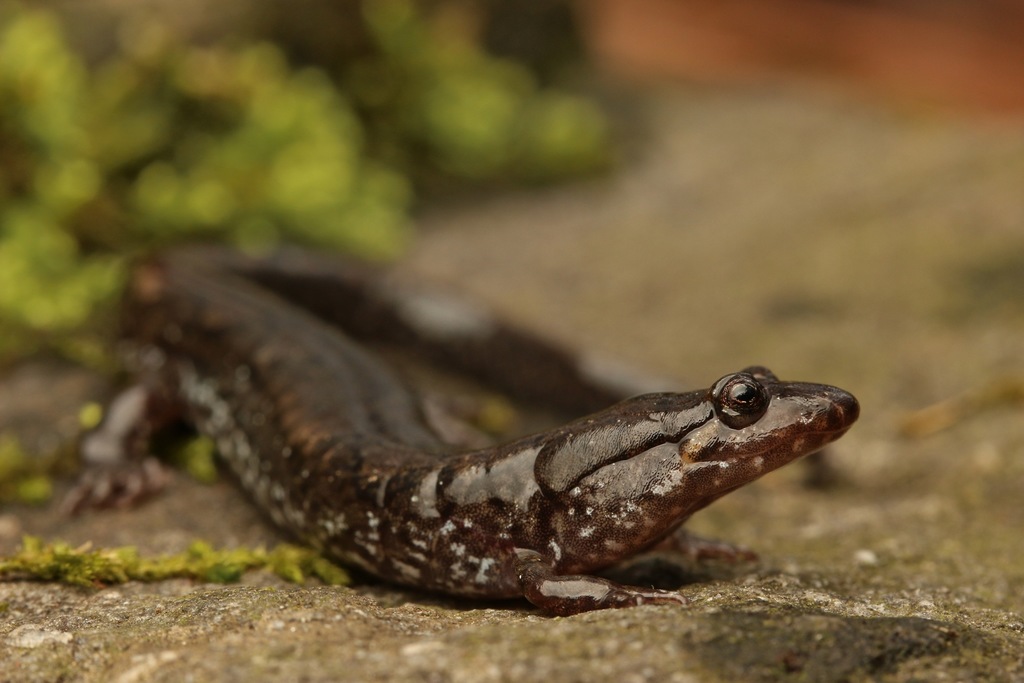
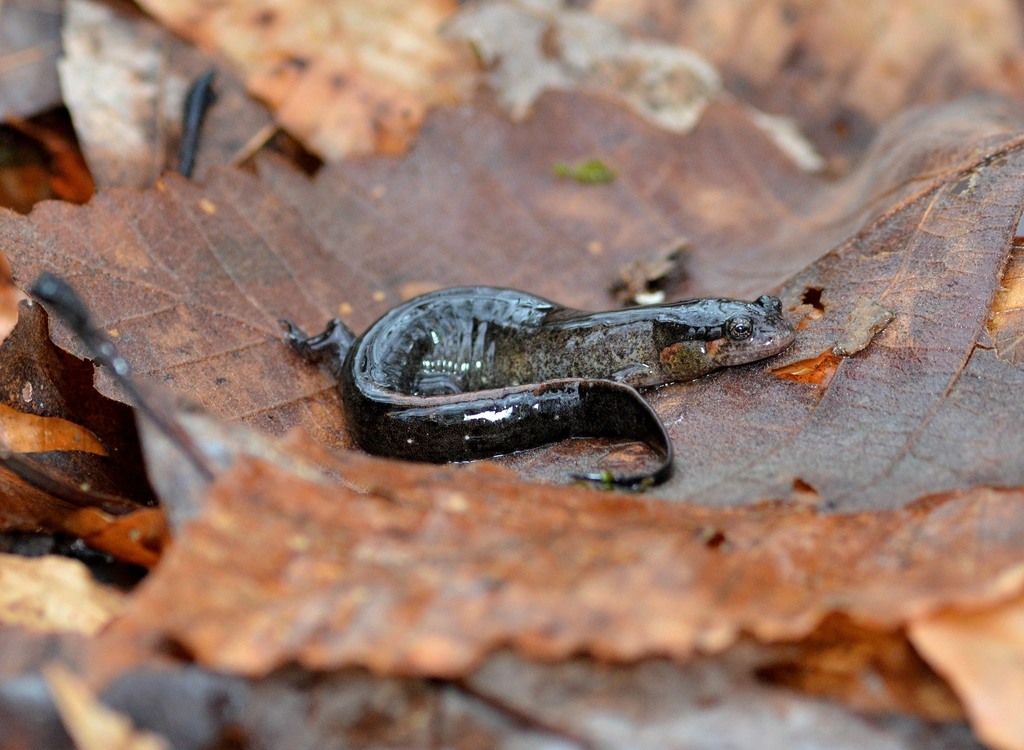
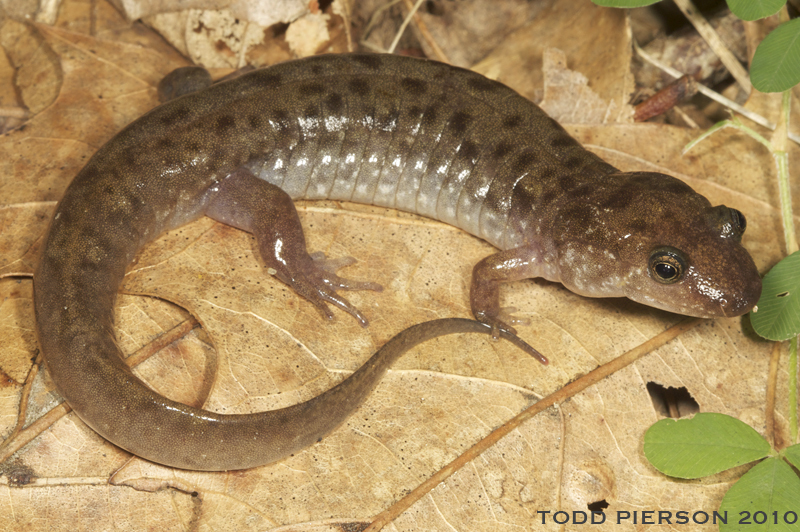
Dusky Salamanders (Desmognathus)
SalamandersKey mark: light line from eye to jaw and tail shape
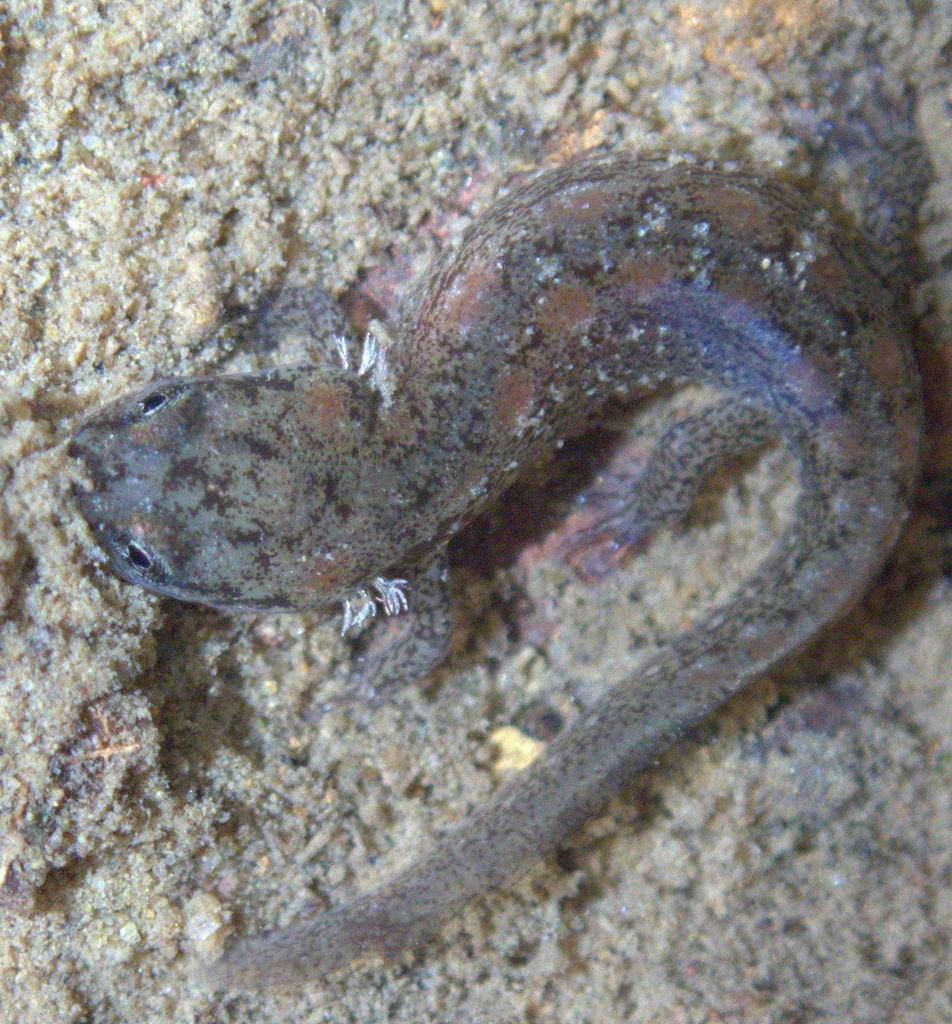
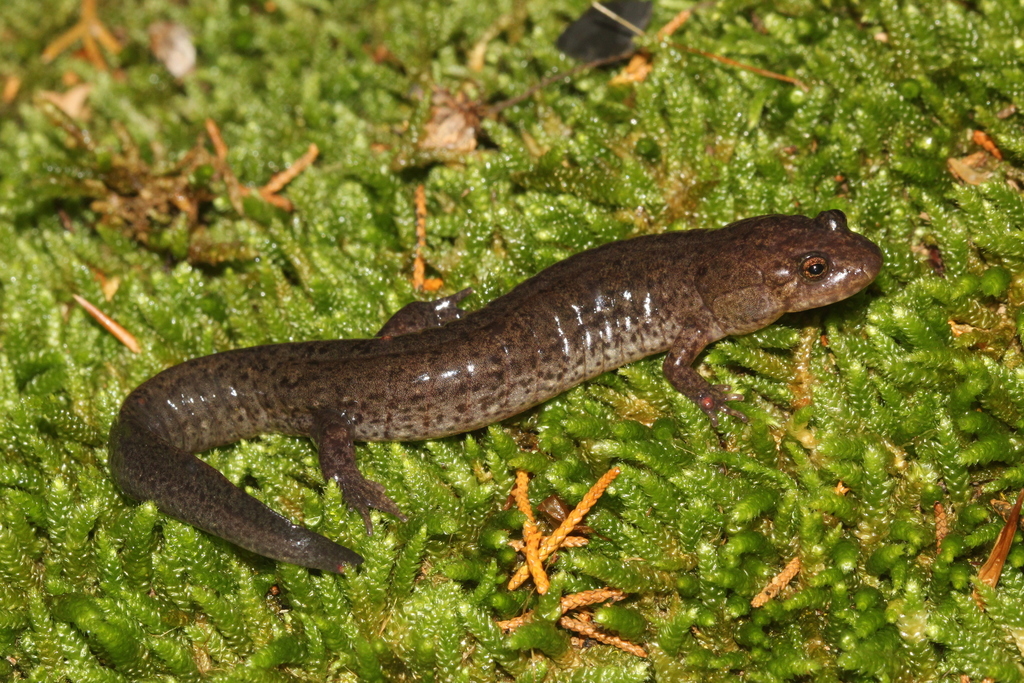
Dusky salamanders are among the most abundant salamanders in Appalachian streams but are notoriously difficult to identify. All have a pale line running from the eye to the angle of the jaw — a diagnostic feature of the genus. Northern Dusky: brown with faint mottled pattern; keel on tail is rounded. Seal Salamander: distinctive large size; boldly patterned with worm-like dorsal marks; robust body. Allegheny Mountain Dusky: smaller; tan to gray; found at higher elevations in the northern Appalachians. Many species in this group hybridize and require close examination of costal grooves and habitat elevation to confirm.

Mole Salamanders (Ambystoma)
SalamandersKey mark: spot pattern and body size
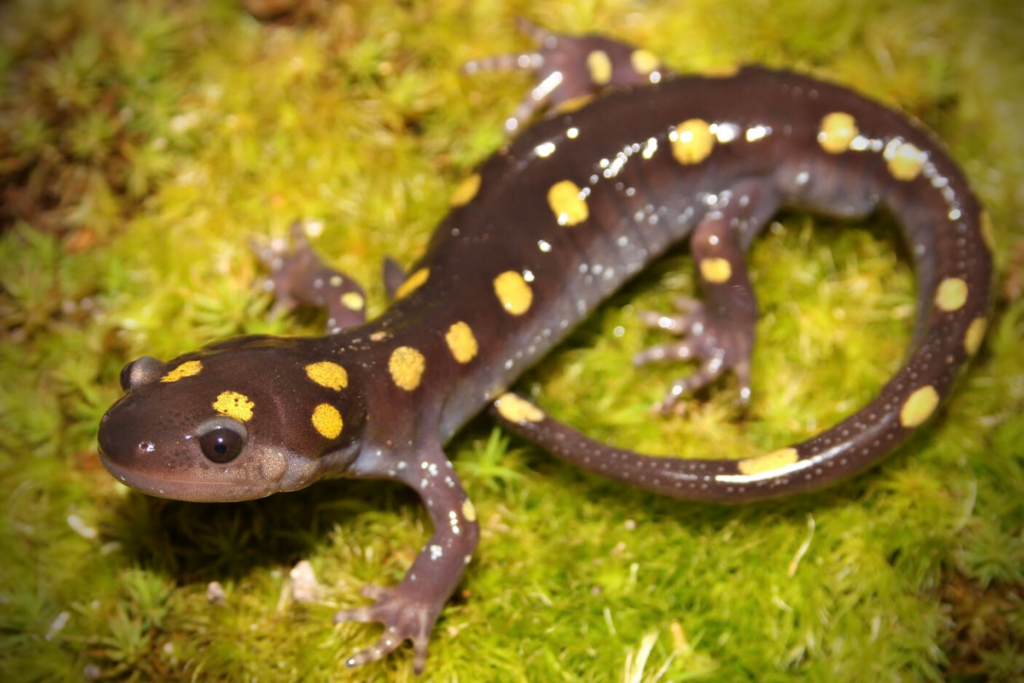
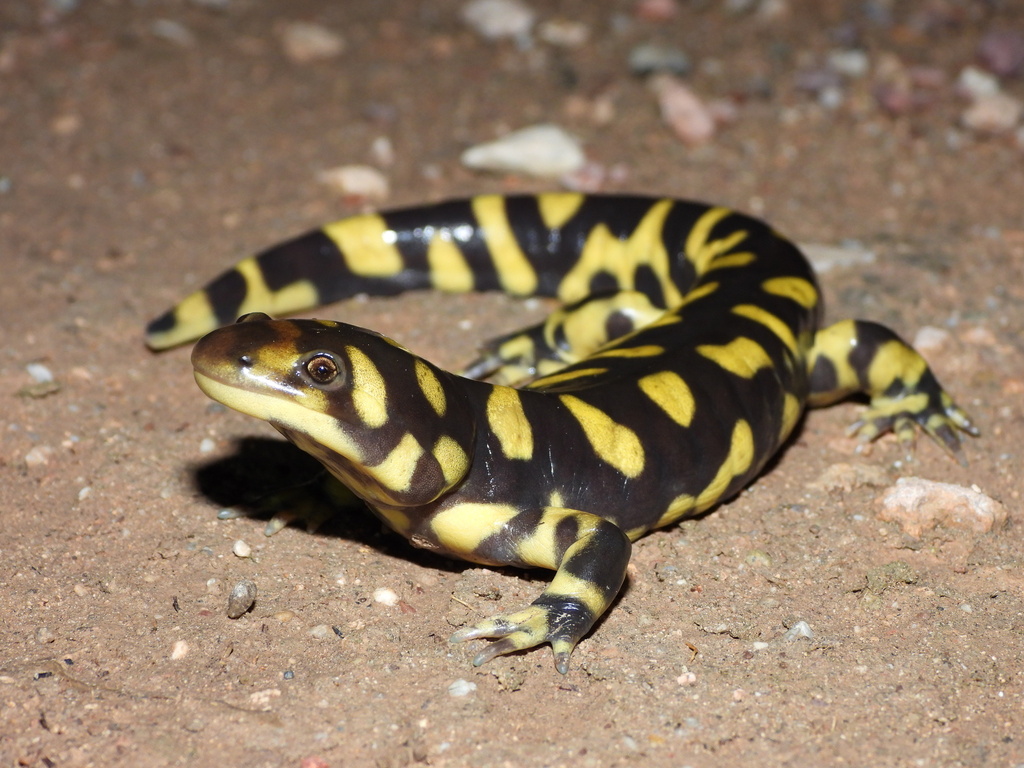
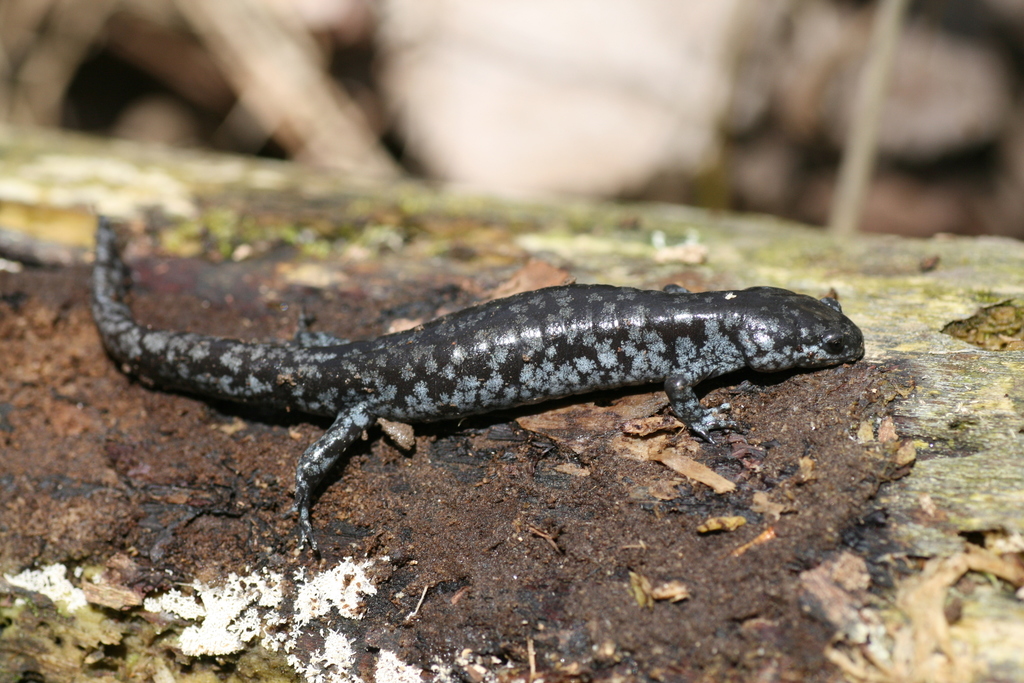
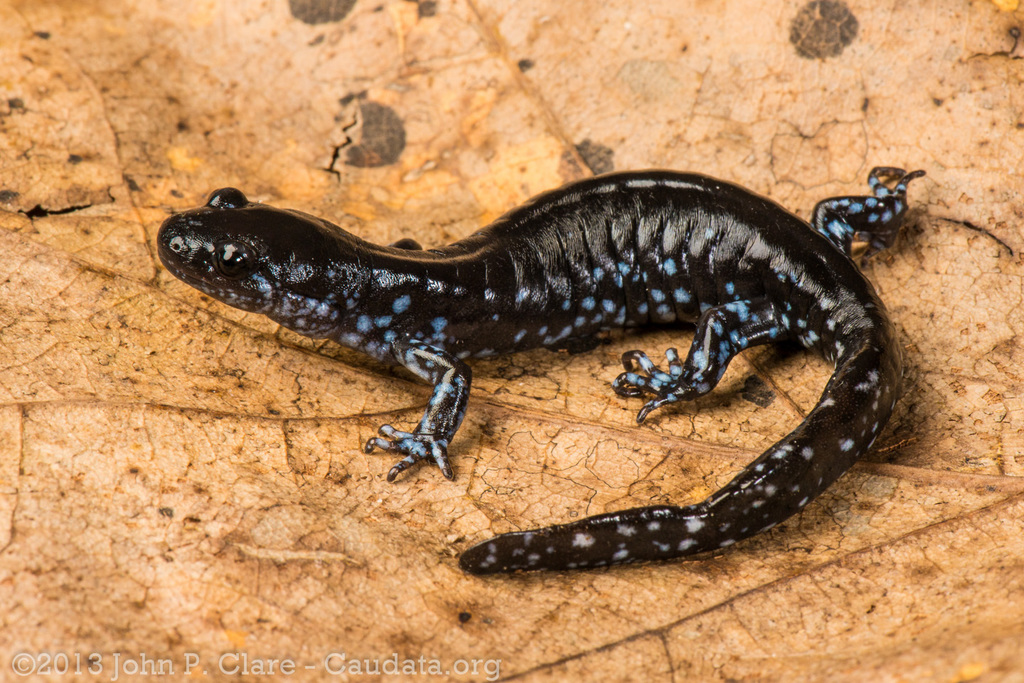
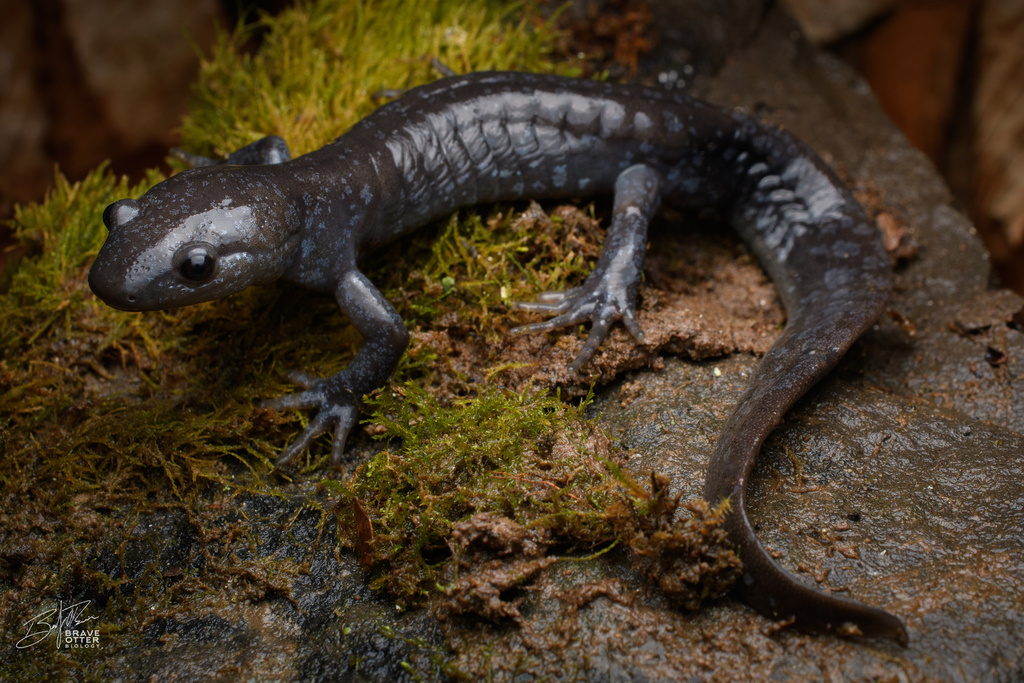
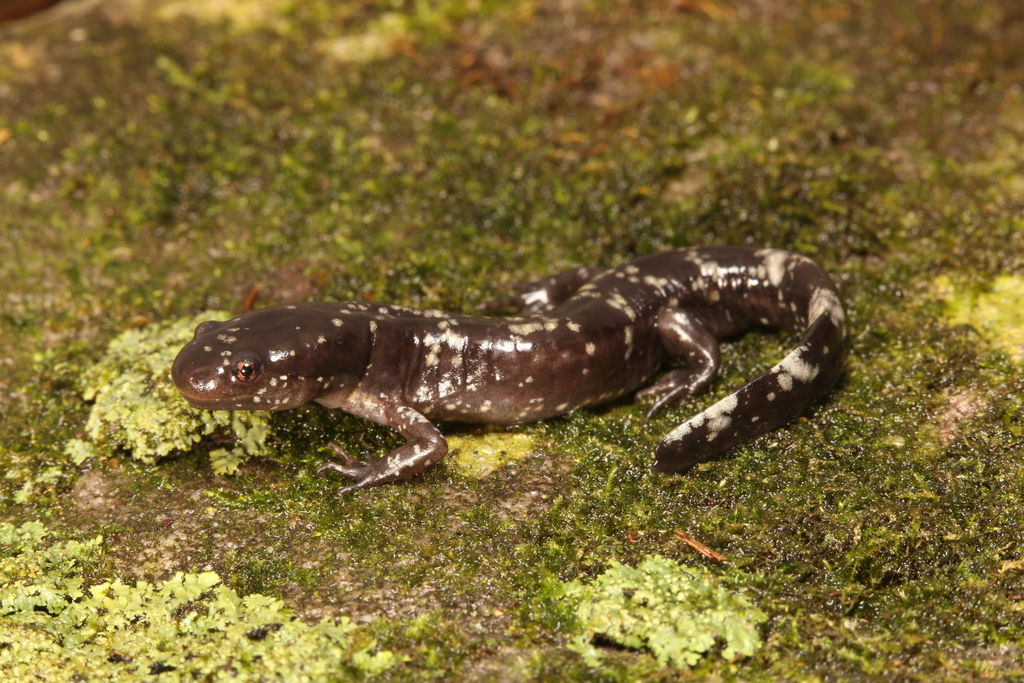
Mole salamanders are large, stocky, smooth-skinned salamanders that spend most of the year underground, emerging to breed in ponds on rainy nights in late winter or early spring. Spotted Salamander: large (7-9 in.), two irregular rows of yellow or orange spots on a blue-black body. Blue-spotted Salamander: smaller, blue-black with blue and white spots scattered on sides; northeastern US. Jefferson Salamander: gray-brown with blue flecks on the sides; similar range; can hybridize with Blue-spotted. Small-mouthed Salamander: plain dark gray-brown with a small head and mouth; central US.
Red & Mud Salamanders
SalamandersKey mark: eye color and spot pattern
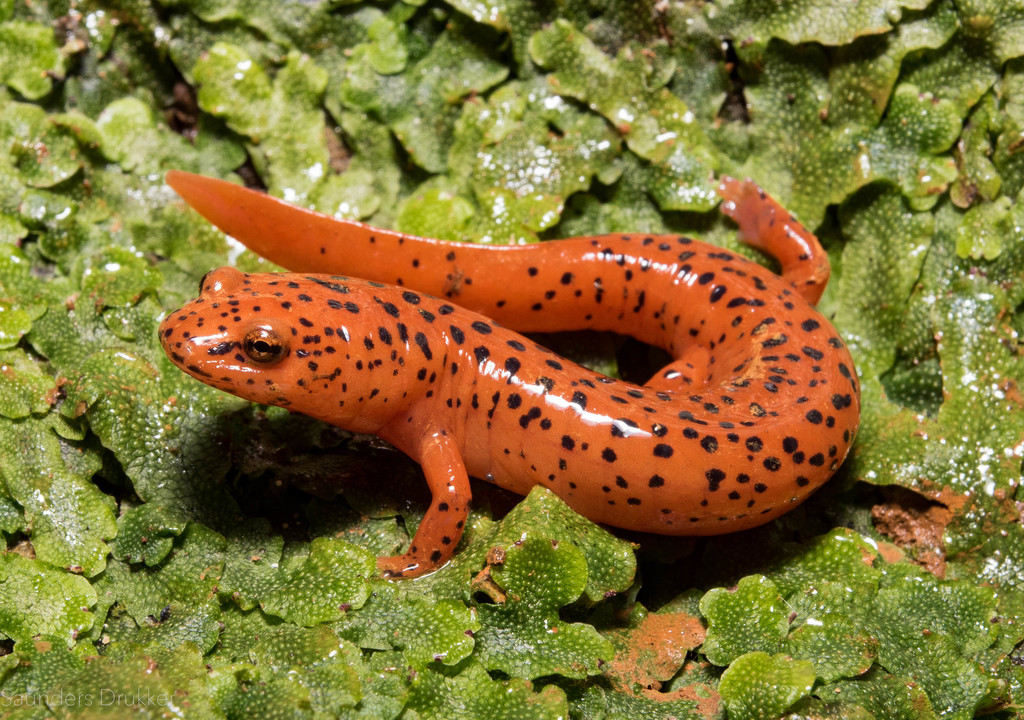
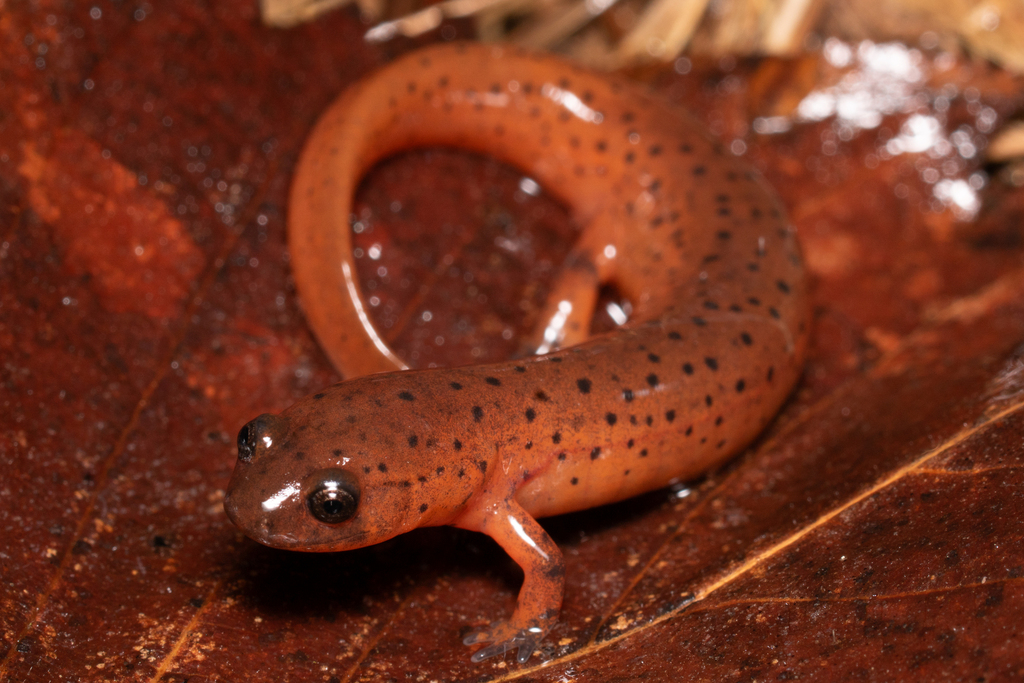
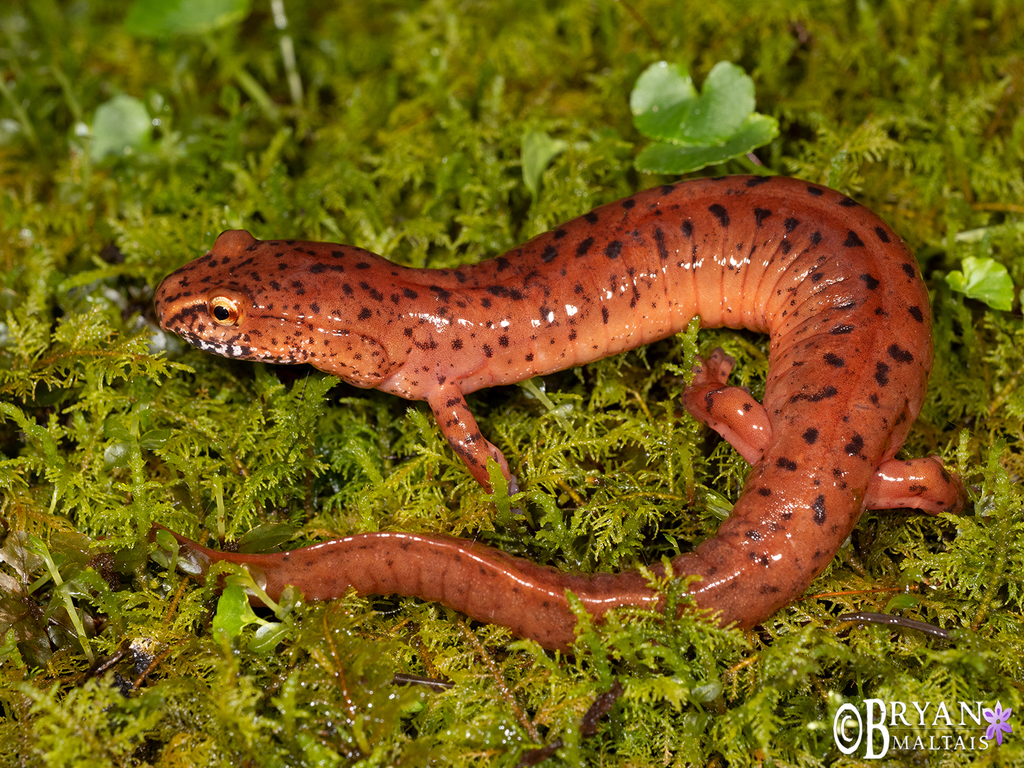
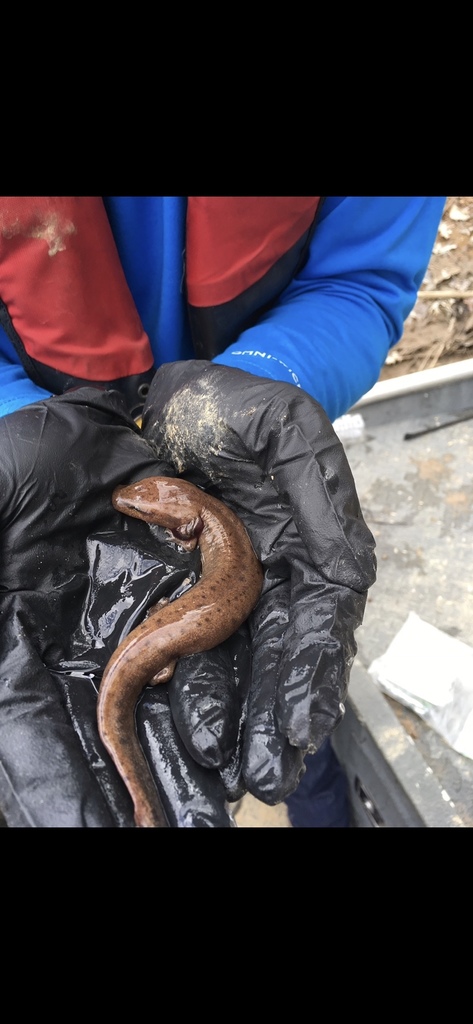
Three red or orange salamanders share overlapping ranges in the eastern US. Red Salamander: brilliant red with irregular black spots; gold or yellow eye; found in cool springs and seeps. Mud Salamander: similar red-orange with round, well-separated black spots; brown eye — the most reliable field mark. Spring Salamander: salmon-pink to reddish with faint mottling and a distinct pale line from eye to nostril (nasolabial groove visible); cave-associated streams and cold springs; longer and more slender than the other two.
Amphiumas & Sirens
SalamandersKey mark: leg count and gill presence
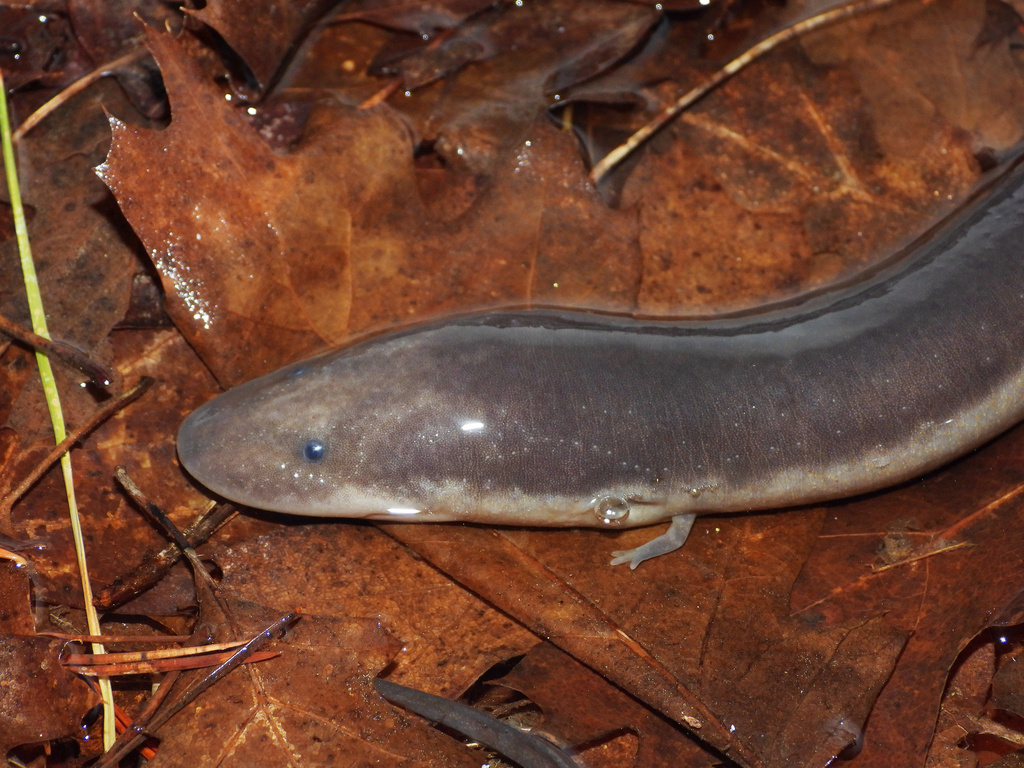
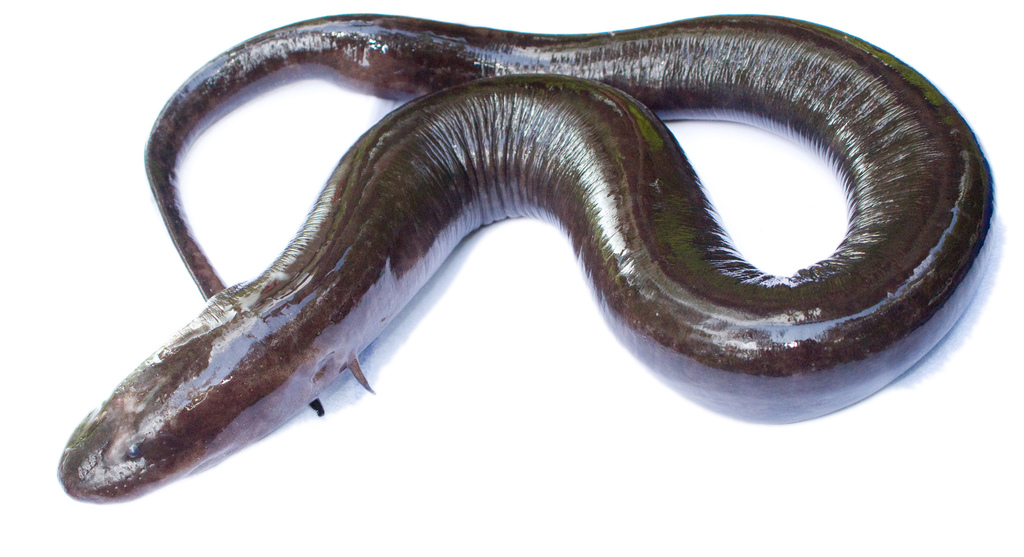
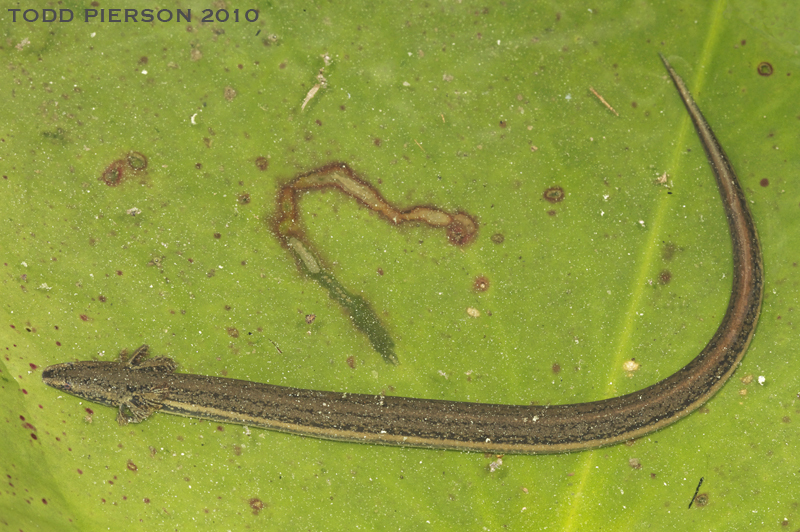
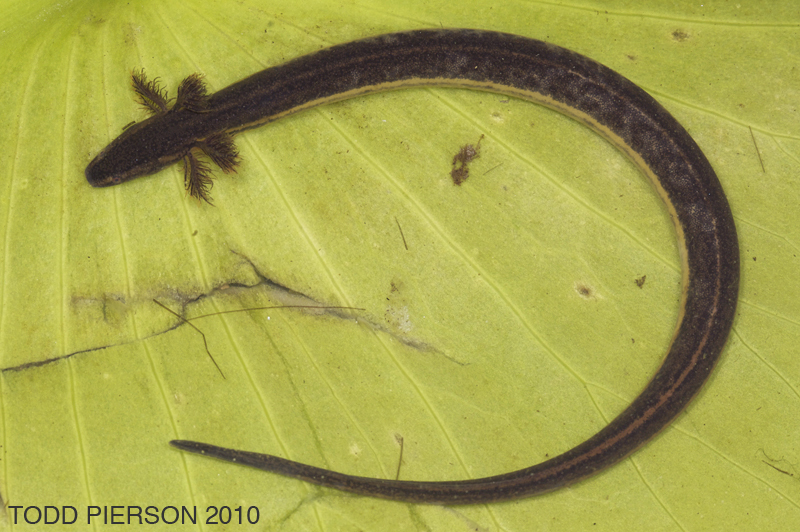
All are large, eel-like aquatic salamanders — but they belong to two very different families. Amphiumas (Amphiuma) have four tiny, nearly useless legs and NO external gills; they look like a thick, dark eel and can deliver a painful bite. Tell the three species apart by counting toes: one, two, or three. Sirens (Siren, Pseudobranchus) have only two small front legs and NO hind legs at all, plus bushy external gills that stay visible throughout life. Greater Siren is huge (up to 38") and dark; Lesser Siren is smaller (up to 20"); Dwarf Sirens are tiny (under 8") and often striped.
Mudpuppies, Waterdogs & Hellbender
SalamandersKey mark: body size and gill form
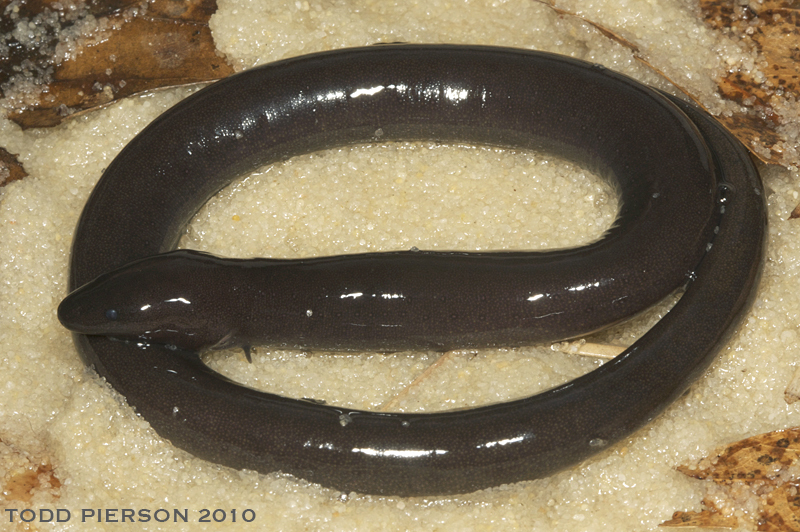
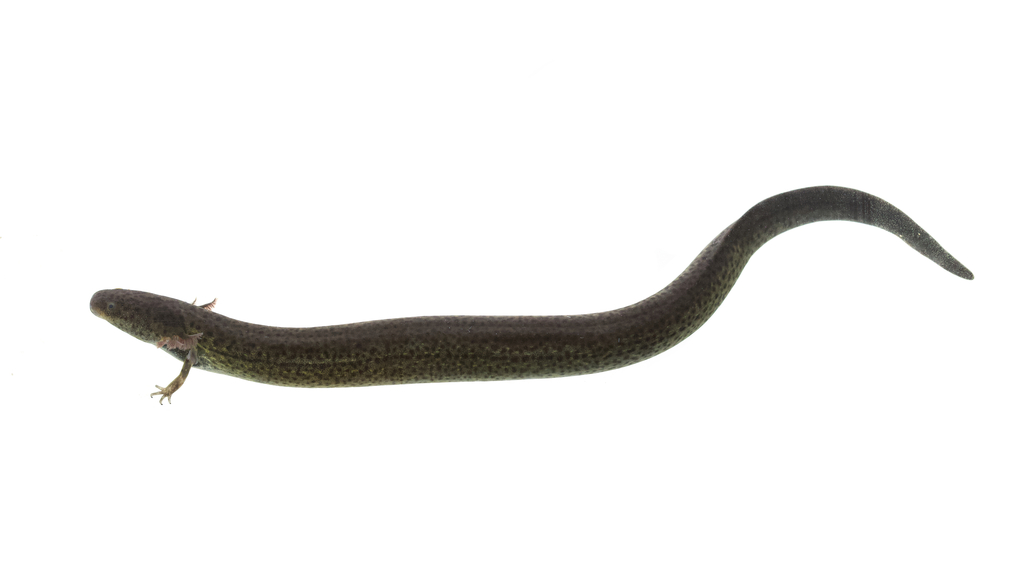
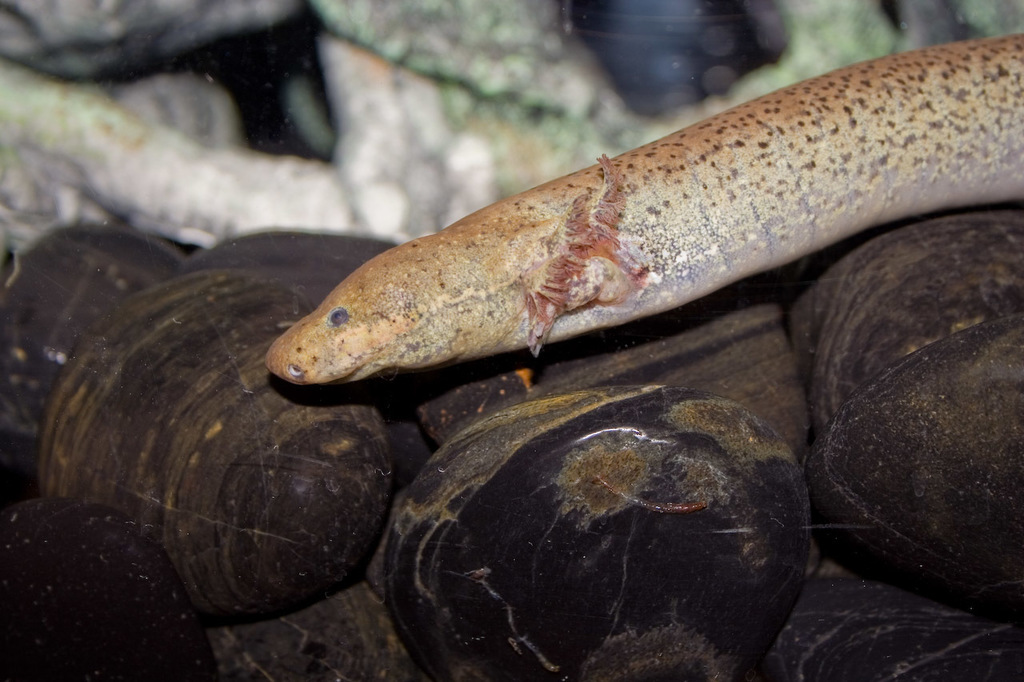
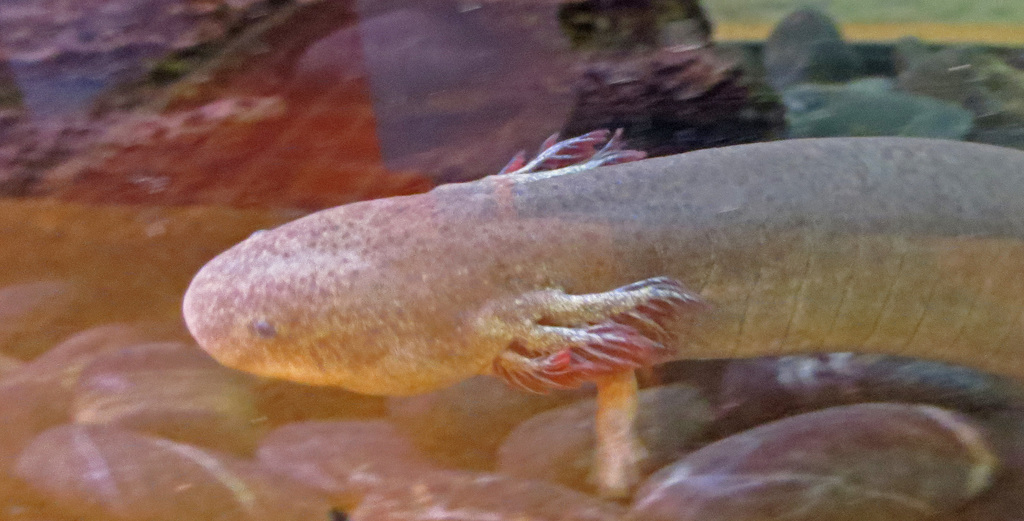
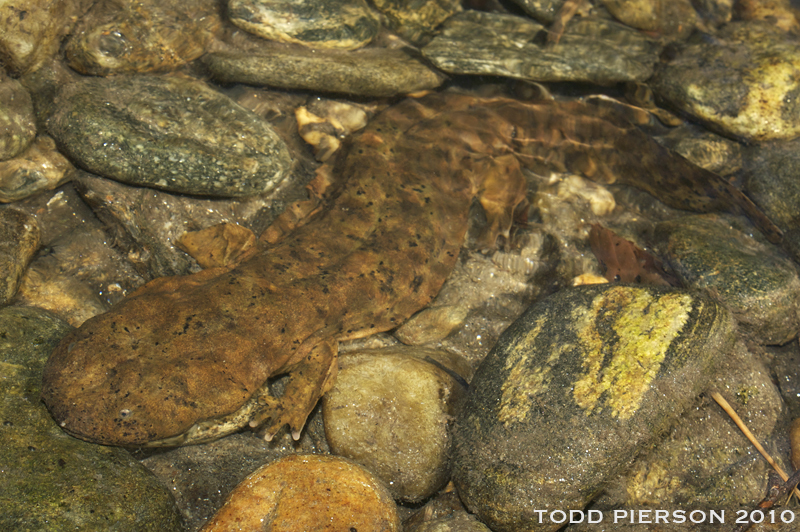
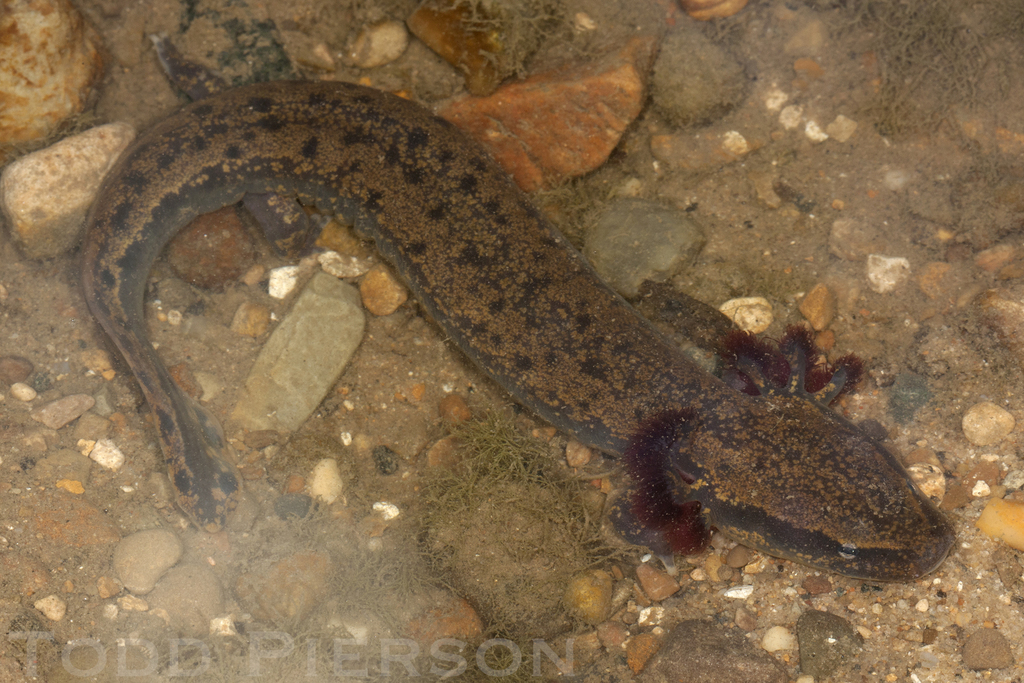
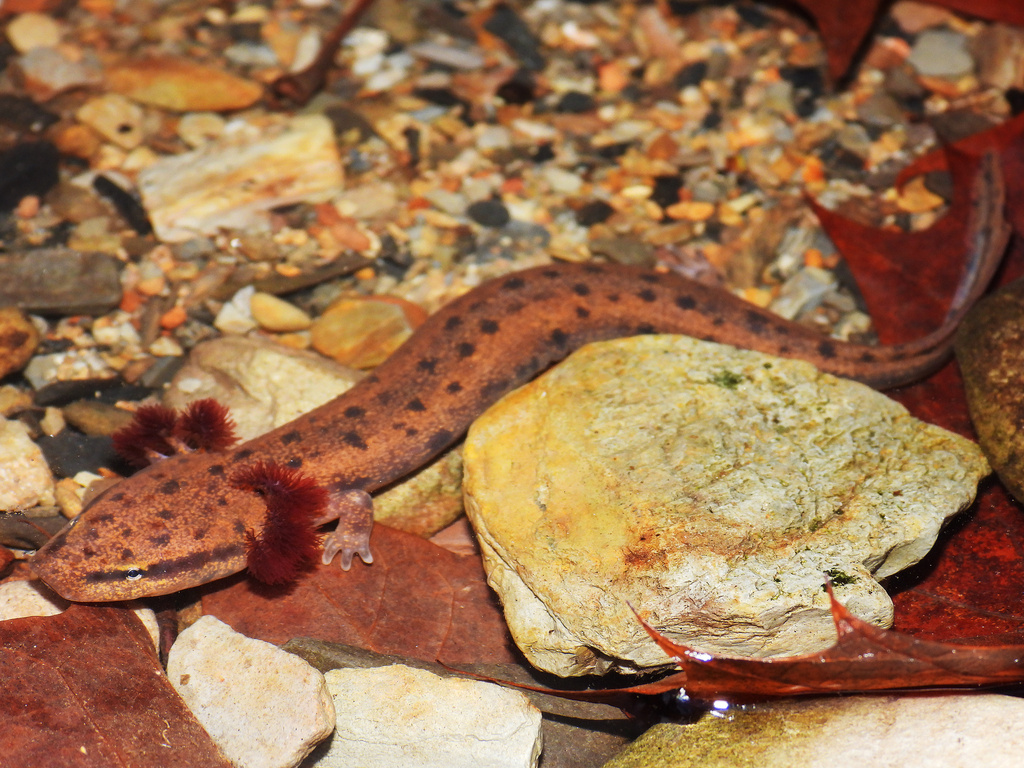
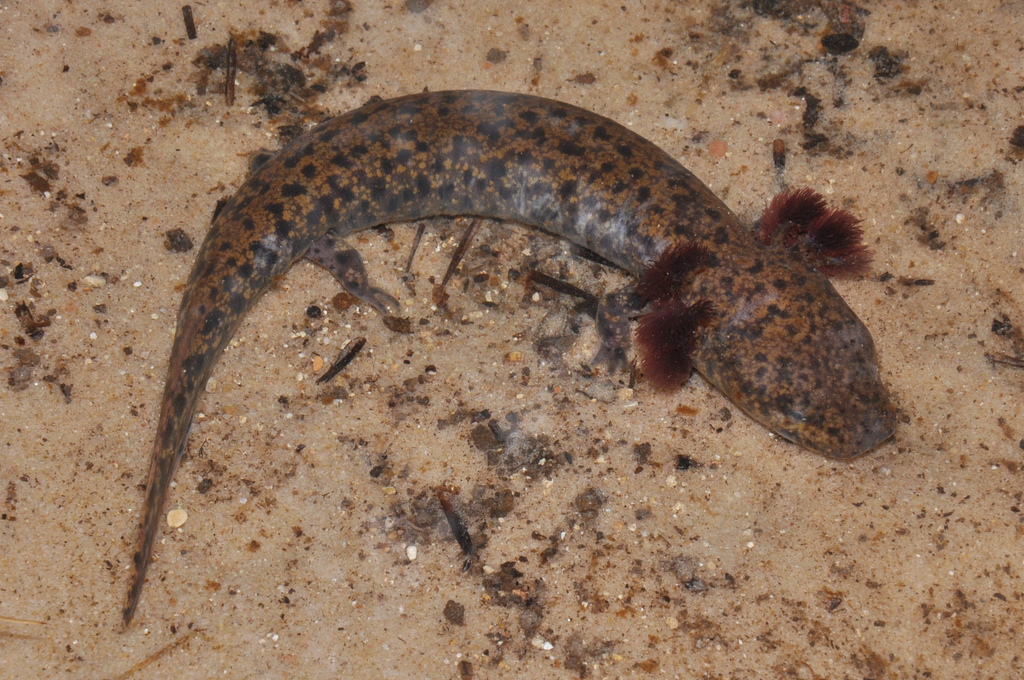
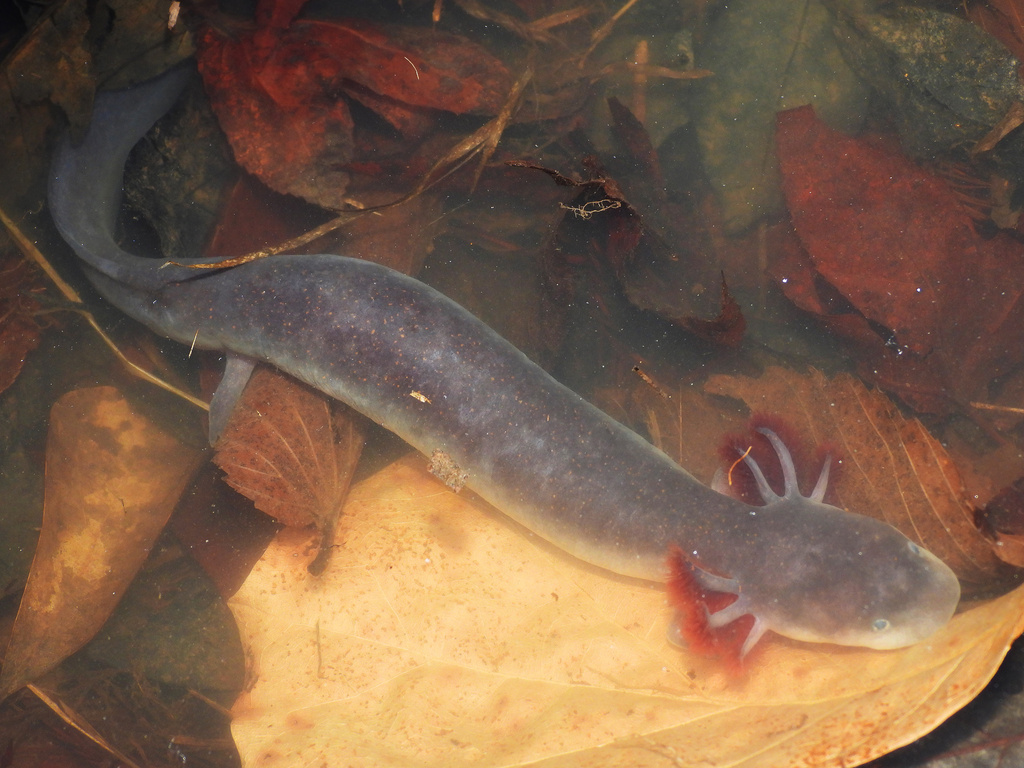
All are permanently aquatic and never fully metamorphose. Hellbender is in a league of its own — the largest N. American salamander (up to 29"), with a massively flattened body, deeply wrinkled flanks for oxygen absorption, and no visible external gills in adults. It hides under large flat rocks in clear, fast-moving streams. Mudpuppies and Waterdogs (Necturus) are much smaller (6–17") with four well-developed legs and prominent bushy external gills that stay red-maroon in well-oxygenated water. Species are told apart mainly by range and spot pattern: Common Mudpuppy is widespread in the North; Gulf Coast and Red River Waterdogs replace it in the South-Central US; Dwarf Waterdog is small and found only in SE coastal streams; Black Warrior Waterdog is critically endangered in Alabama.
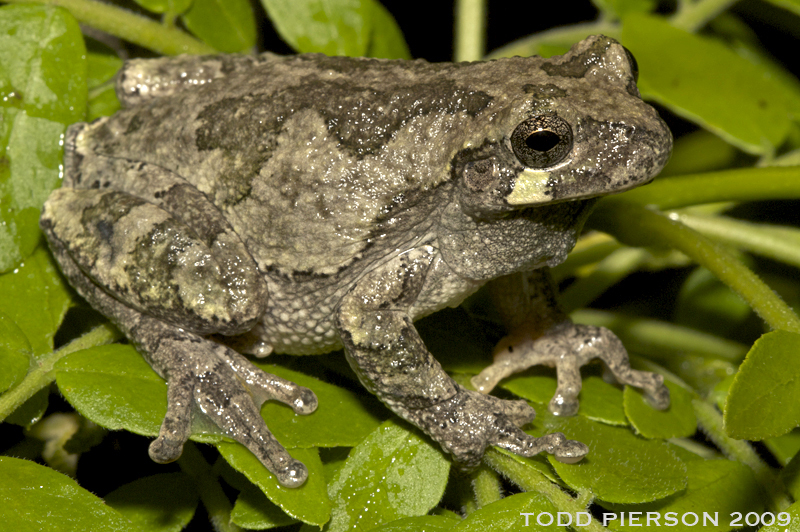
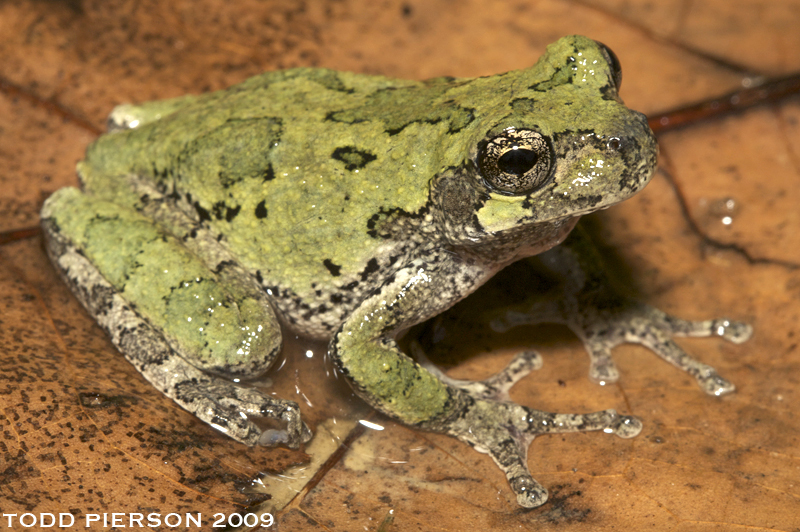
Gray Treefrog vs. Cope's Gray Treefrog
FrogsKey mark: call
Visually identical — the only reliable field mark is the call. Cope's has a faster, harsher trill (roughly double the pulse rate of Gray Treefrog's slower, musical trill). If you can't hear it call, record it as the complex Hyla chrysoscelis/versicolor.
Leopard & Pickerel Frogs (Lithobates)
FrogsKey mark: spot shape and groin color
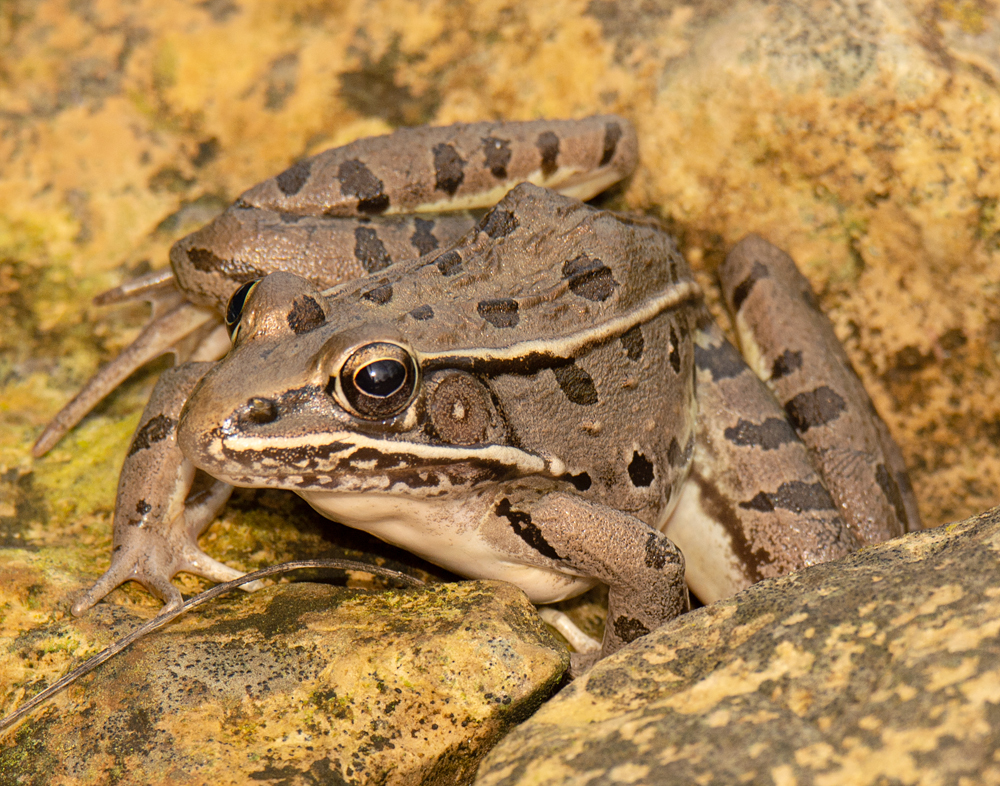
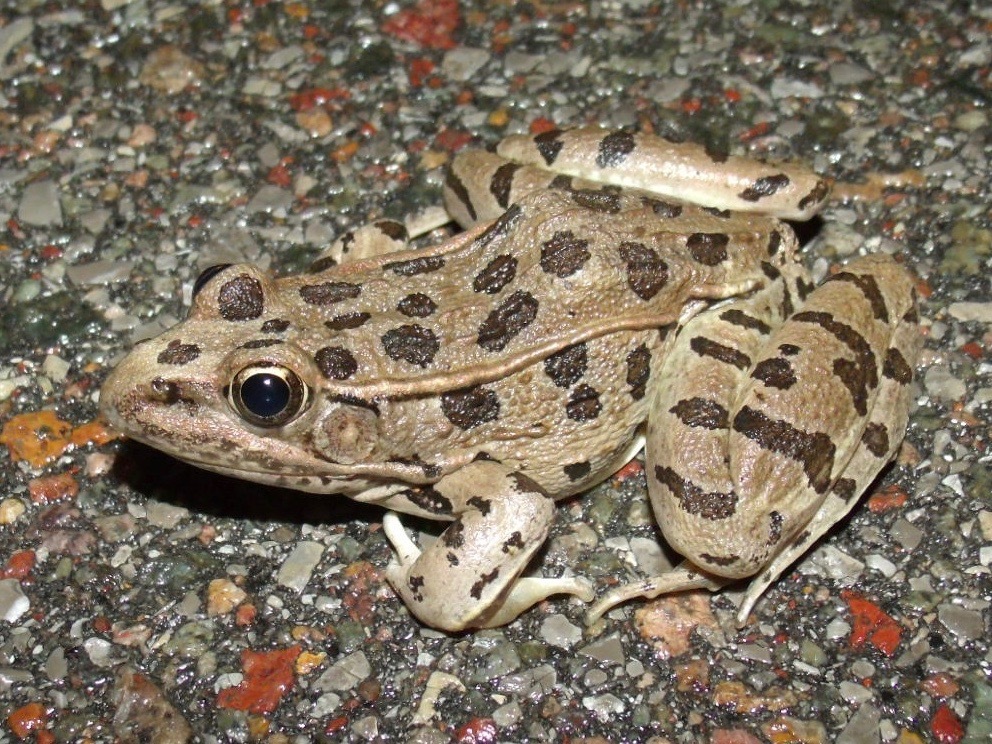
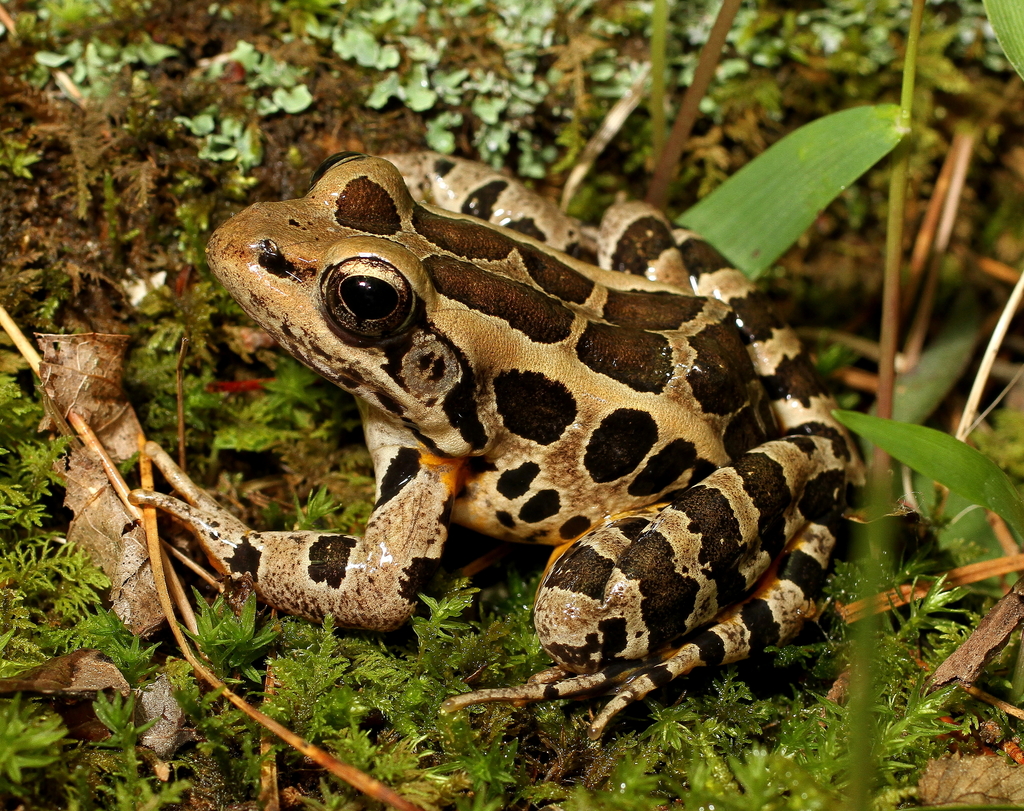
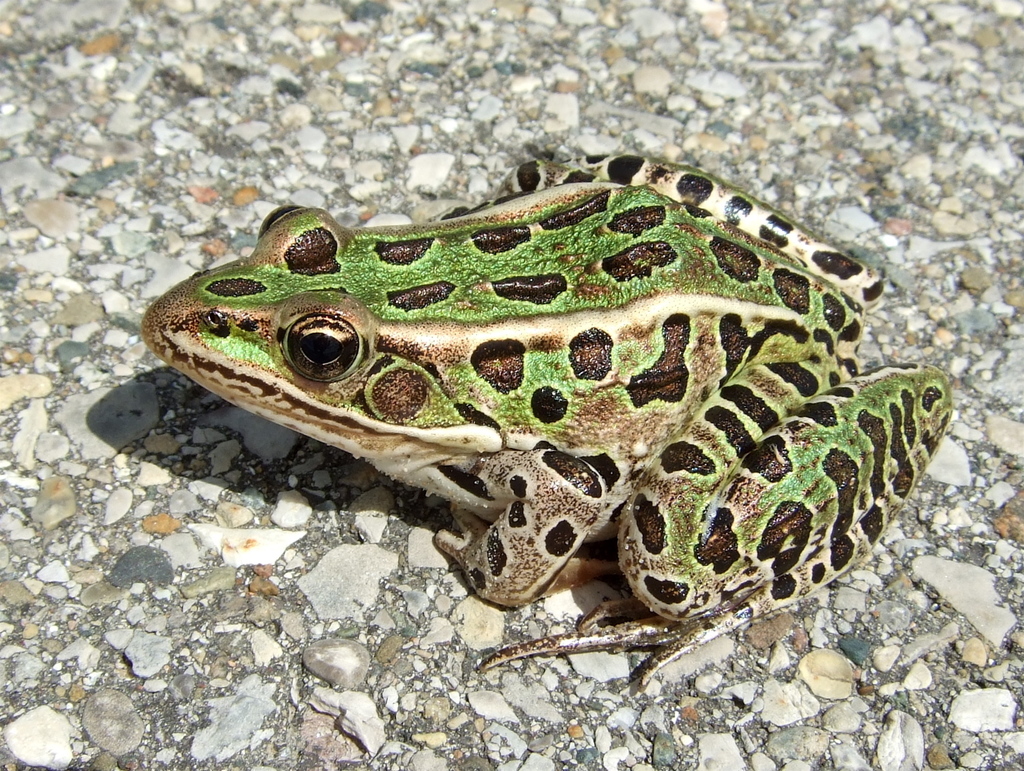
Spot shape and inner thigh color separate these at a glance. Southern Leopard Frog: irregular round spots, no bright color on groin, pointed snout. Plains Leopard Frog: similar but paler, more westerly; white spot center on tympanum. Northern Leopard Frog: well-defined round spots with pale halos; overlaps with both in northern states. Pickerel Frog: rectangular spots in 2 parallel rows; bright yellow-orange on inner thighs and groin — the only US leopard frog with that yellow flash.
Southeast Treefrogs
FrogsKey mark: size, lip stripe, and skin texture
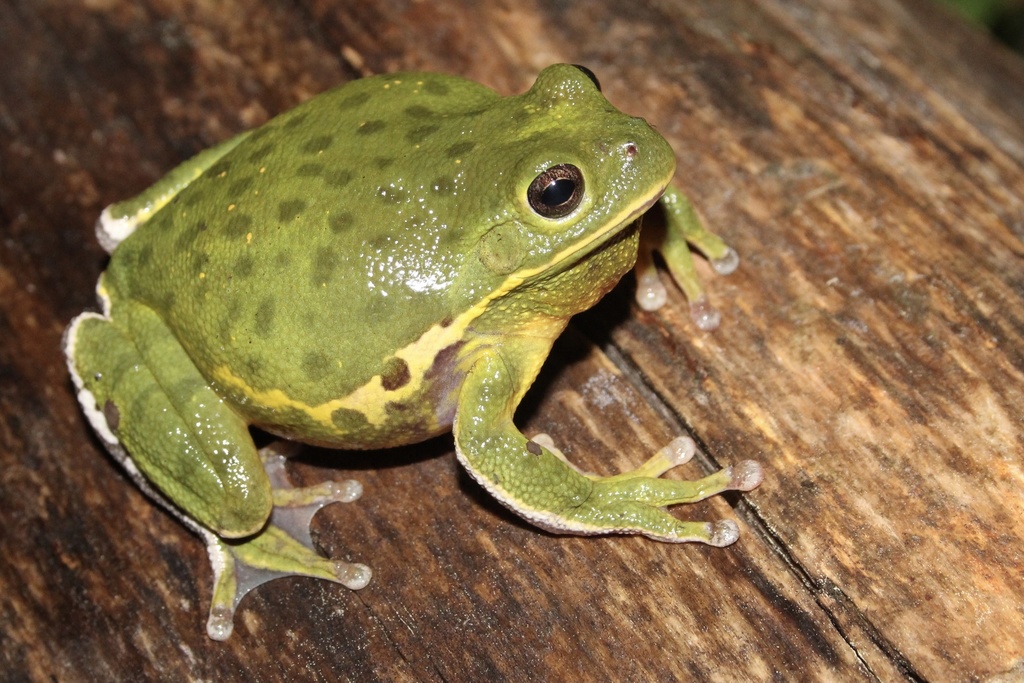
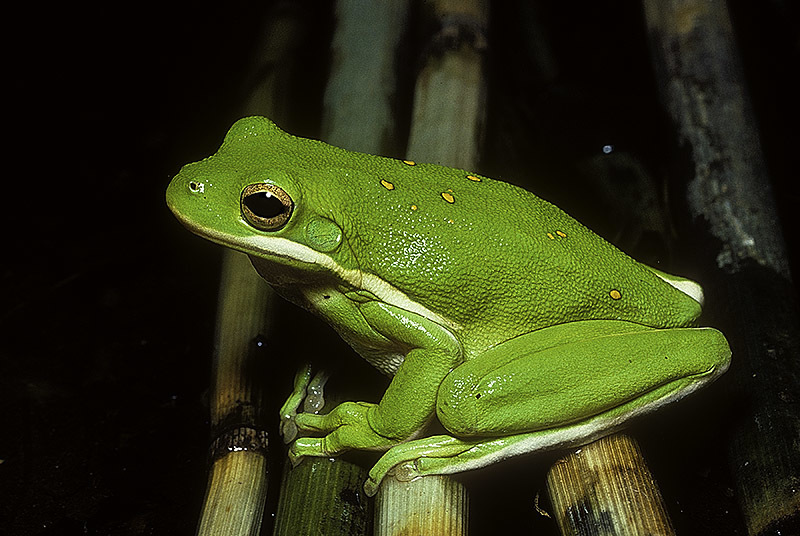
Three treefrogs commonly co-occur across the Southeast and are frequently mixed up. Green Treefrog: large (to 2.5 in.), bright green with a bold white or yellow lateral stripe from jaw to flank. Squirrel Treefrog: smaller and more variable — green to brown with stripe absent or faint; the most chameleon-like of the three. Barking Treefrog: the largest (to 2.7 in.), distinctly granular skin, yellow-green with bold round dark spots; spotted pattern is diagnostic.
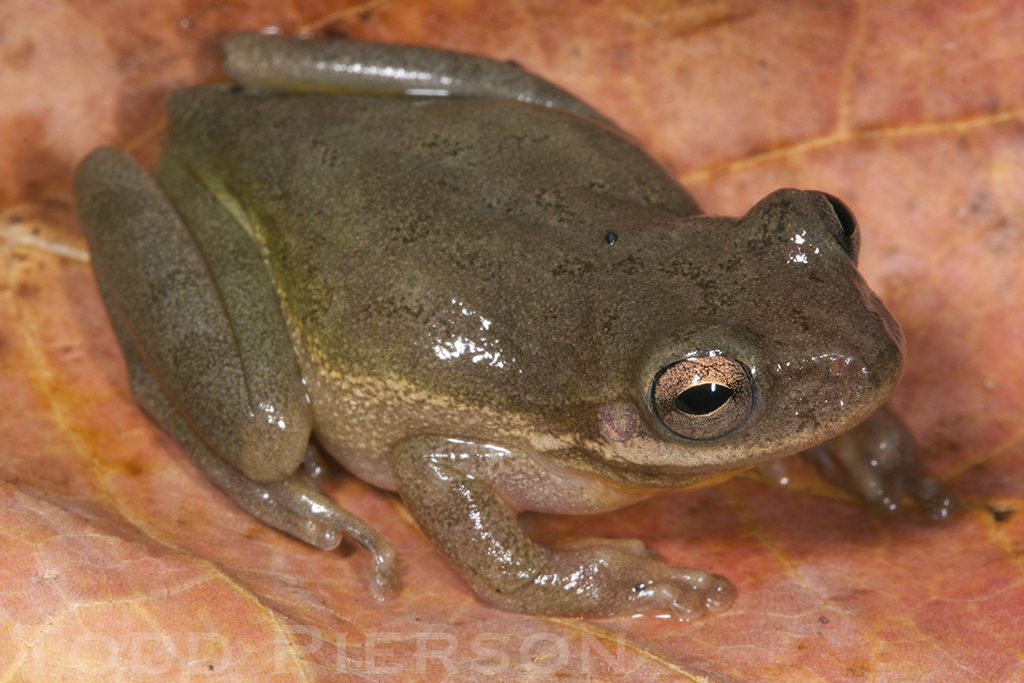
Chorus Frogs (Pseudacris)
FrogsKey mark: dorsal stripes vs. spots and range
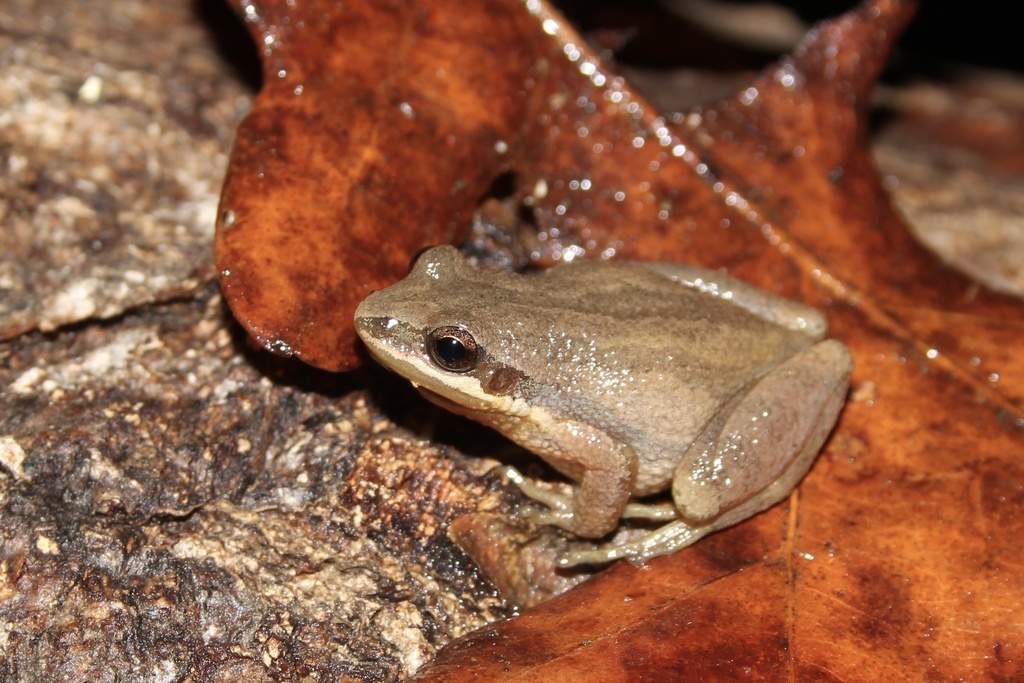
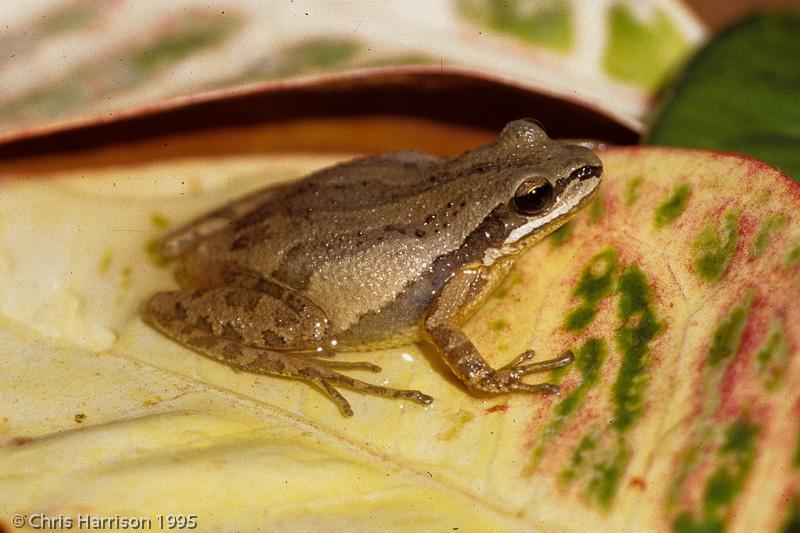
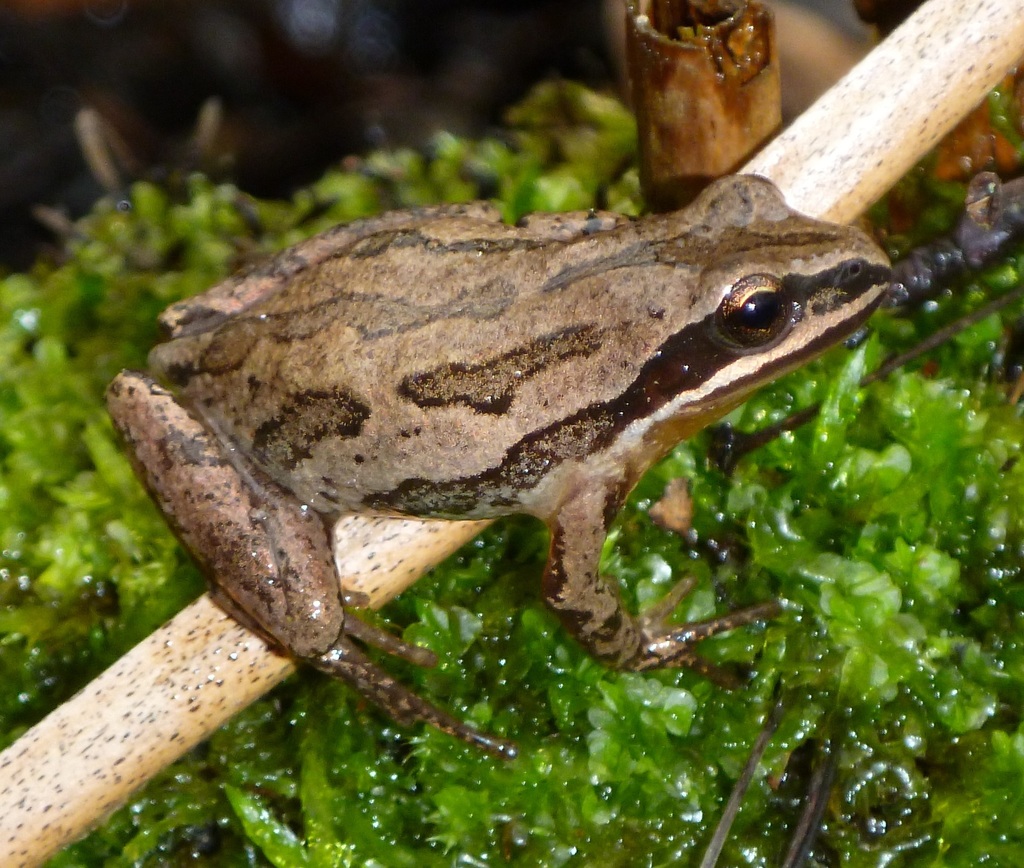
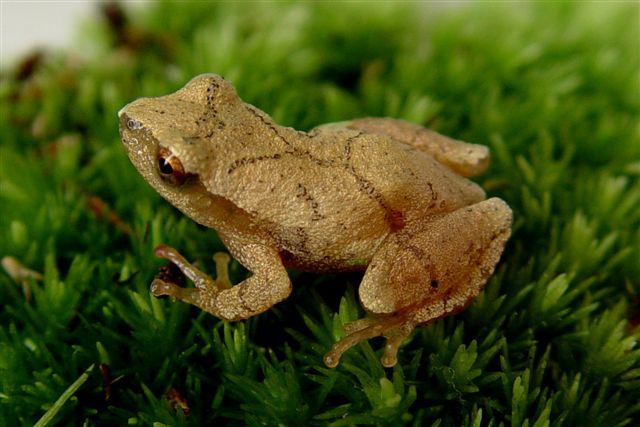
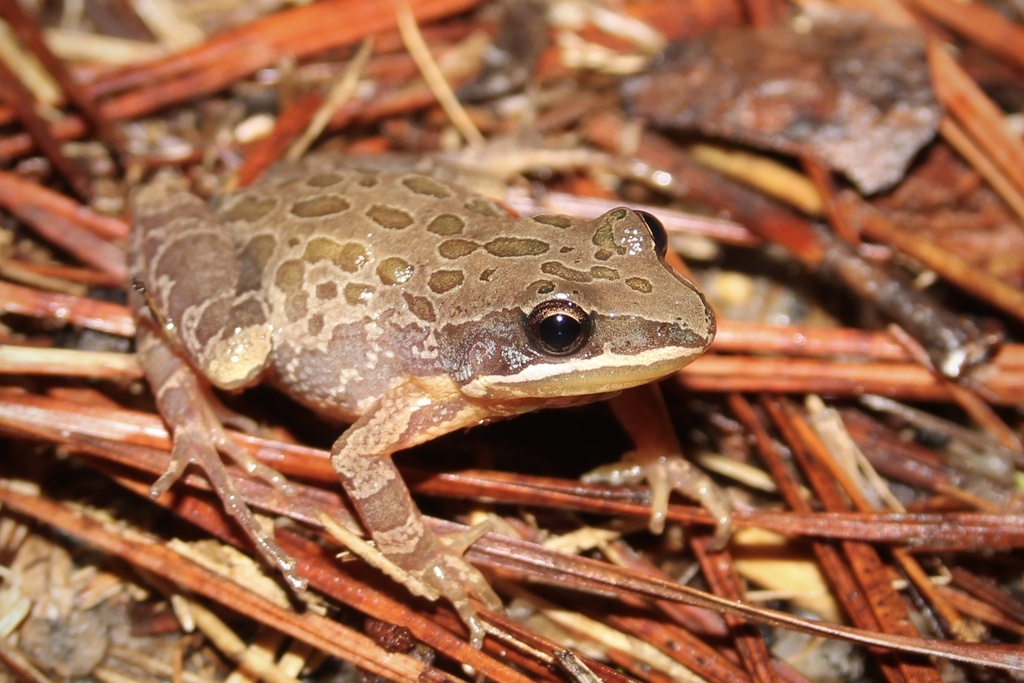
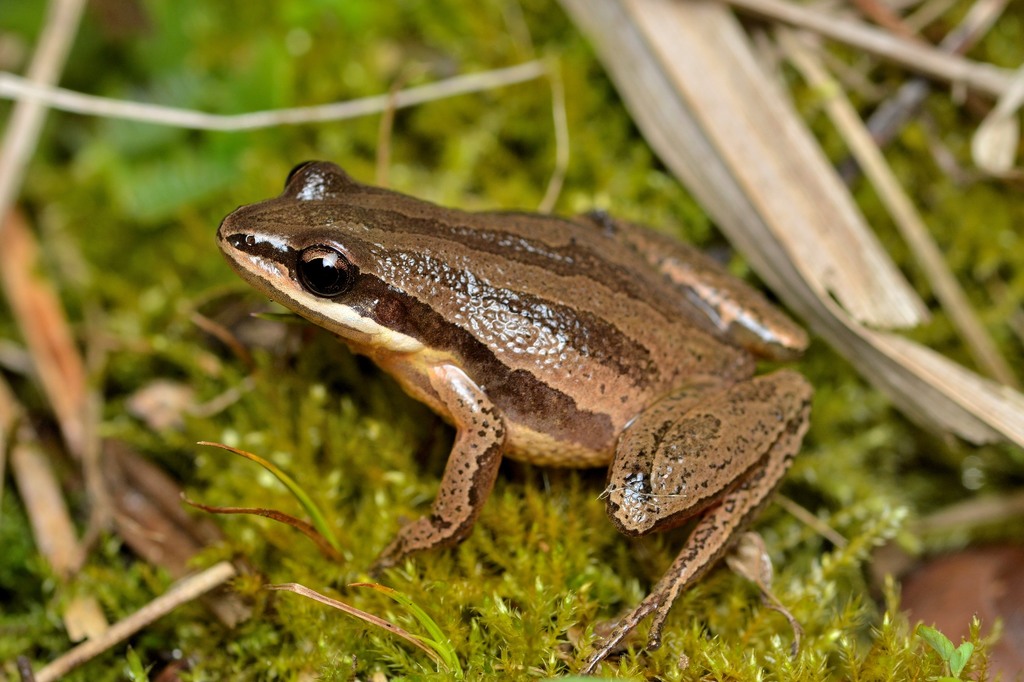
Chorus frogs are tiny (under 1.5 in.), treefrog relatives that are far more often heard than seen. Most have three dark dorsal stripes (sometimes broken into spots) and a dark stripe through the eye. Spring Peeper is the exception — it has a bold X or cross mark on its back and is usually pinkish-brown. Upland and Cajun Chorus Frogs are nearly identical and best separated by range (Cajun = Mississippi/Gulf lowlands; Upland = everywhere else east). Western and Boreal Chorus Frogs overlap in the central US with very subtle differences.

Cricket Frogs (Acris)
FrogsKey mark: thigh pattern and call
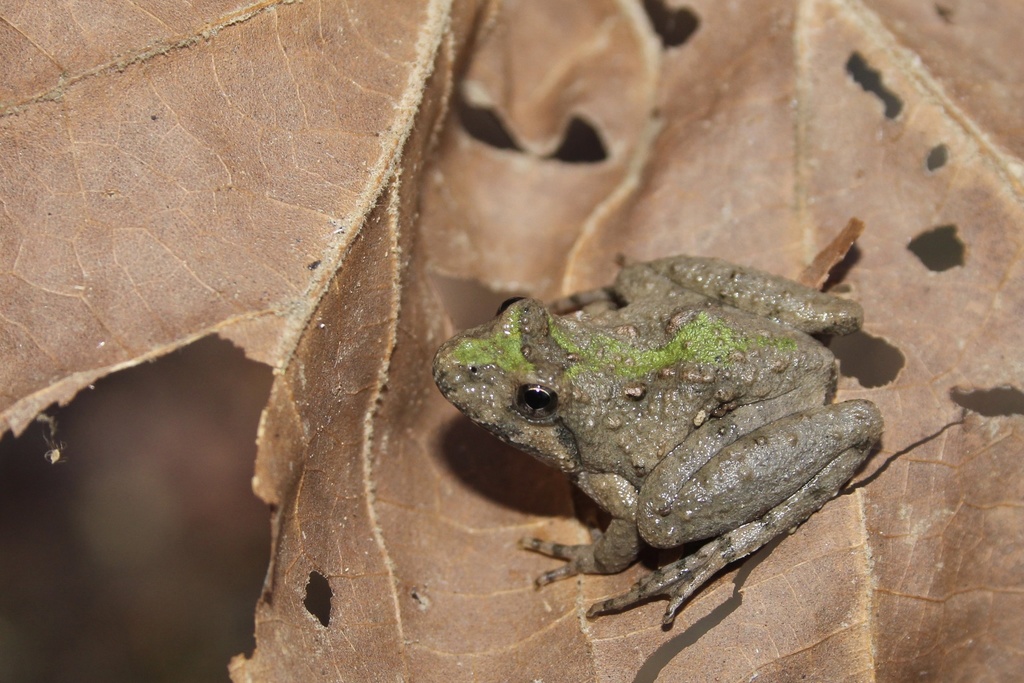
Northern and Southern Cricket Frogs are tiny, warty-skinned, and extremely variable — they may be green, brown, gray, or nearly black, with or without a mid-dorsal stripe. The most reliable field mark is the inner thigh: Northern Cricket Frog has a ragged, irregular dark stripe on the inner thigh; Southern Cricket Frog has a cleaner, more defined stripe. Both are found in and around water, hop erratically, and are far more often heard (a rapid clicking call) than identified visually. Range is the easiest separator where they overlap along the coastal plain.
Spadefoot Toads
FrogsKey mark: spade shape and eye pupil
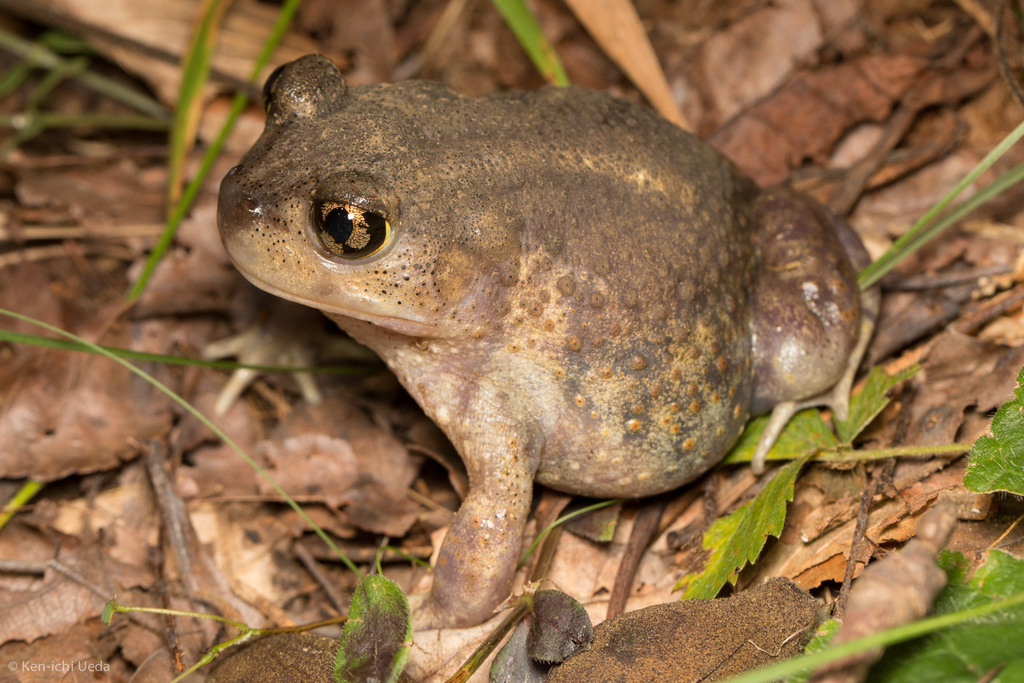
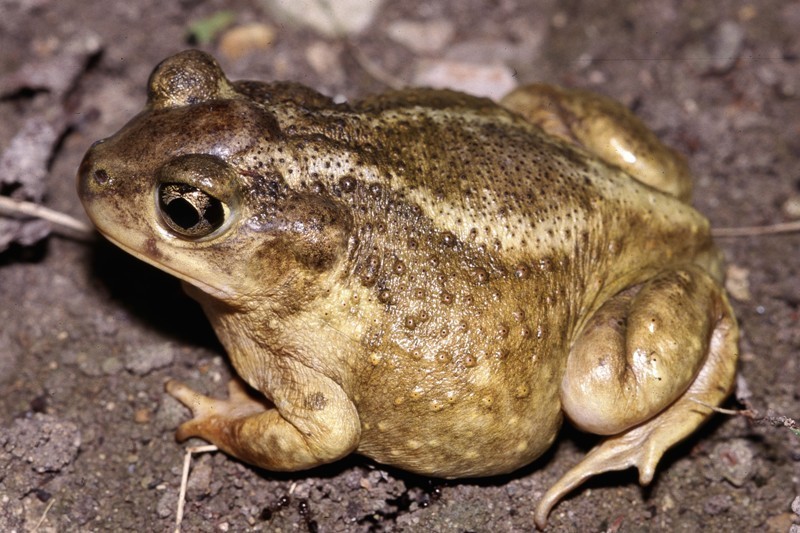
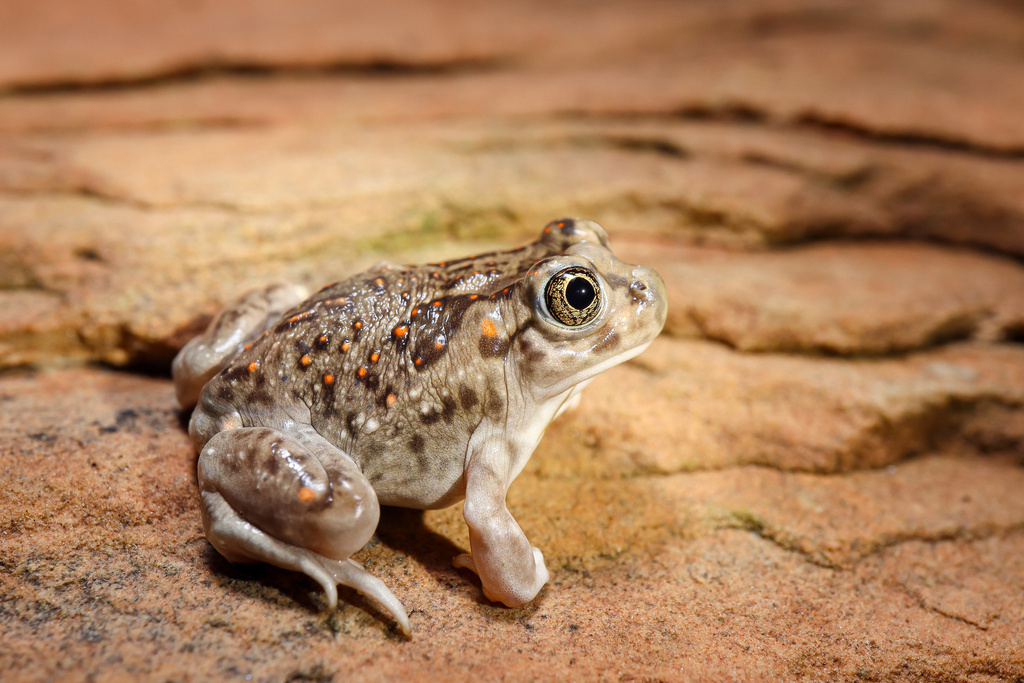
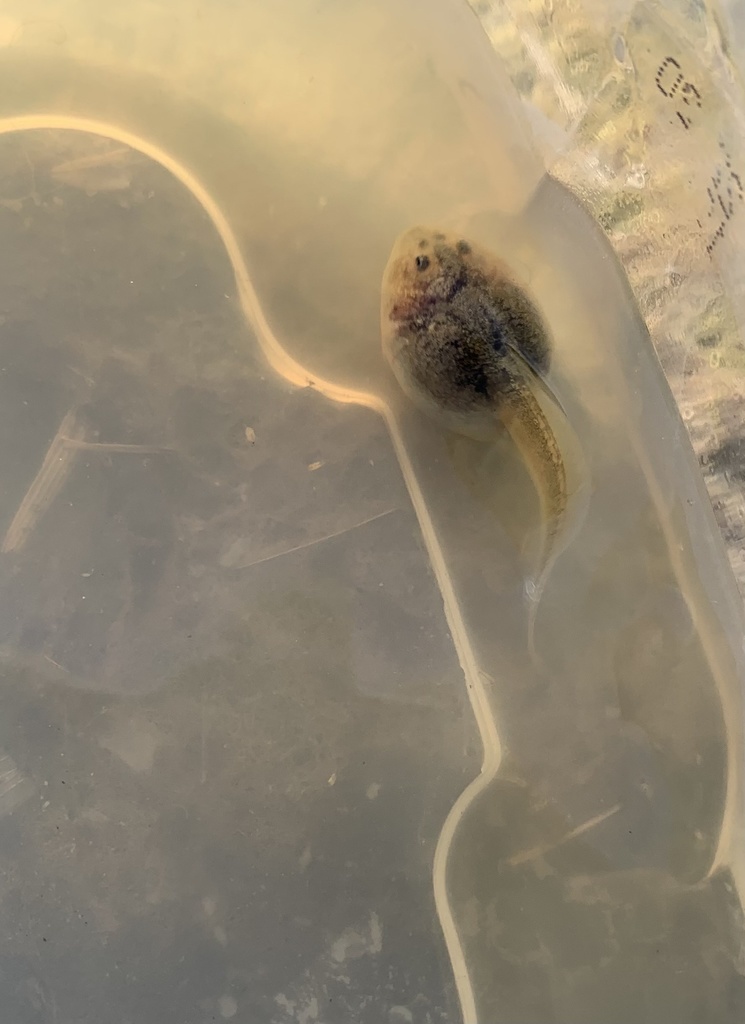
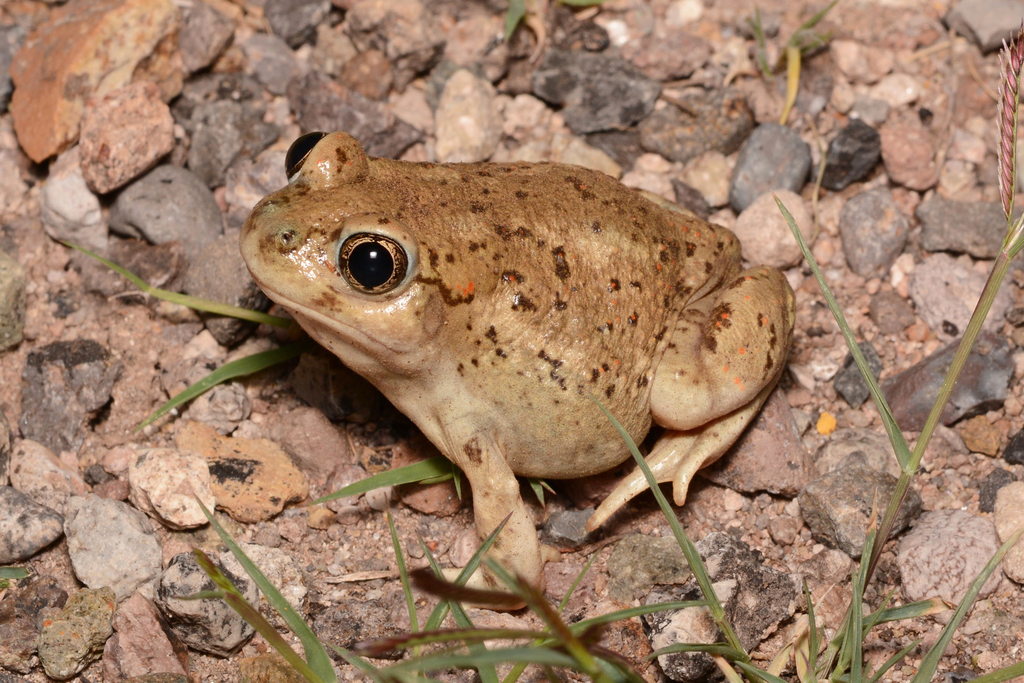
Spadefoots look like true toads but belong to a separate family. They have a vertical cat-eye pupil (true toads have horizontal), smooth to slightly bumpy skin (no parotoid glands), and a hard black digging spade on each hind foot. Eastern and Hurter's Spadefoot (Scaphiopus) have a single spade that is sickle-shaped; Plains, Western, and Mexican Spadefoot (Spea) have a wedge-shaped spade and often a boss between the eyes. Spadefoots breed explosively after heavy rains and are rarely seen otherwise.
Large Ranid Frogs (Lithobates)
FrogsKey mark: dorsolateral ridges and snout shape
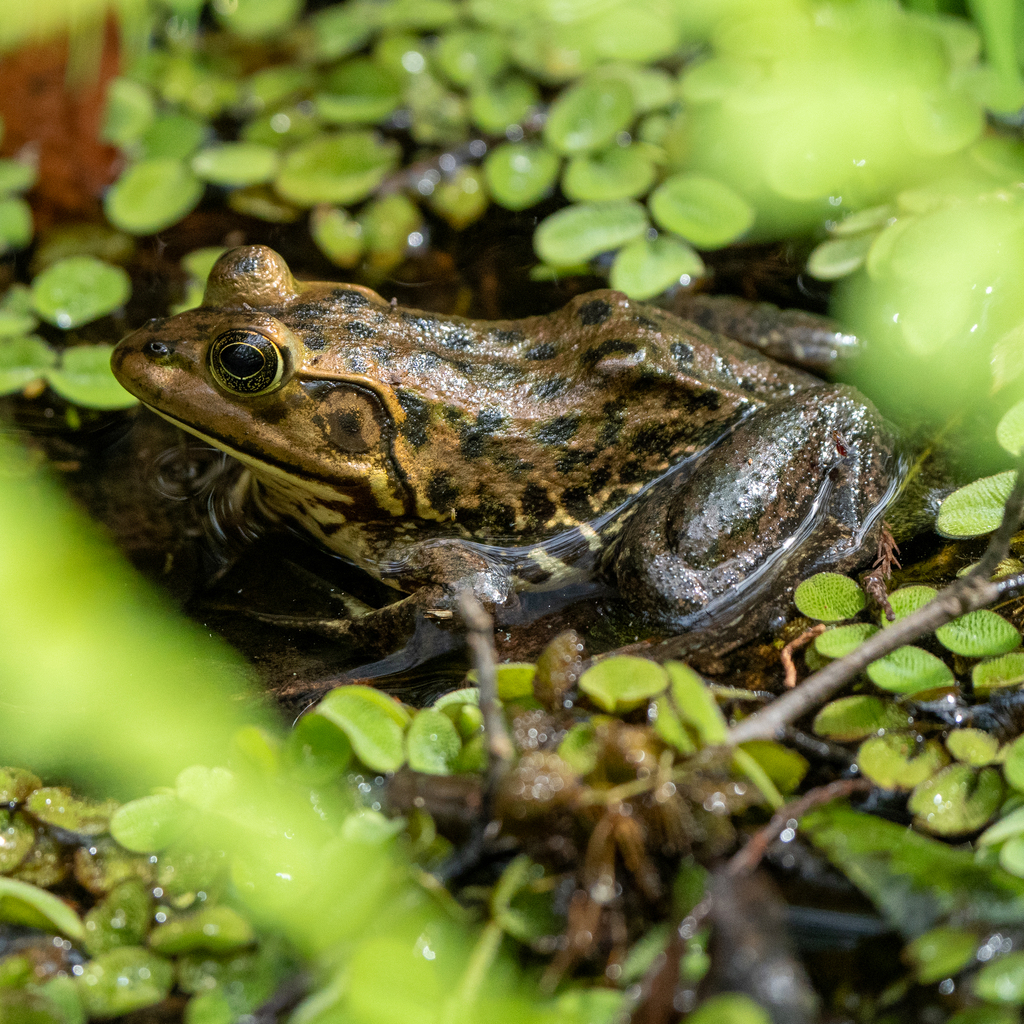
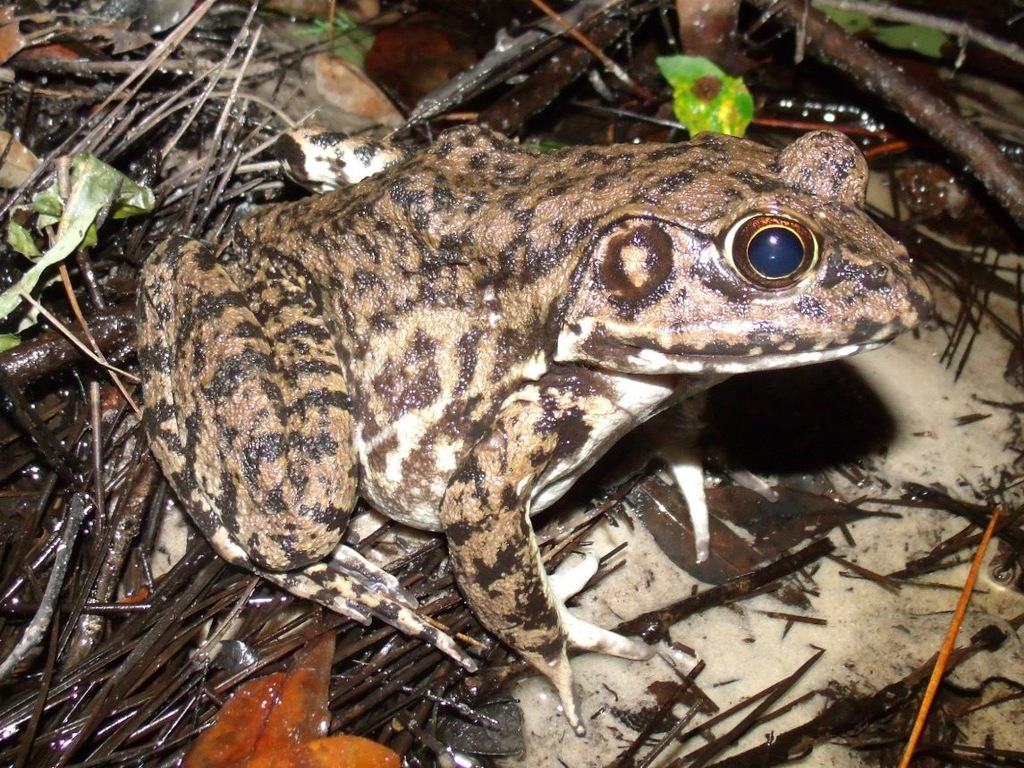
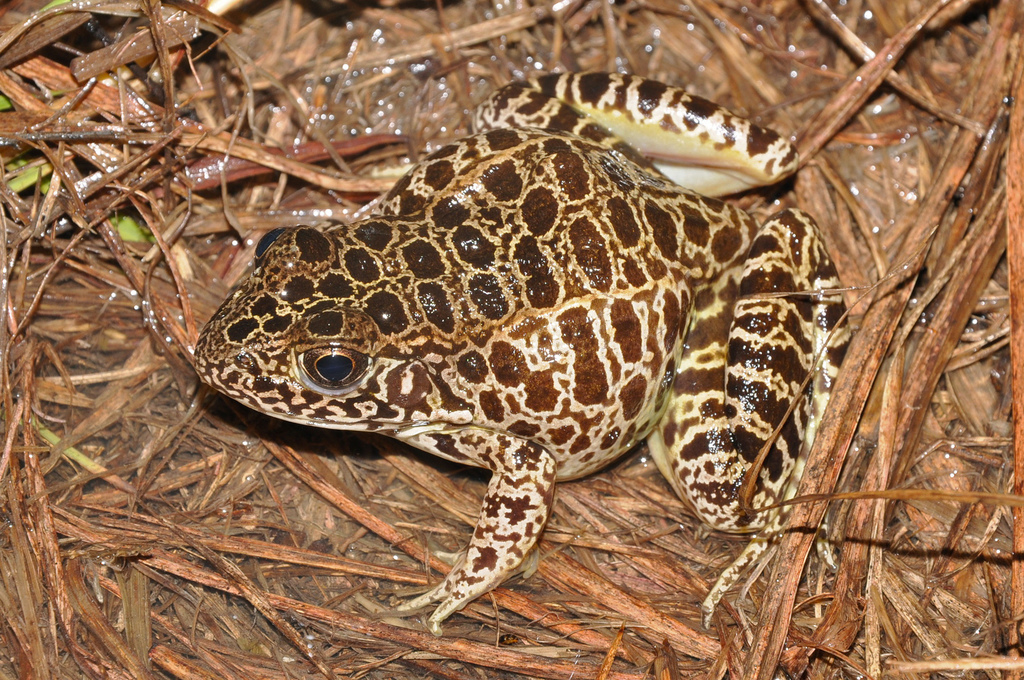
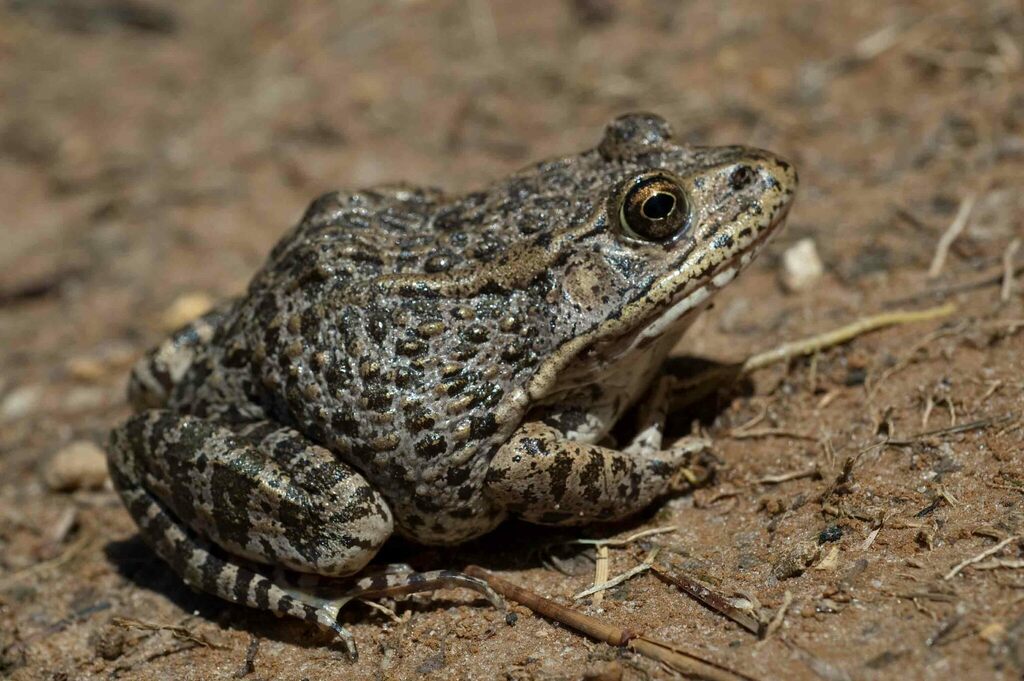
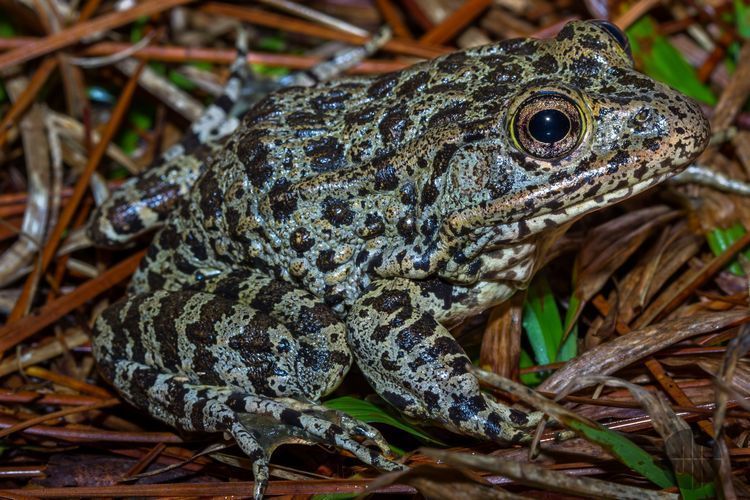
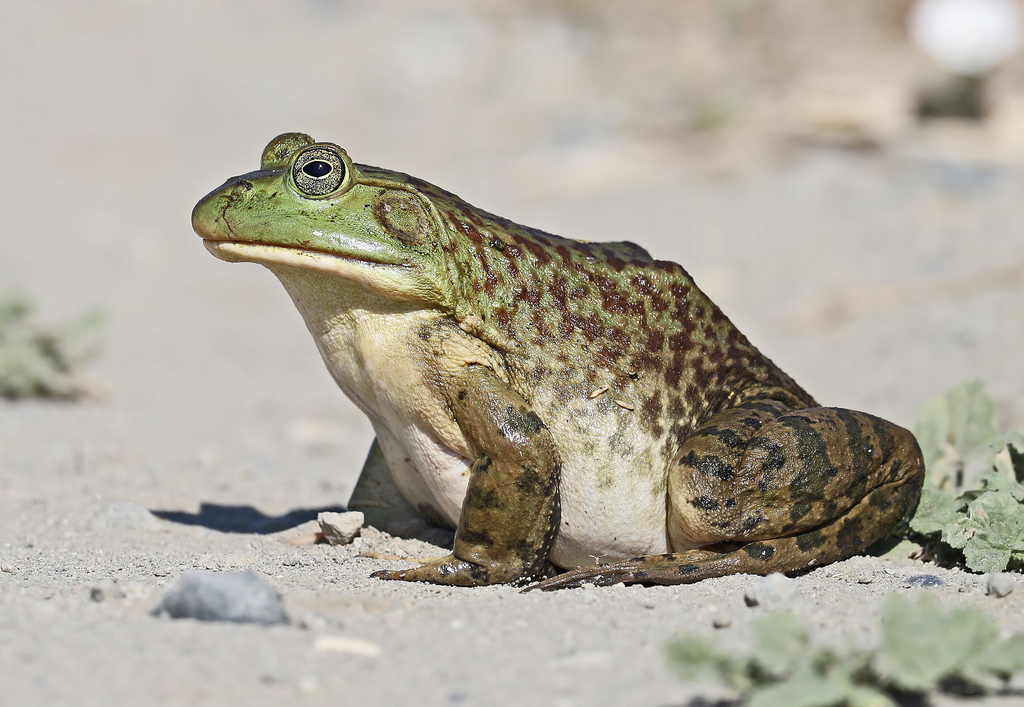
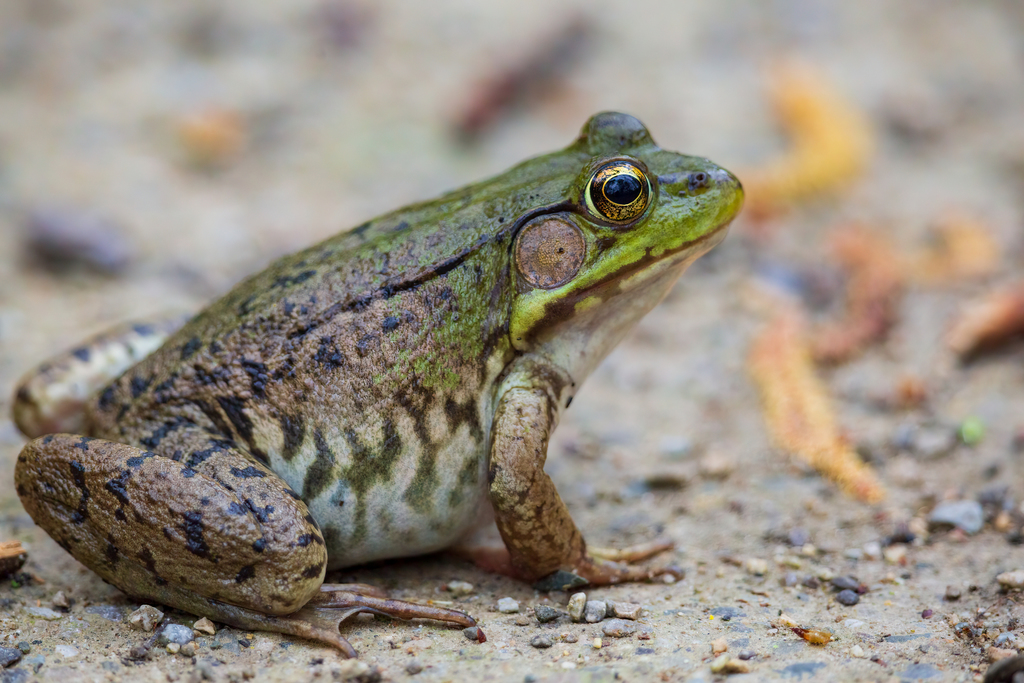
The first thing to check is dorsolateral ridges — raised folds of skin running from behind the eye to the hind legs. American Bullfrog has NO ridges and a massive tympanum nearly as large as the eye. Green Frog has prominent ridges and is much smaller. Pig Frog also lacks ridges but has a more pointed snout and heavily webbed, reticulated hind legs — it is the bullfrog of the Deep South. River Frog is large and dark (brown to black) with white spots on the lip; no ridges; a loud snoring call. Crawfish Frog and Gopher Frog are stockier with bold round spots and low ridges — they live in burrows and upland areas rather than pond edges.
North American Toads (Anaxyrus)
FrogsKey mark: cranial crests and parotoid contact
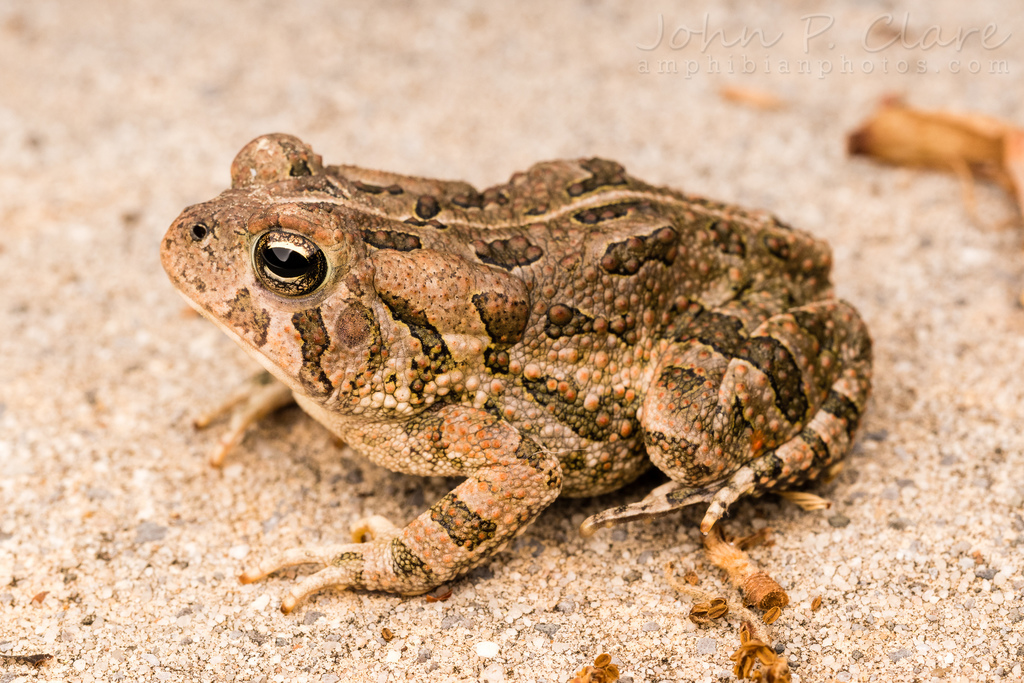
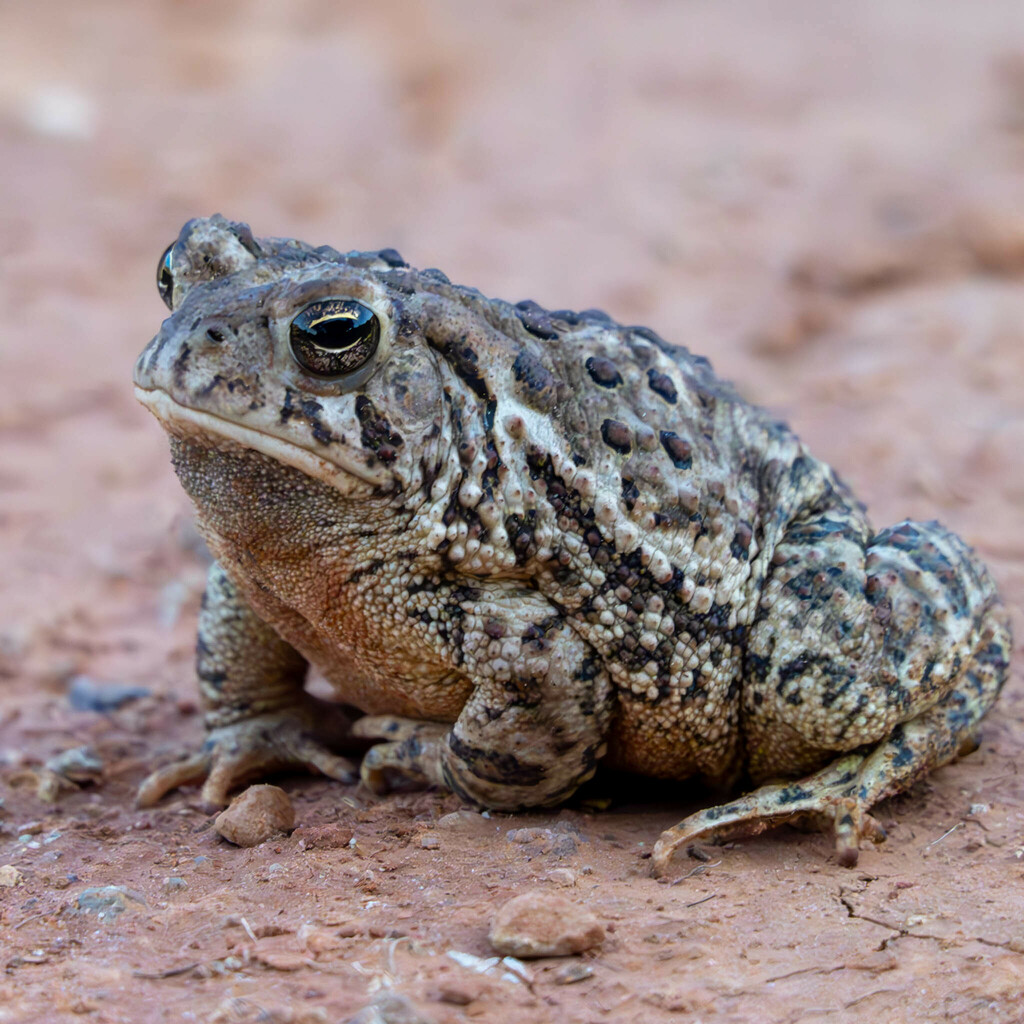
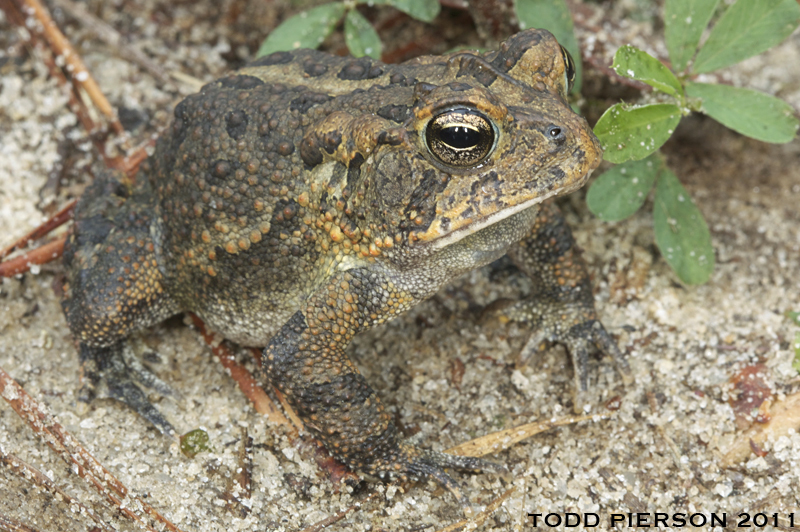
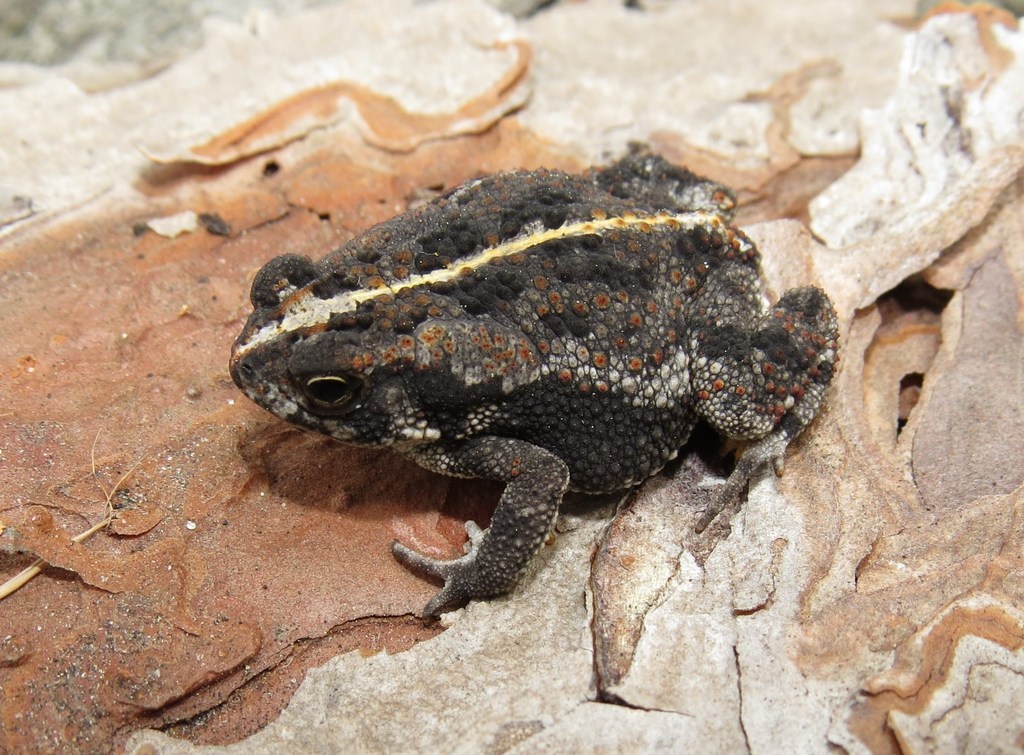
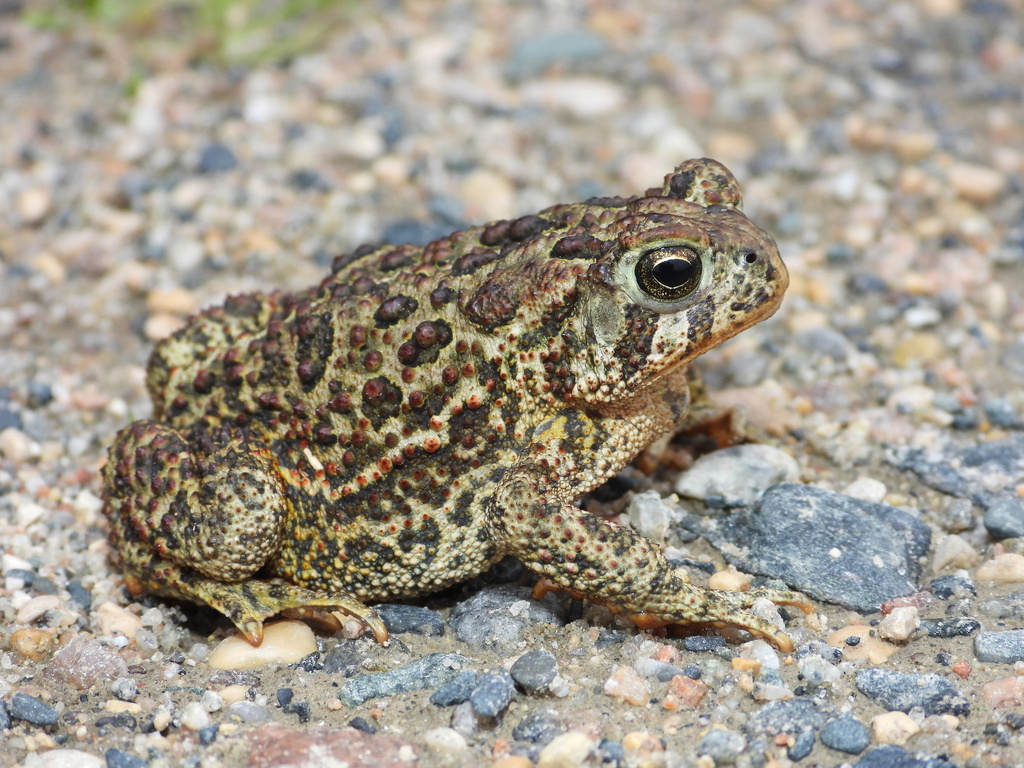
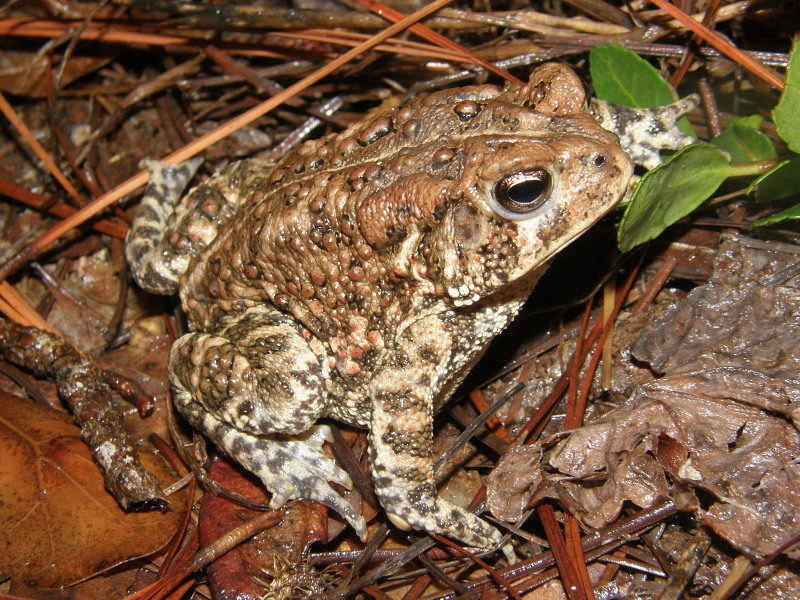
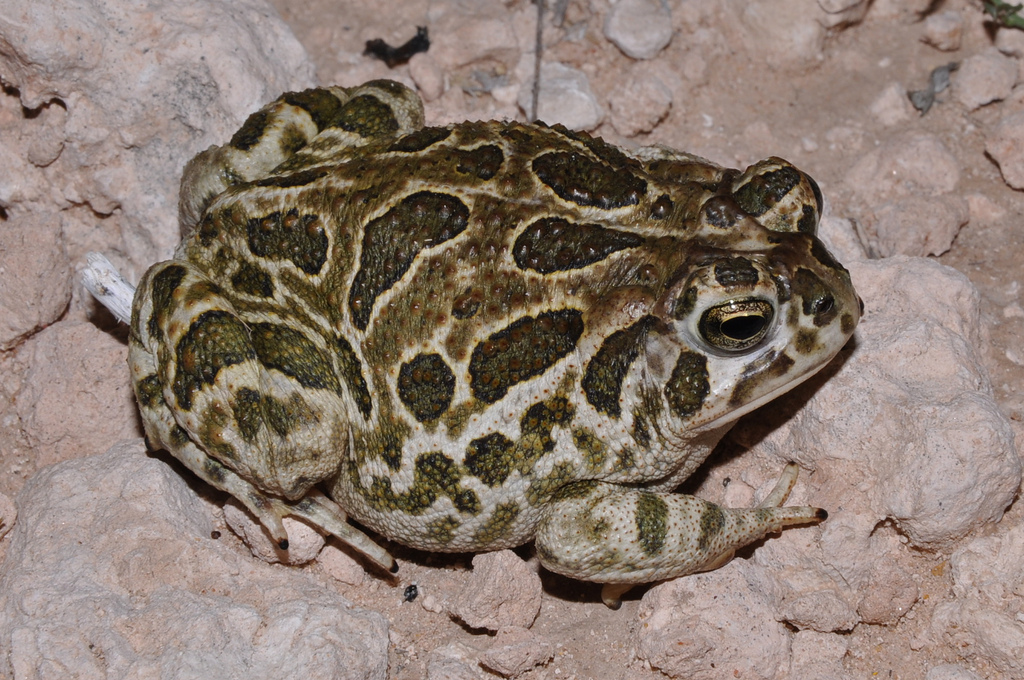
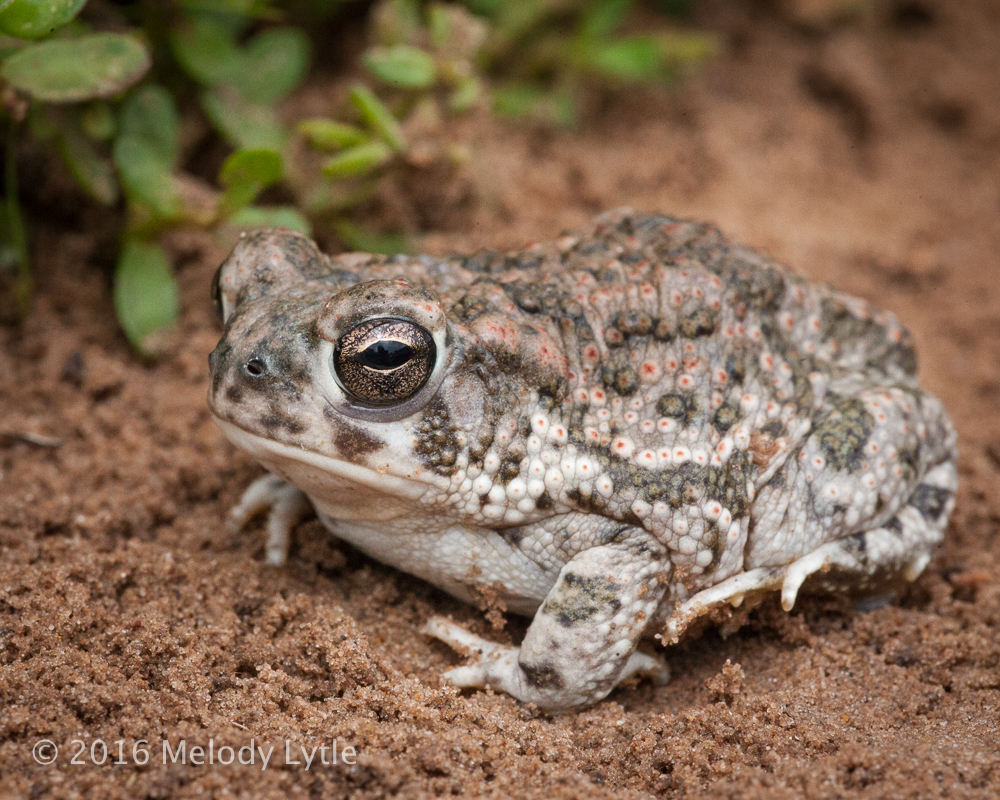
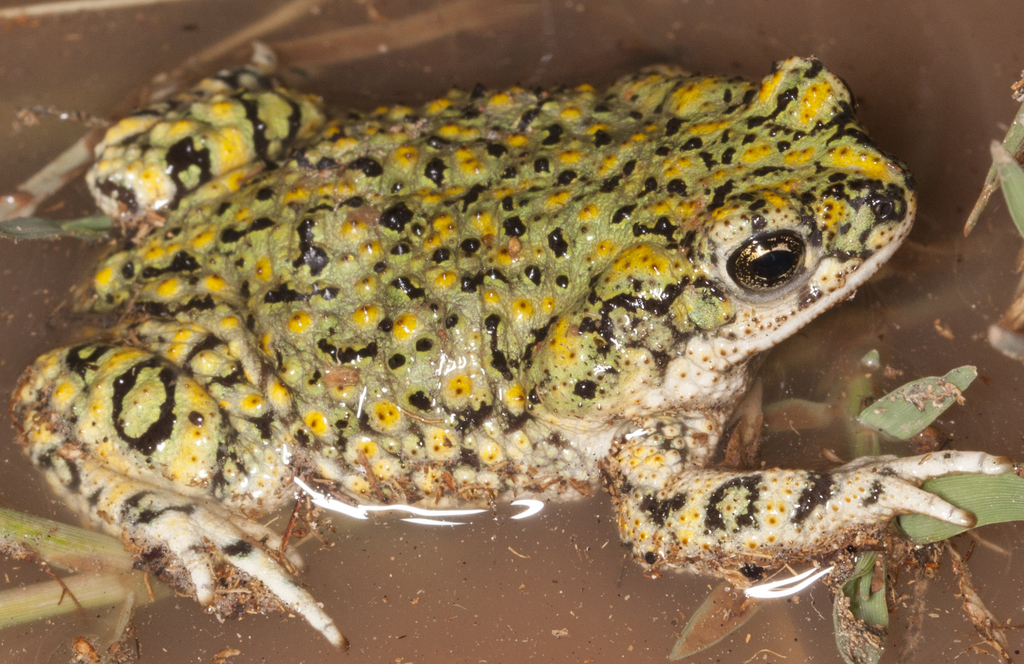
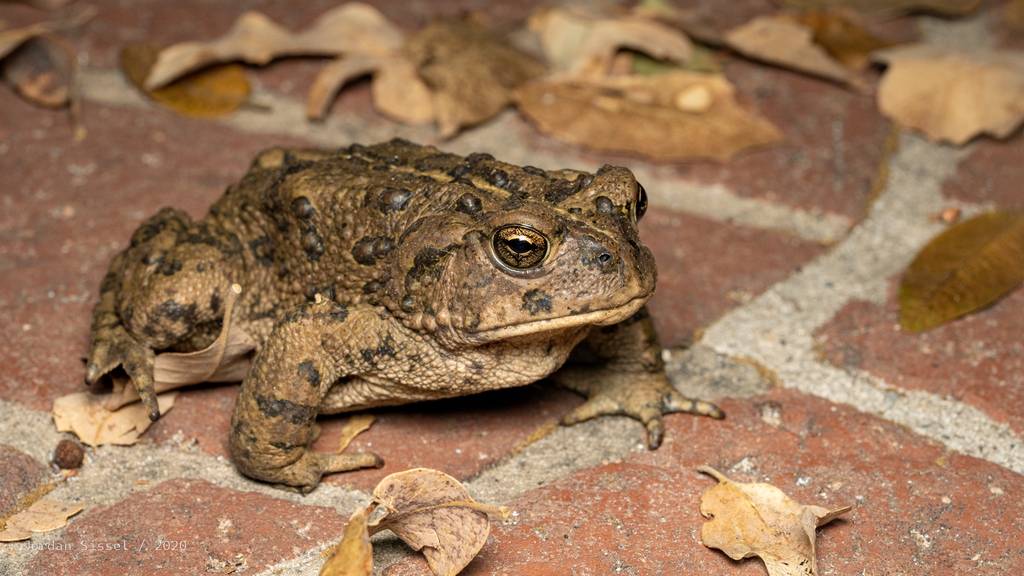
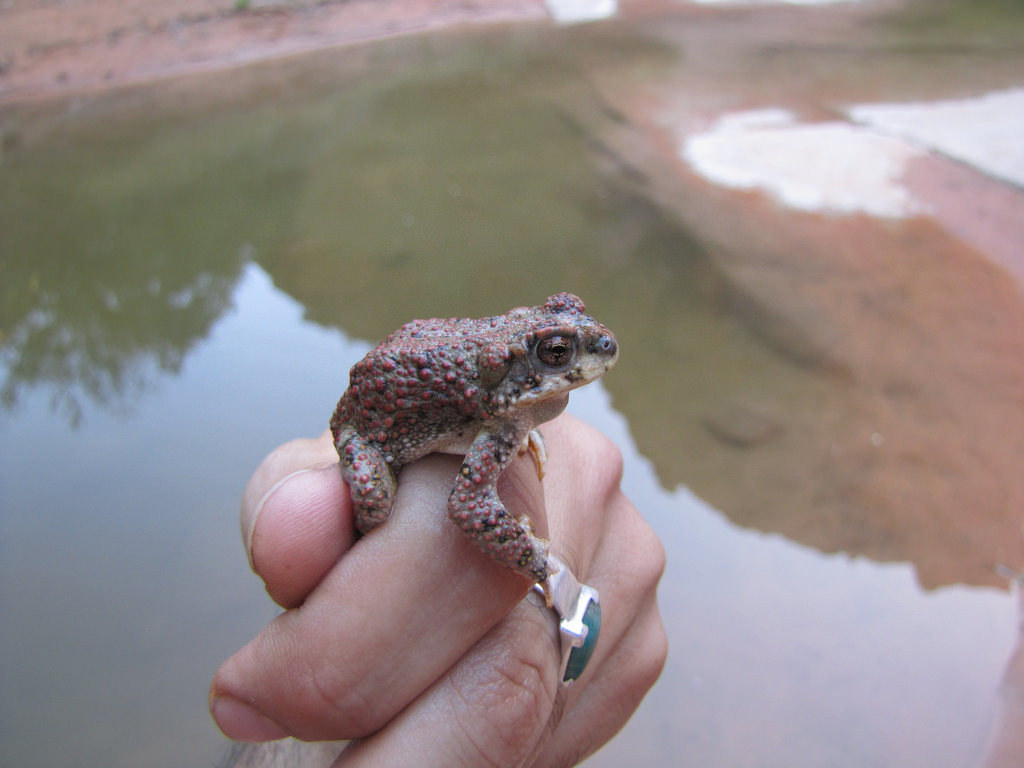
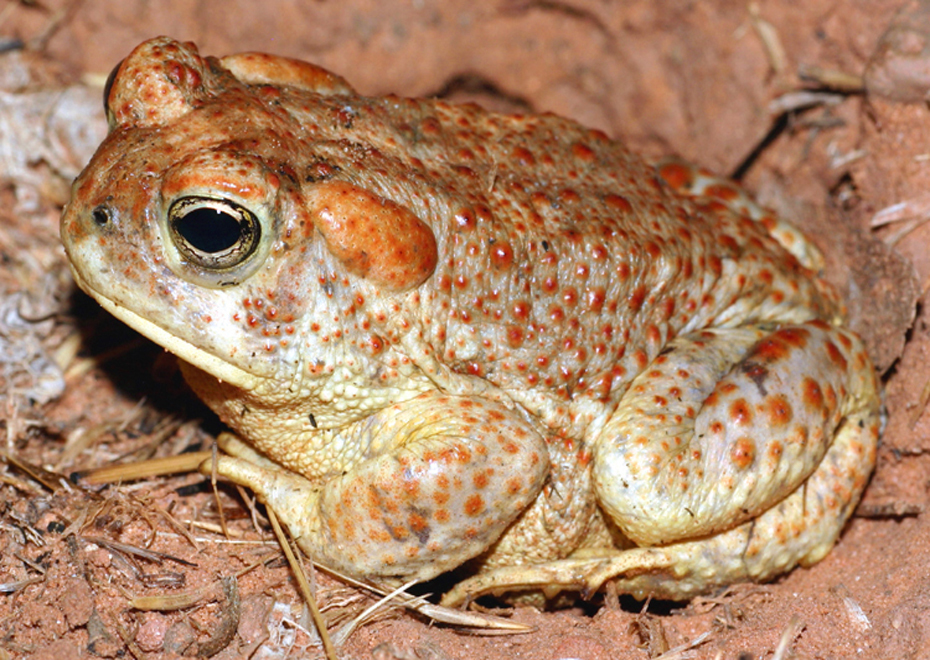
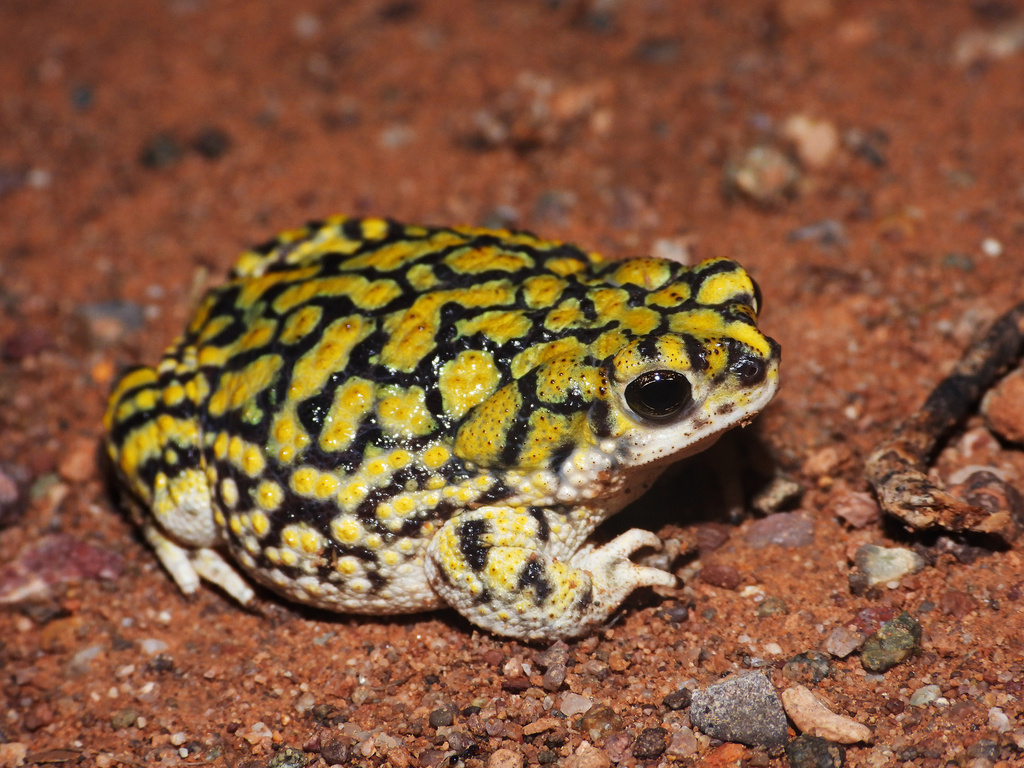
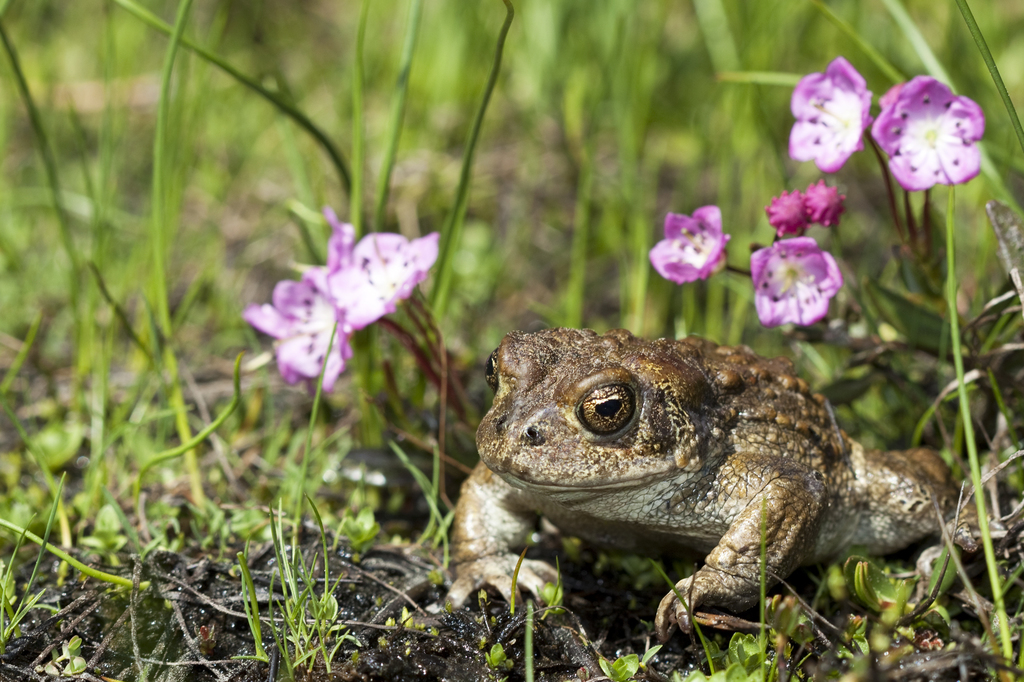
For eastern species, the parotoid-to-crest relationship is the fastest field mark. American Toad: parotoid gland separate from postorbital crest (or linked by a thin spur); 1–2 warts per dorsal spot. Fowler's Toad: parotoid contacts crest directly; 3+ warts per spot. Woodhouse's Toad: similar to Fowler's but larger and burlier with elongated parotoids; central US. Southern Toad: tall, knobbed cranial crests — the most distinctive of any eastern toad. Oak Toad is tiny (under 1.3") with a white dorsal stripe; SE only. Canadian Toad has a distinctive boss (hump) between the eyes; northern plains. For western and central species: Great Plains Toad has a large V-shaped cranial boss and strongly patterned back. Red-spotted Toad is small with round parotoids and reddish wart tips; desert SW. Western Toad lacks cranial crests entirely and has a white dorsal stripe; widespread in the West. Arizona Toad resembles Western but has a pinkish wash; desert rivers of AZ/NM/UT. Green Toad and Sonoran Green Toad are small with distinctive bright green and black reticulated patterns. Texas Toad and Houston Toad (endangered) are best told by range in TX.


Softshell Turtles
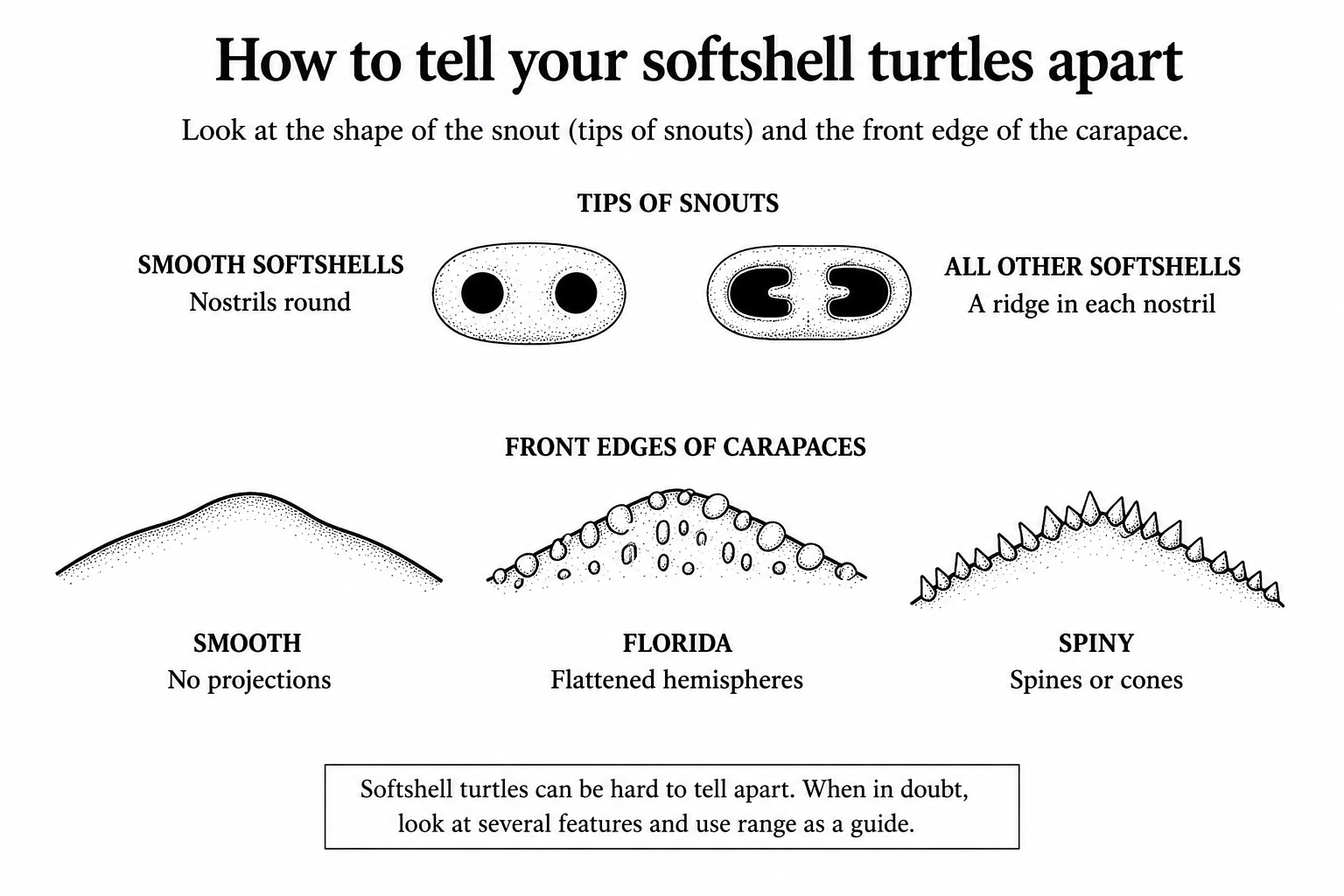
TurtlesKey mark: SNOUT + CARAPACE EDGE
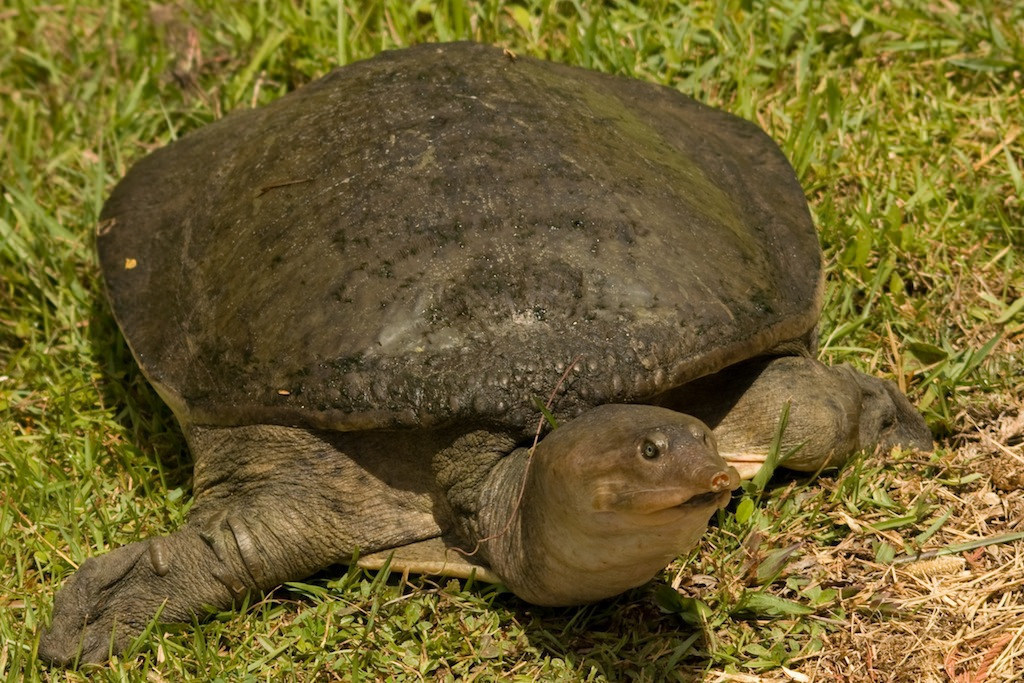
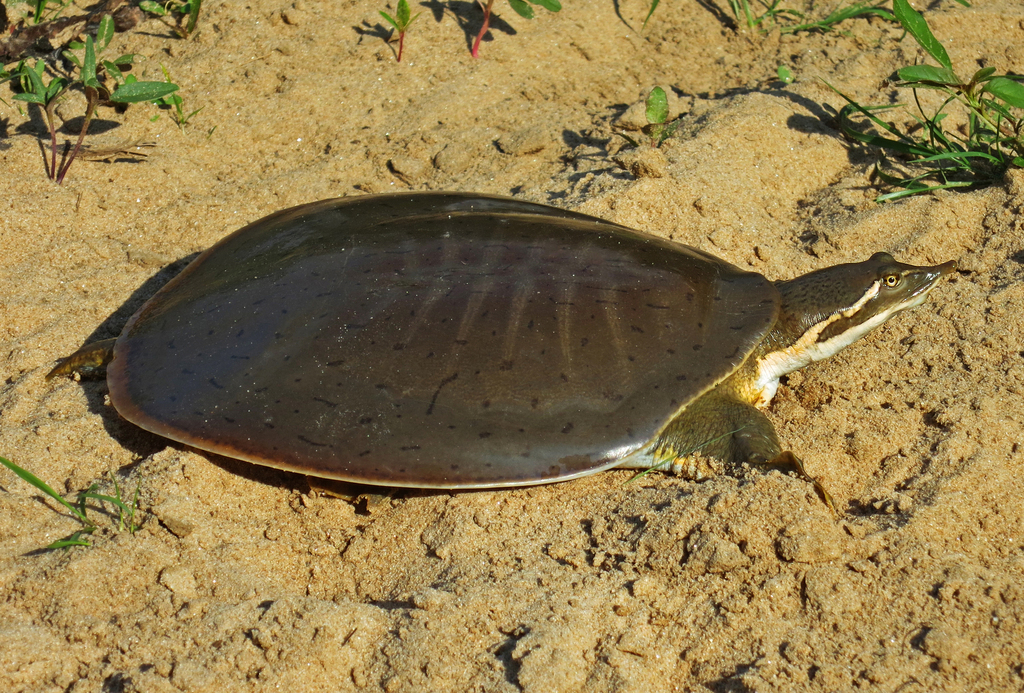
Look at the nostrils and the front edge of the shell. Smooth Softshell has round nostrils and a smooth carapace edge. Spiny Softshell has a ridge in each nostril and spines or cones along the front edge. Florida Softshell has ridged nostrils and flattened hemispheres (bumps) along the front edge rather than true spines.

Mud Turtles & Musk Turtles (Kinosternidae)
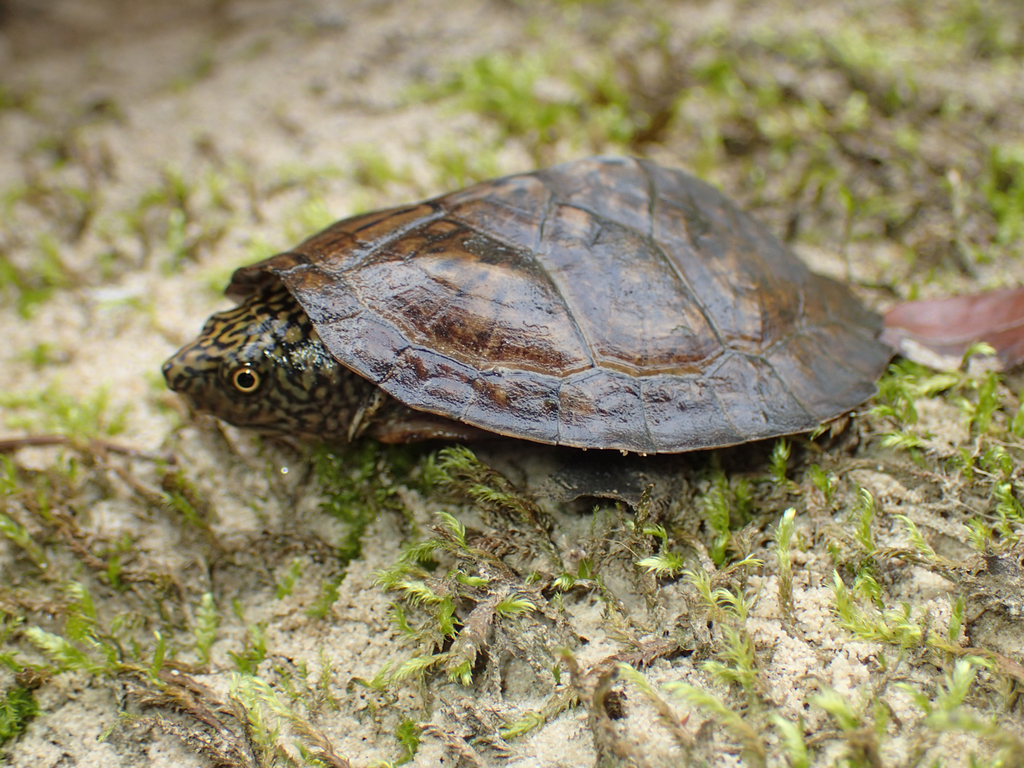
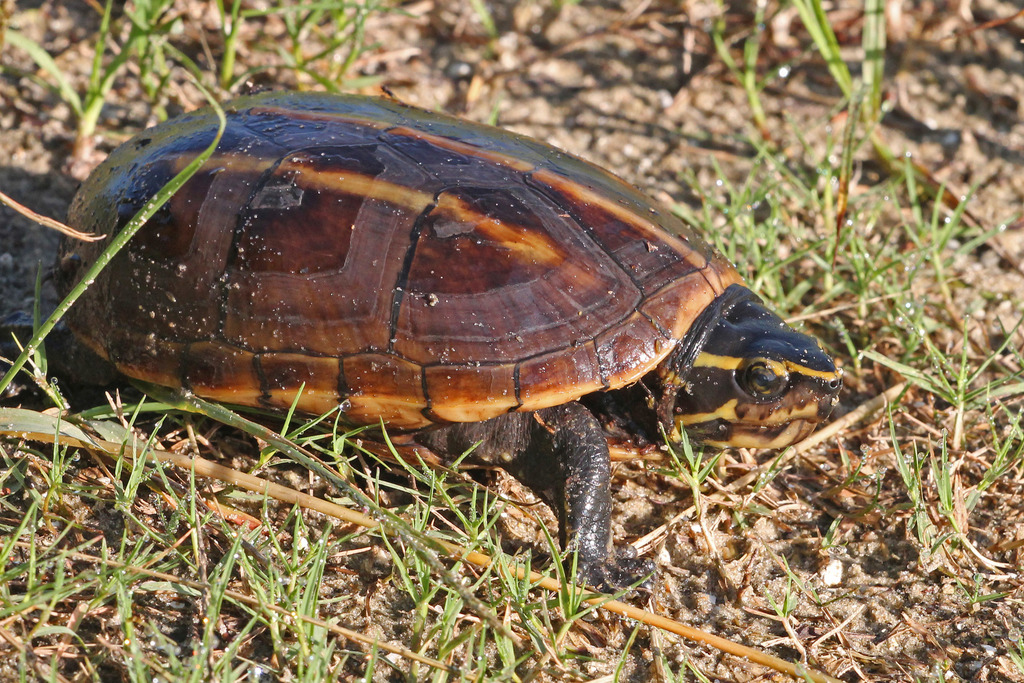
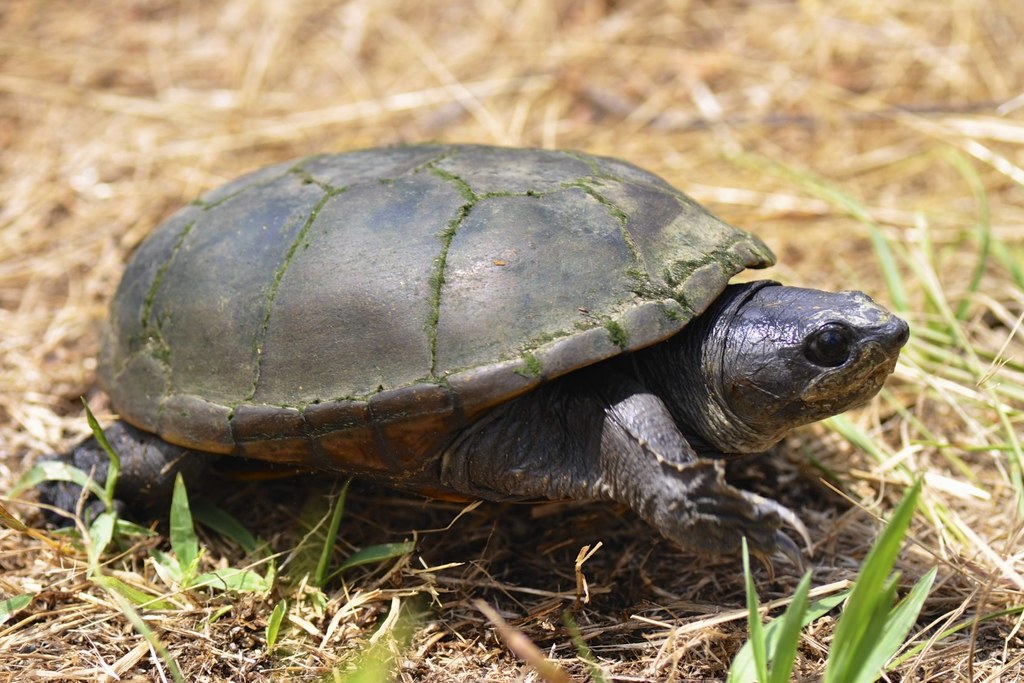
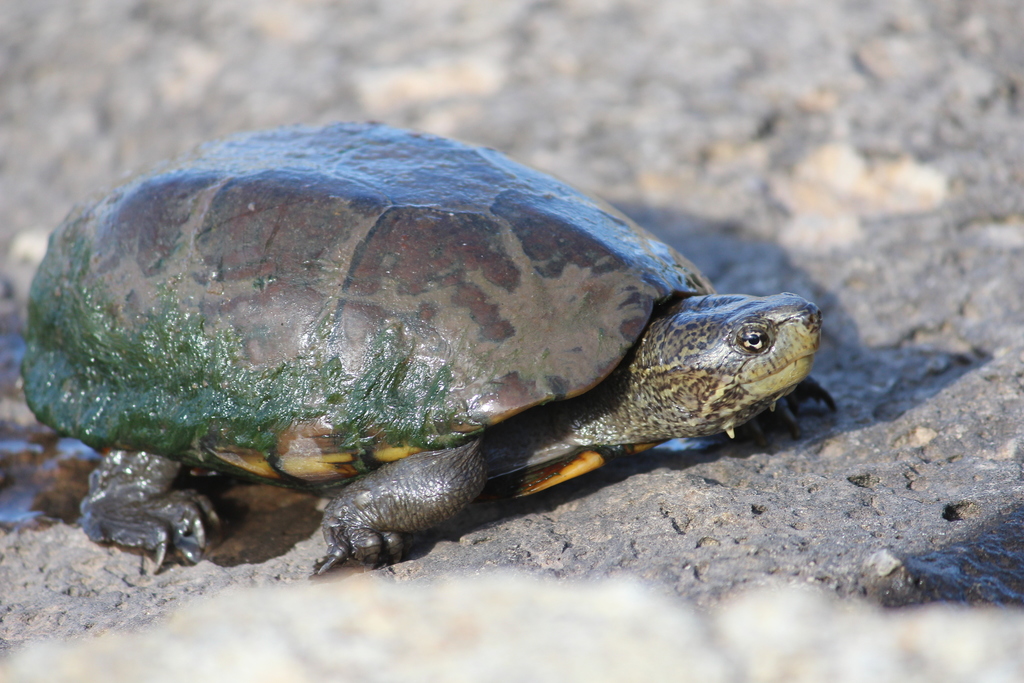
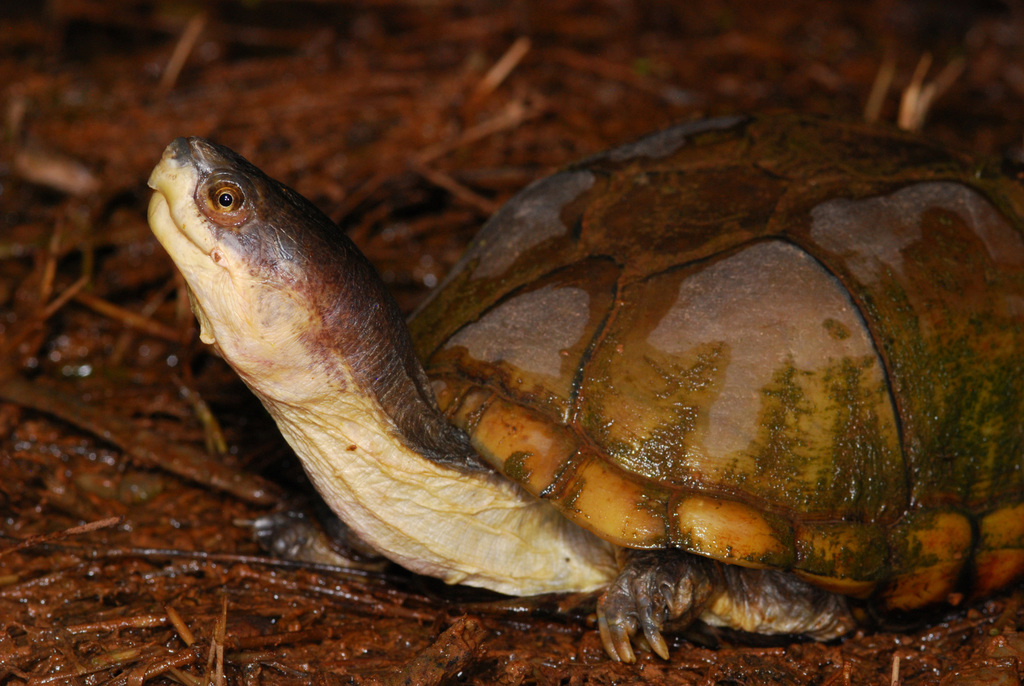
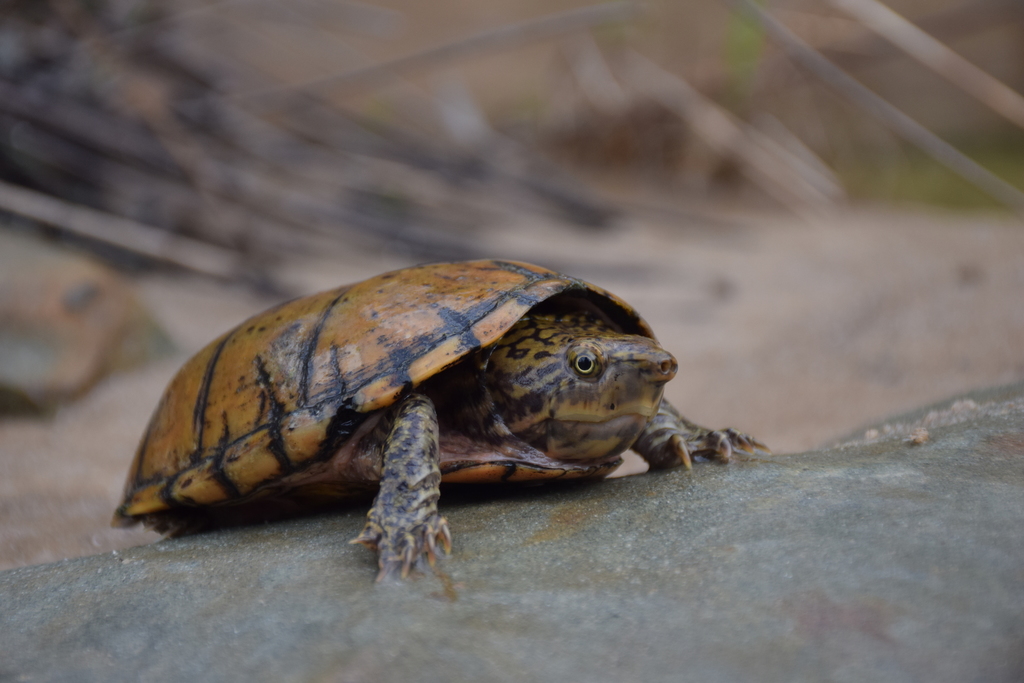
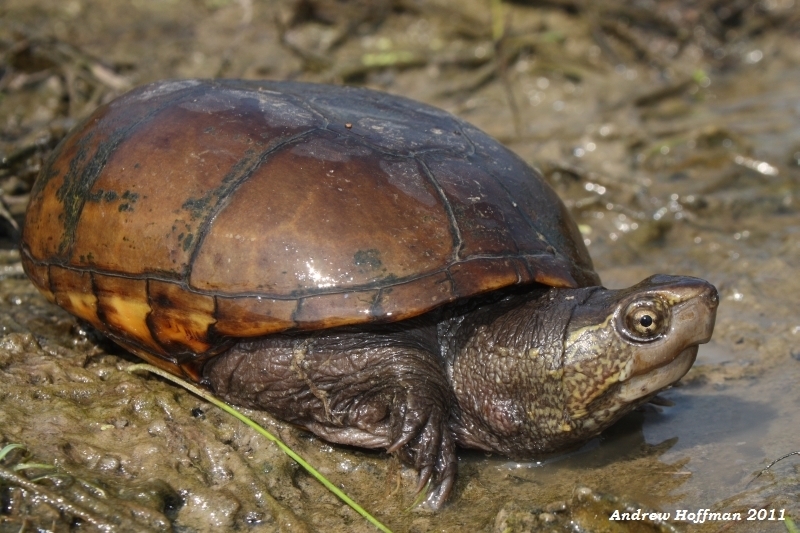
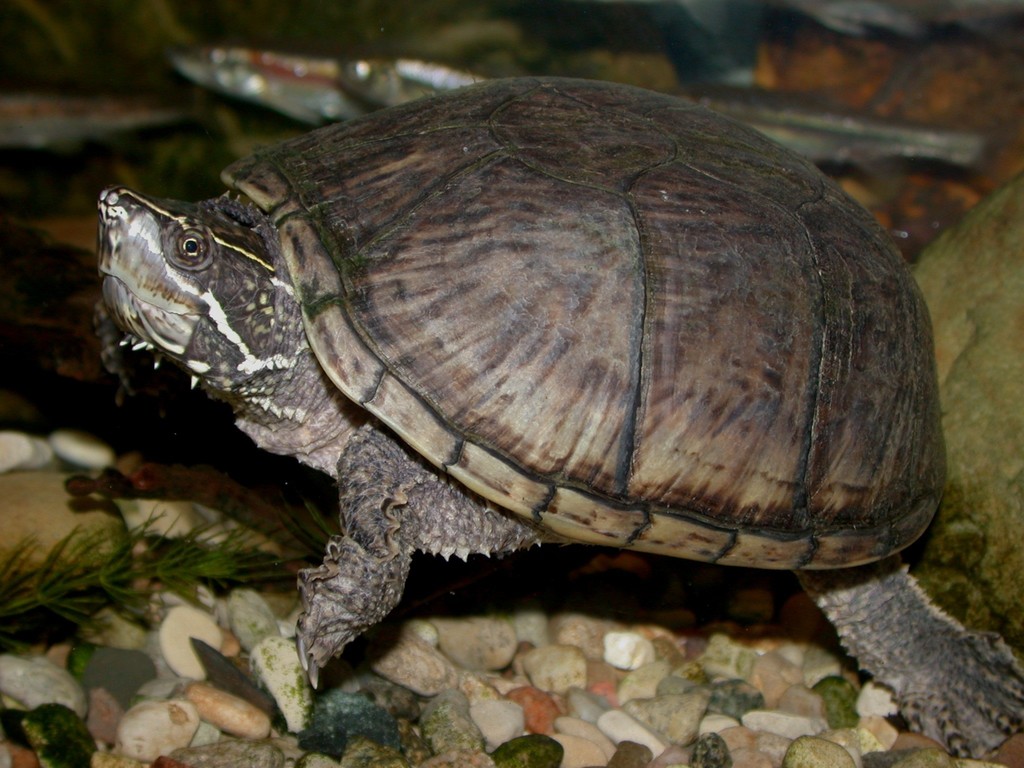
TurtlesKey mark: PLASTRON
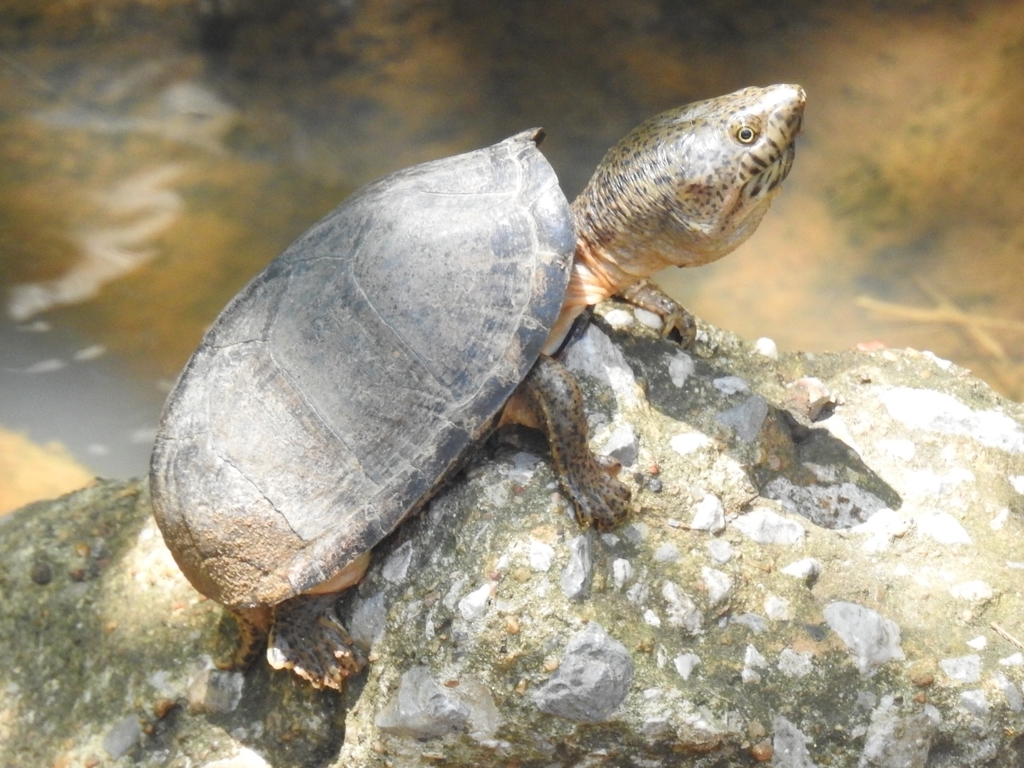
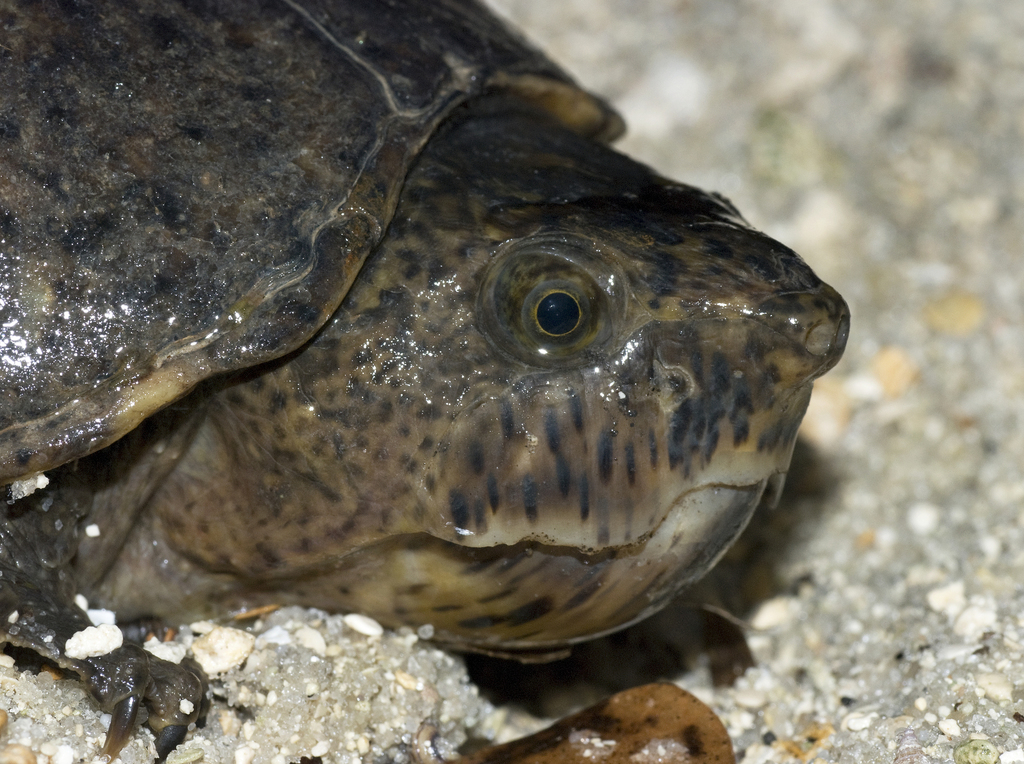
Two genera, one family. Musk Turtles (Sternotherus) have a reduced plastron with one hinge and a squarish pectoral scute — you can see skin between the scutes. Mud Turtles (Kinosternon) have a large plastron with two hinges and a triangular pectoral scute. Within each genus: Razor-backed Musk has a sharp keel visible in profile; Loggerhead Musk has a noticeably large head; Stripe-necked Musk has bold neck stripes. Among mud turtles, Striped Mud Turtle has three yellow head stripes; Yellow Mud Turtle has a yellow-olive head. Western species (Sonoran, Arizona) are found in desert streams of AZ/NM. Use the state filter to see which species occur where you are.

Map Turtles (Graptemys)
TurtlesKey mark: head pattern
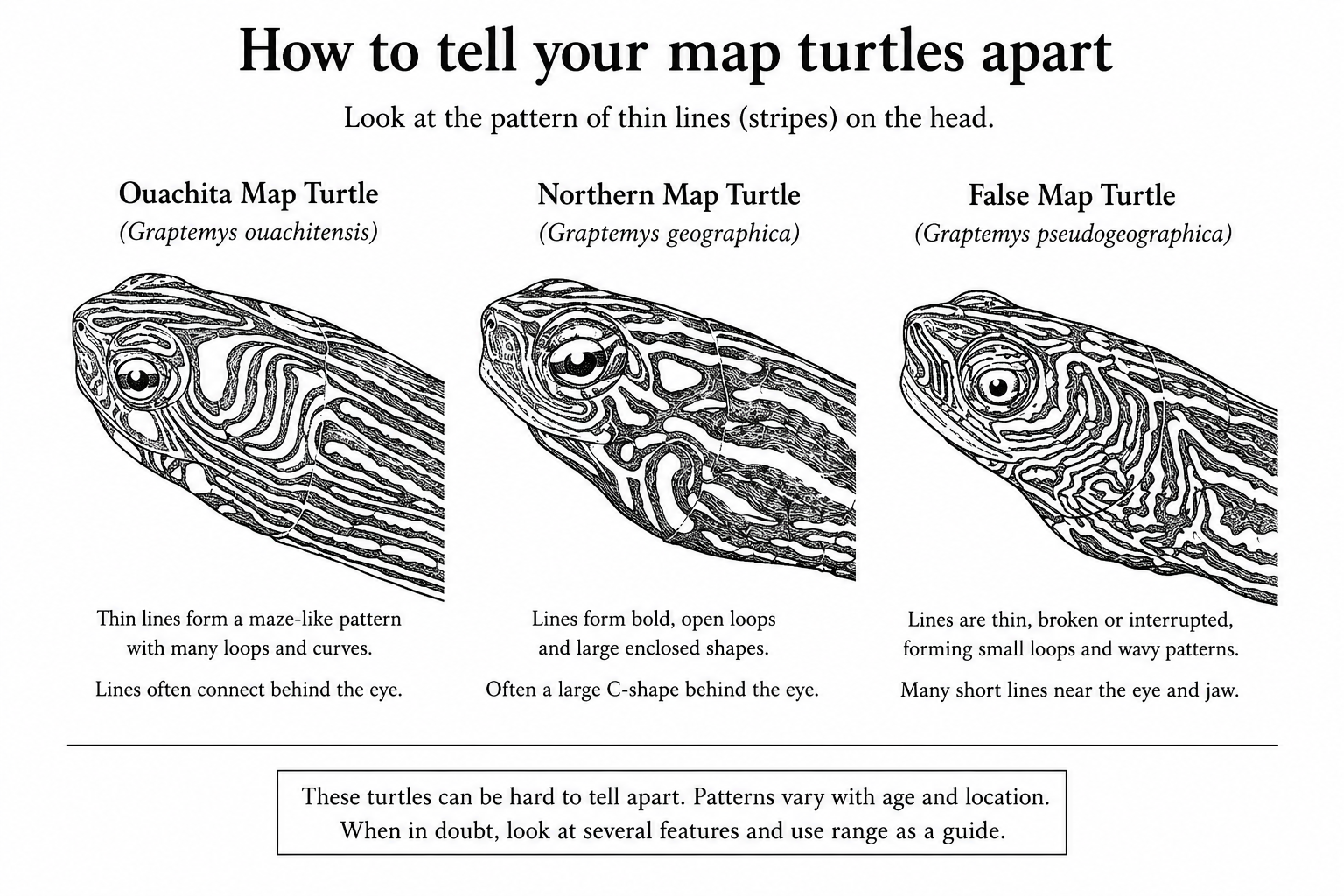
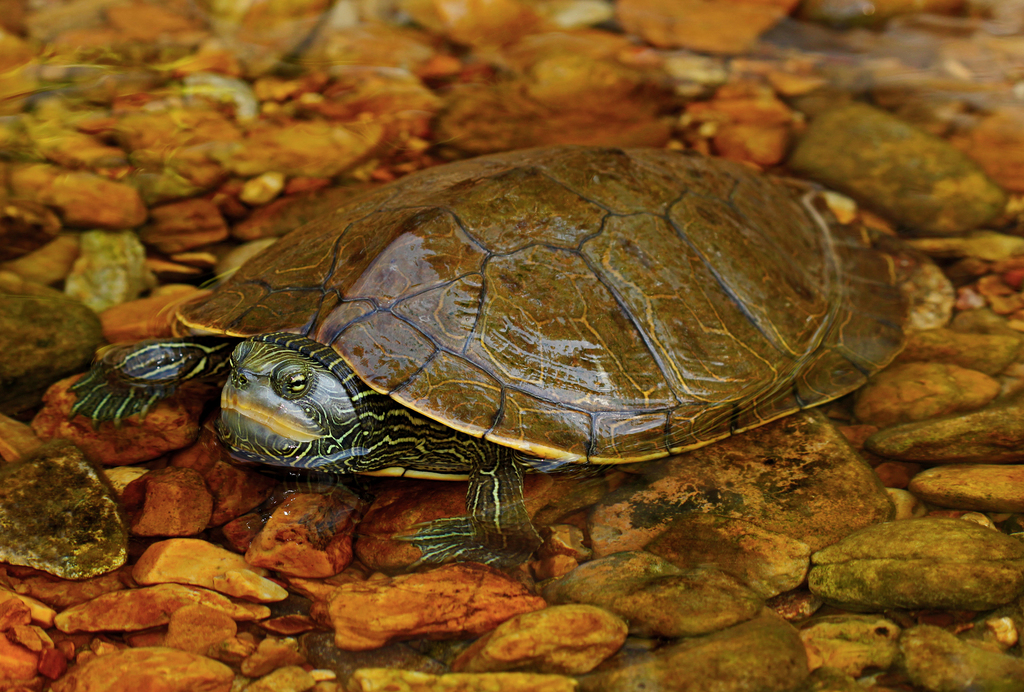
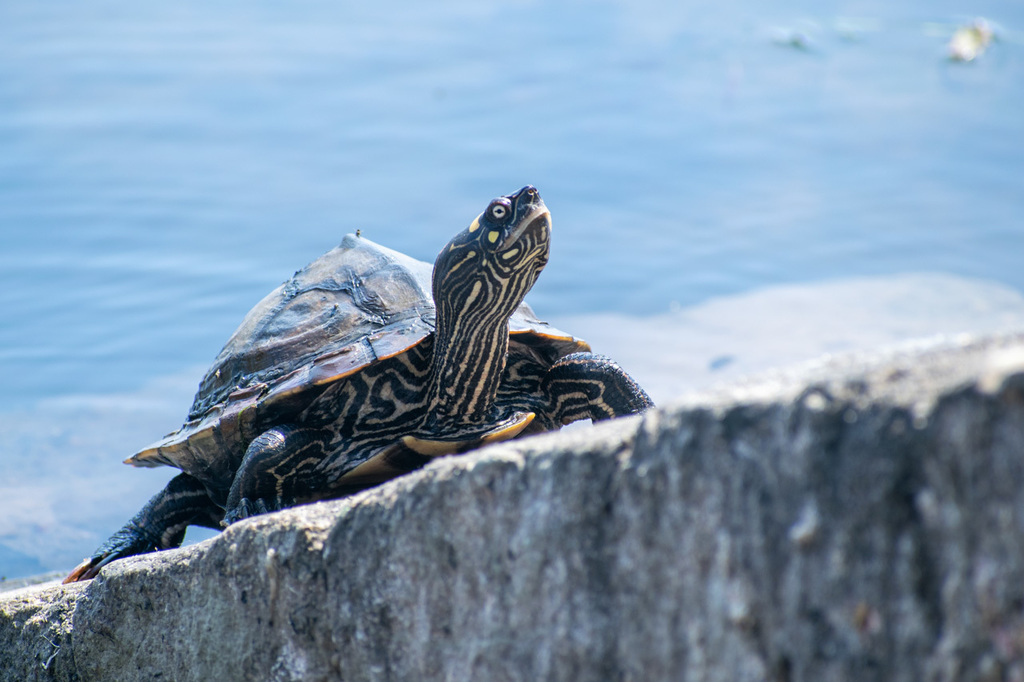
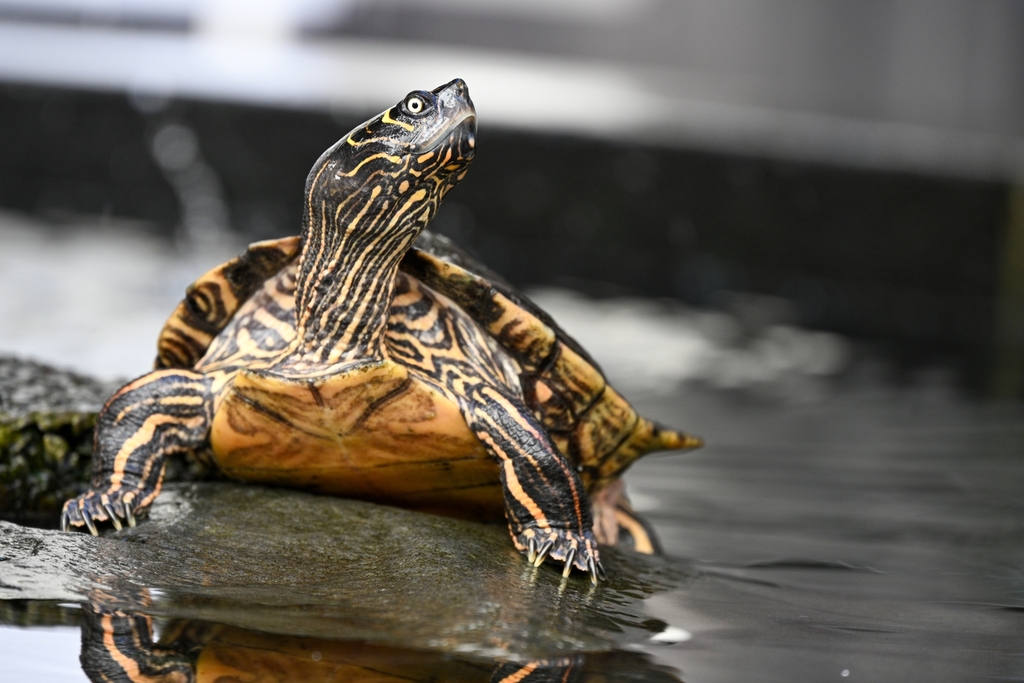
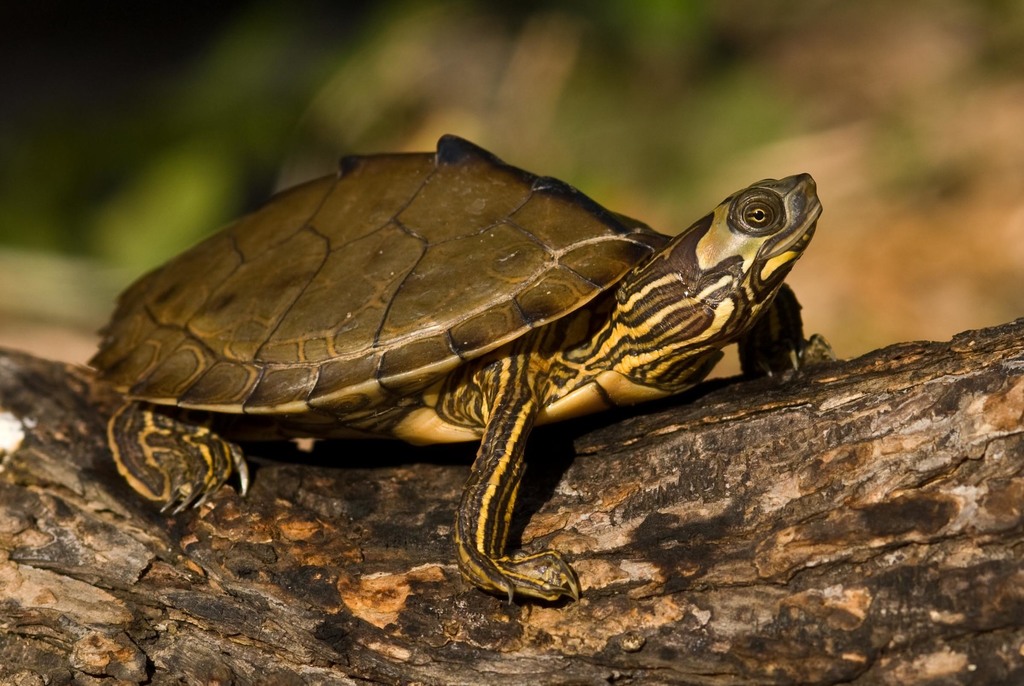
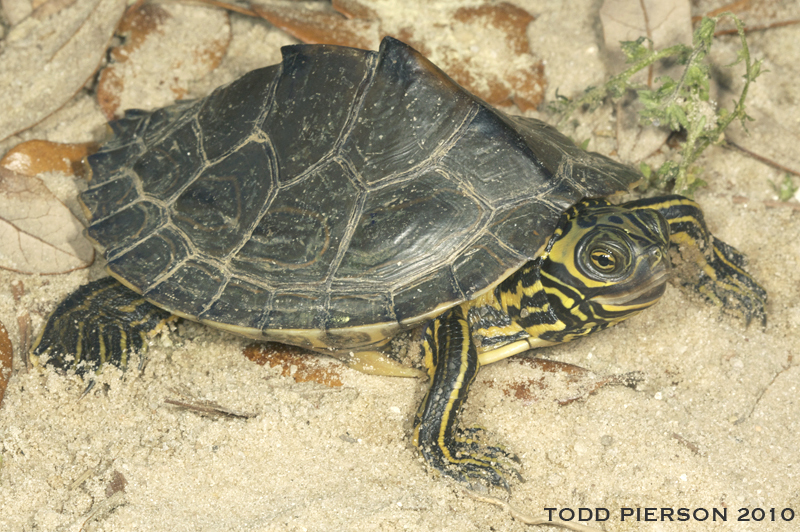
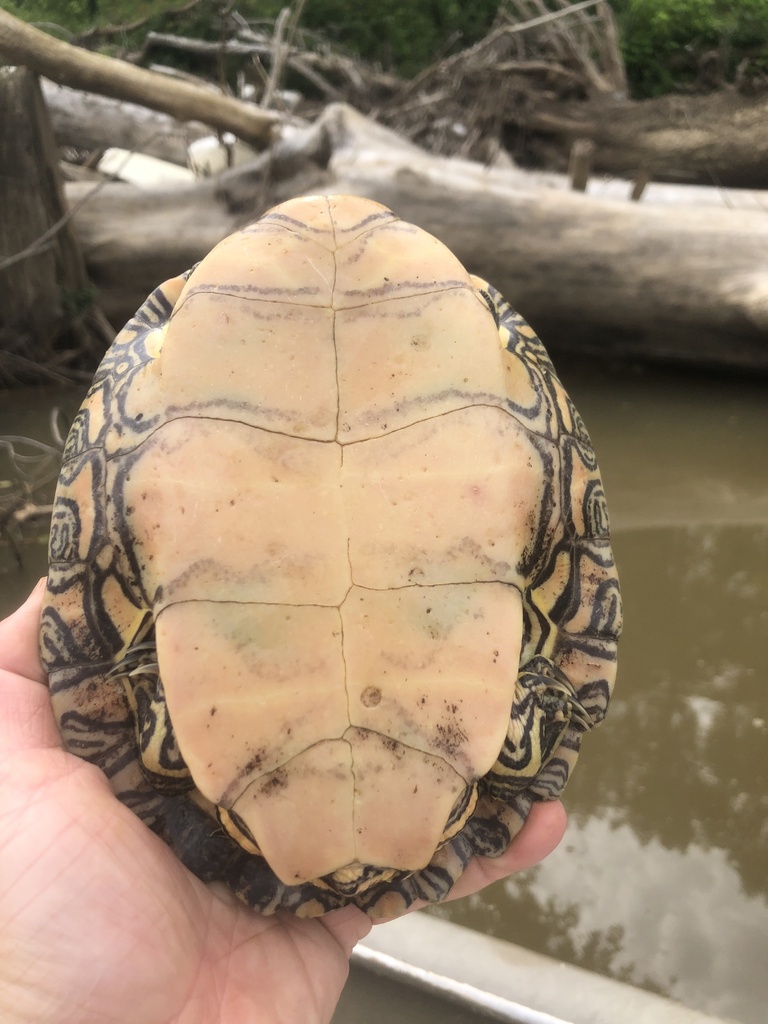
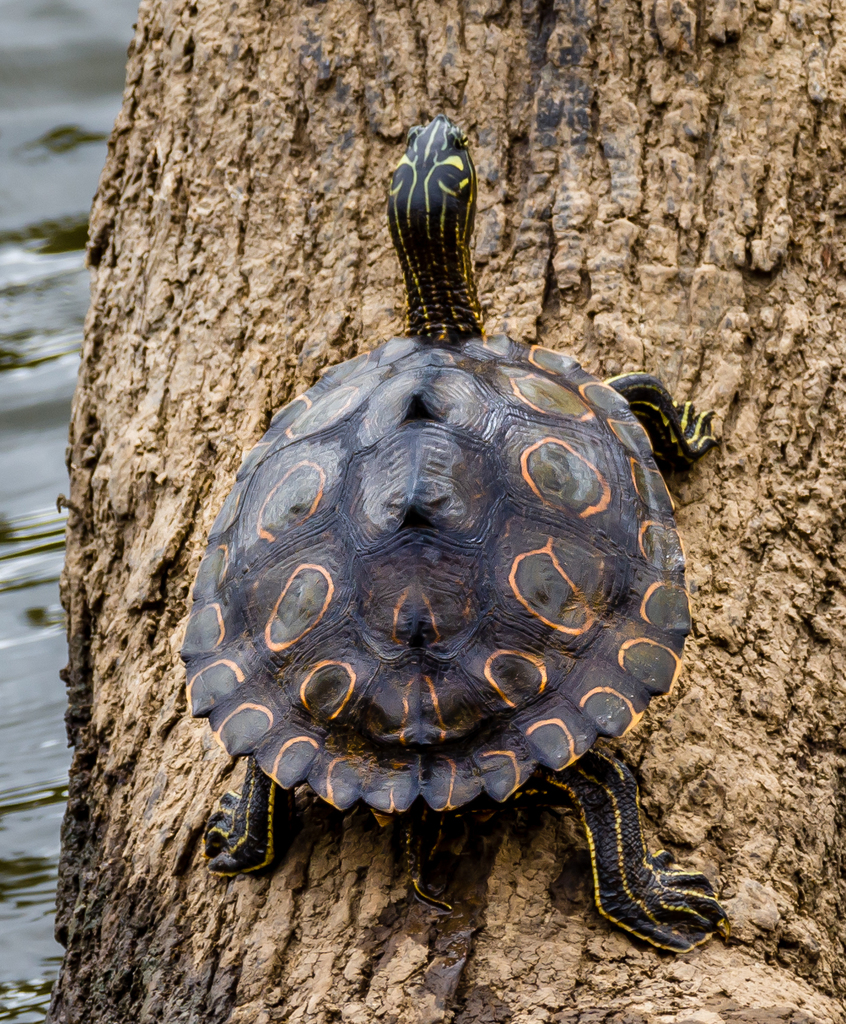
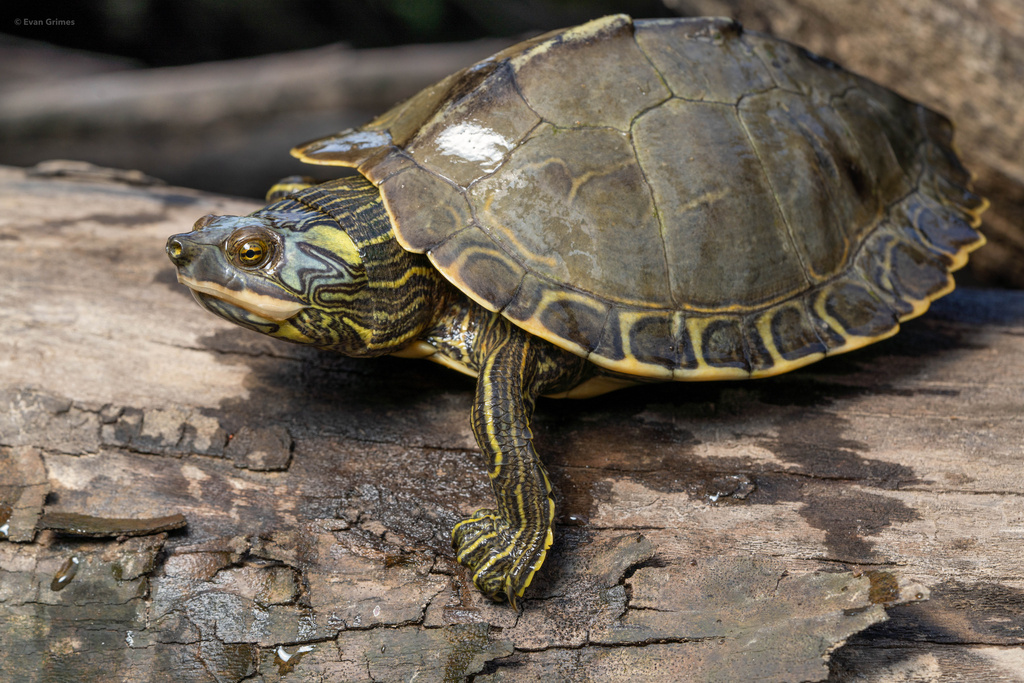
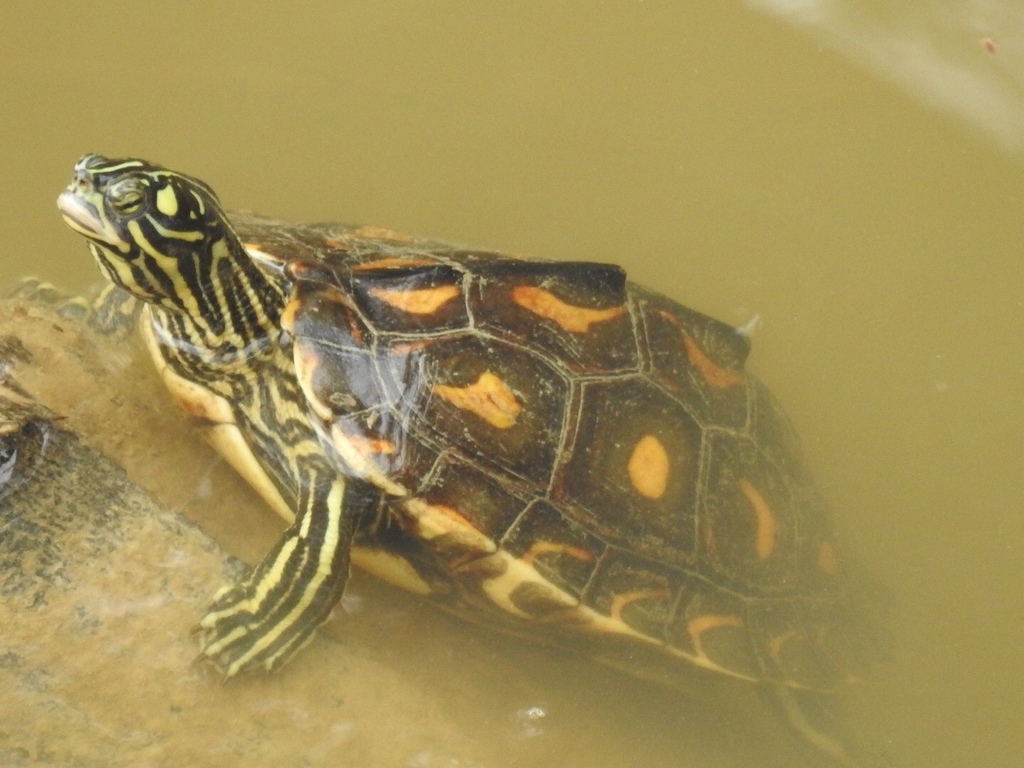
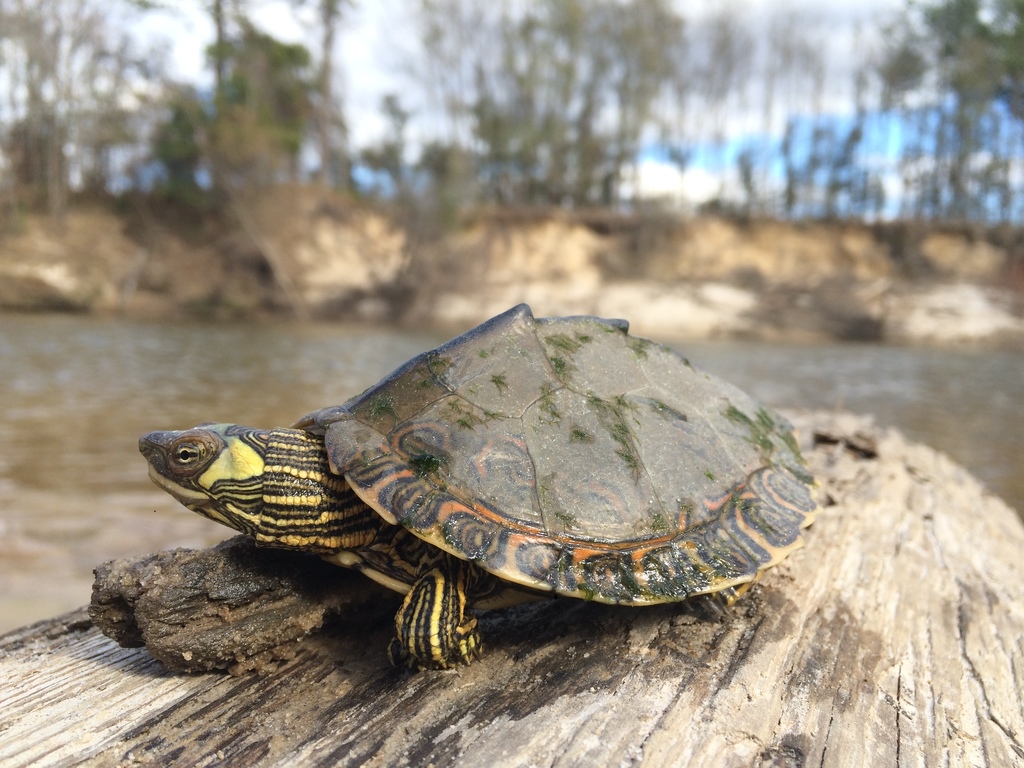
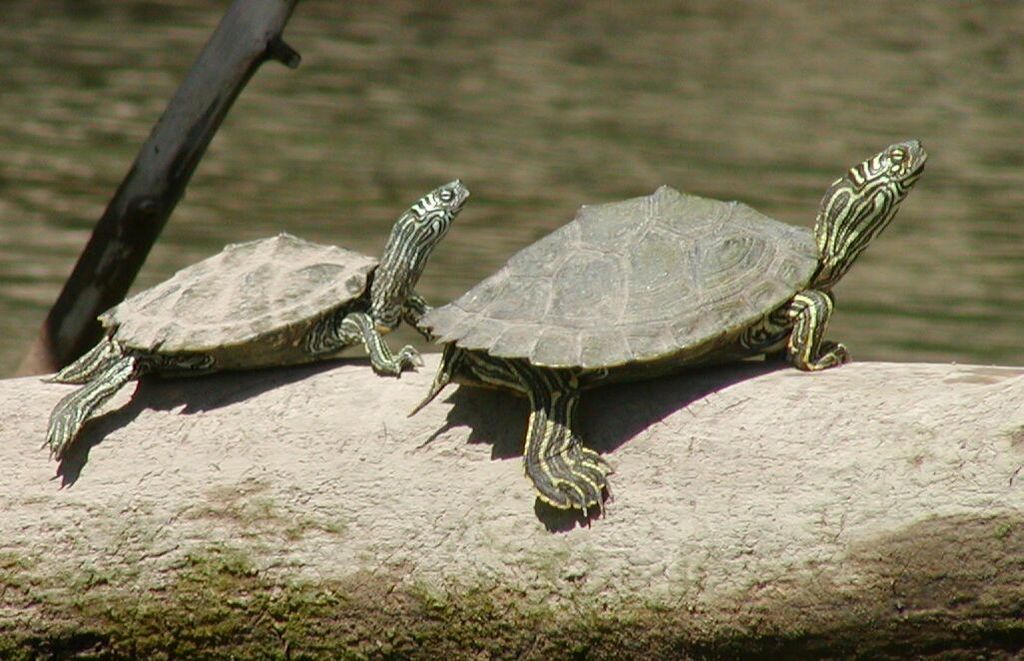
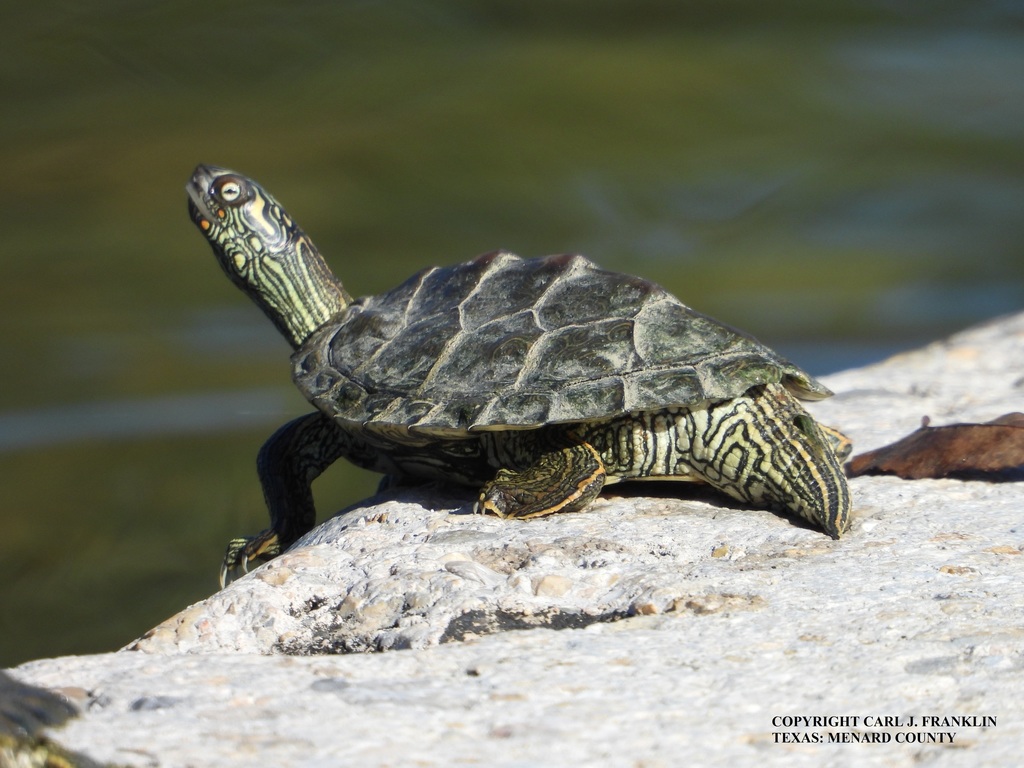
All Graptemys share a keeled carapace with yellowish map-like lines — the head pattern is the key to species ID. The widespread Mississippi drainage species (Ouachita, Northern, False) are most commonly encountered. Gulf Coast river systems each have their own endemics: the Pearl River has both Ringed and Pearl River Map Turtle; the Alabama/Tombigbee system has Black-knobbed, Alabama, and Barbour's; the Pascagoula has Yellow-blotched and Pascagoula Map Turtle; Texas rivers have Cagle's and Texas Map Turtle. Use the state filter to see which species occur where you are.

Box Turtles (Terrapene)
TurtlesKey mark: plastron hinge and toe count
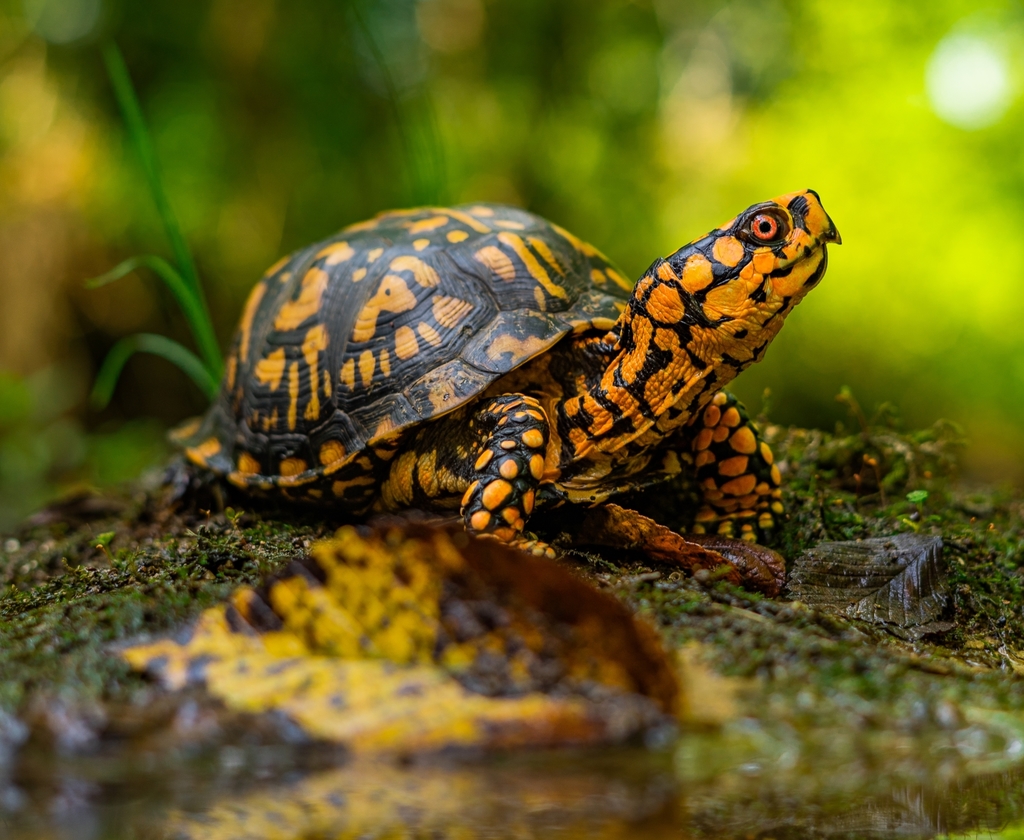
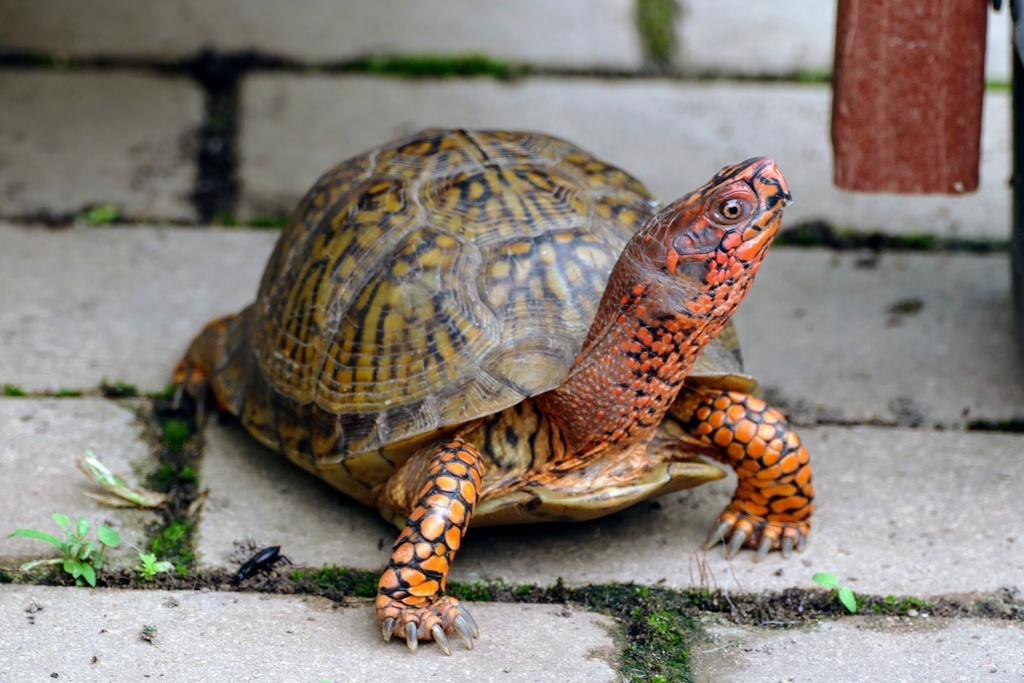
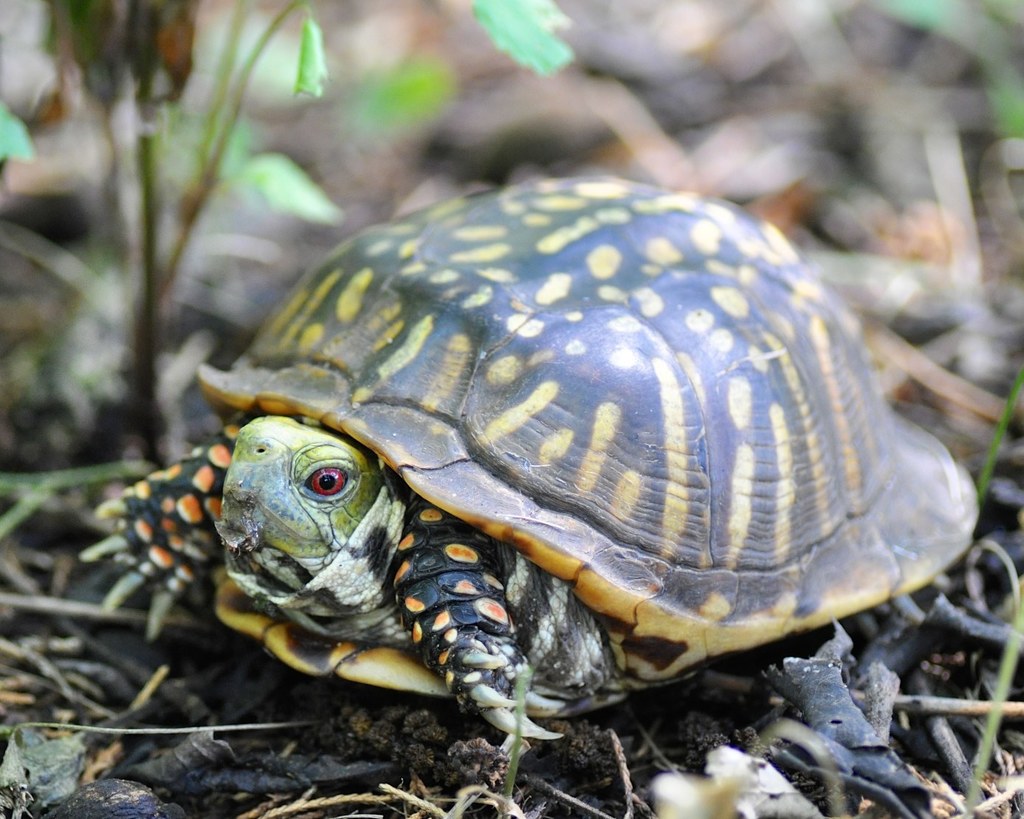
All box turtles have a hinged plastron that lets them close completely — no other North American turtle does this. Eastern/Common Box Turtle: highly variable pattern, 4 toes on hind foot, found in moist forests. Three-toed Box Turtle: usually 3 toes on hind foot, often plain brown with faint markings, south-central US. Ornate Box Turtle: radiating yellow lines on each scute, domed shell, open grasslands and prairies. Where ranges overlap (especially MO, KS, OK, AR), hybrids occur.
Snapping Turtles
TurtlesKey mark: tail length and shell texture
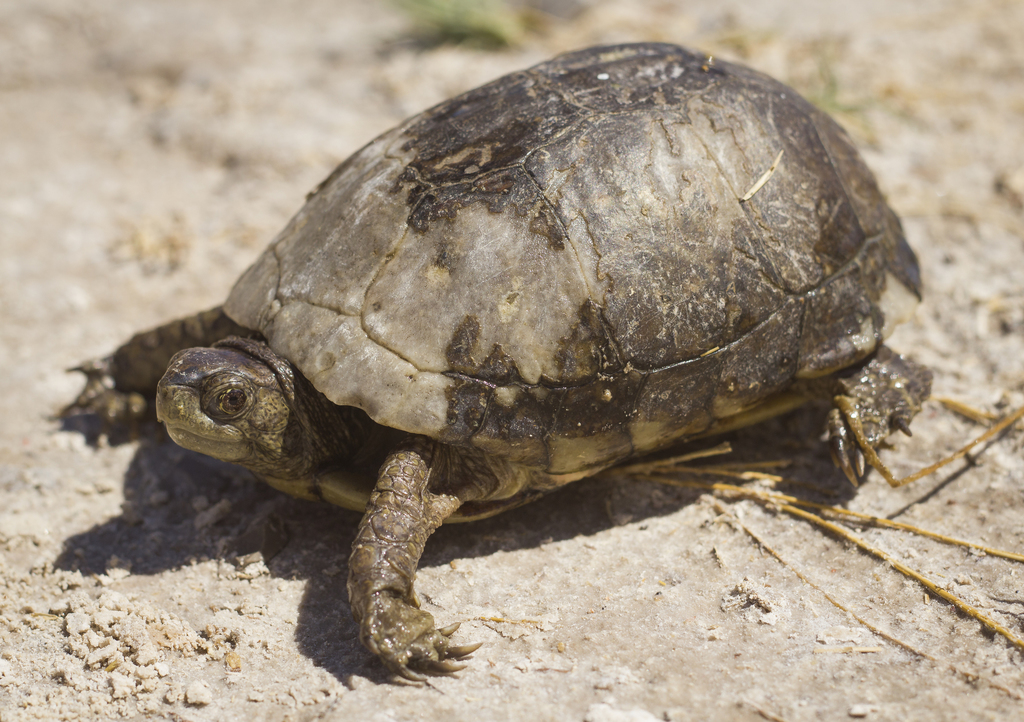
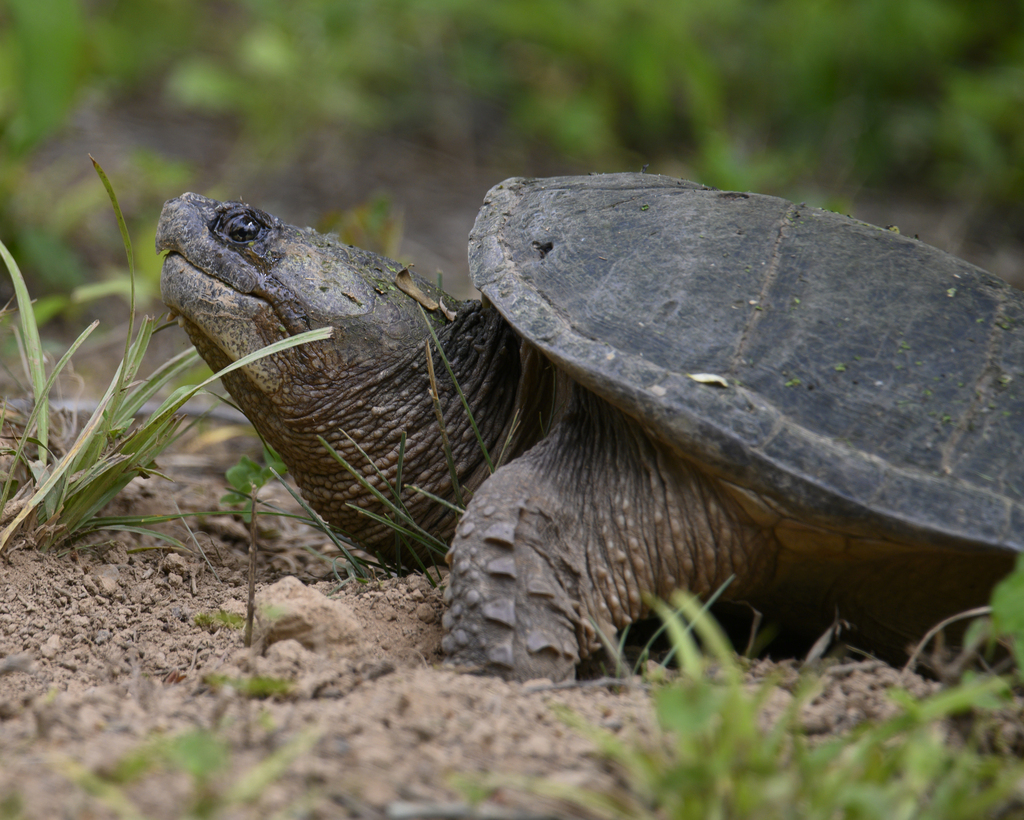
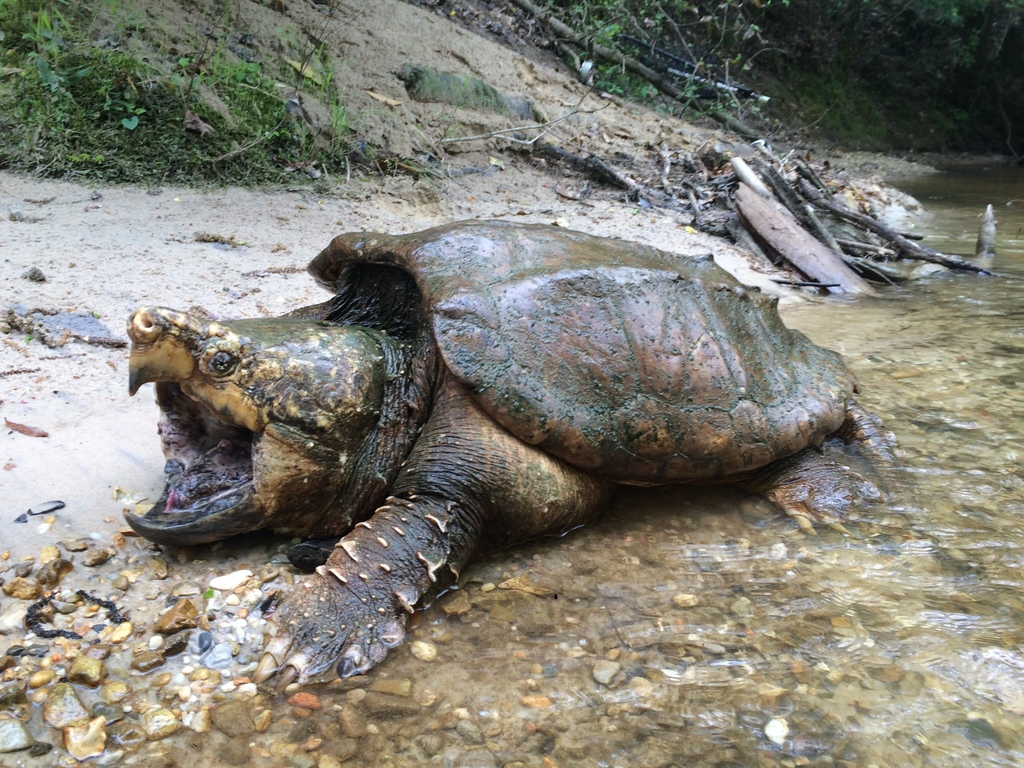
Both species are large, aggressive, and best left alone. Common Snapping Turtle: smooth carapace, long saw-toothed tail, smaller tubercles on the neck, found across eastern North America. Alligator Snapping Turtle: three prominent raised keels on the shell, massive hooked beak, worm-like lure on tongue, restricted to the Gulf drainage. Alligator Snapper is much bulkier and has a larger head relative to body size. Common Snappers often bask and wander overland; Alligator Snappers rarely leave deep water.
Wood Turtle vs. Spotted Turtle
TurtlesKey mark: scute sculpture and spot pattern
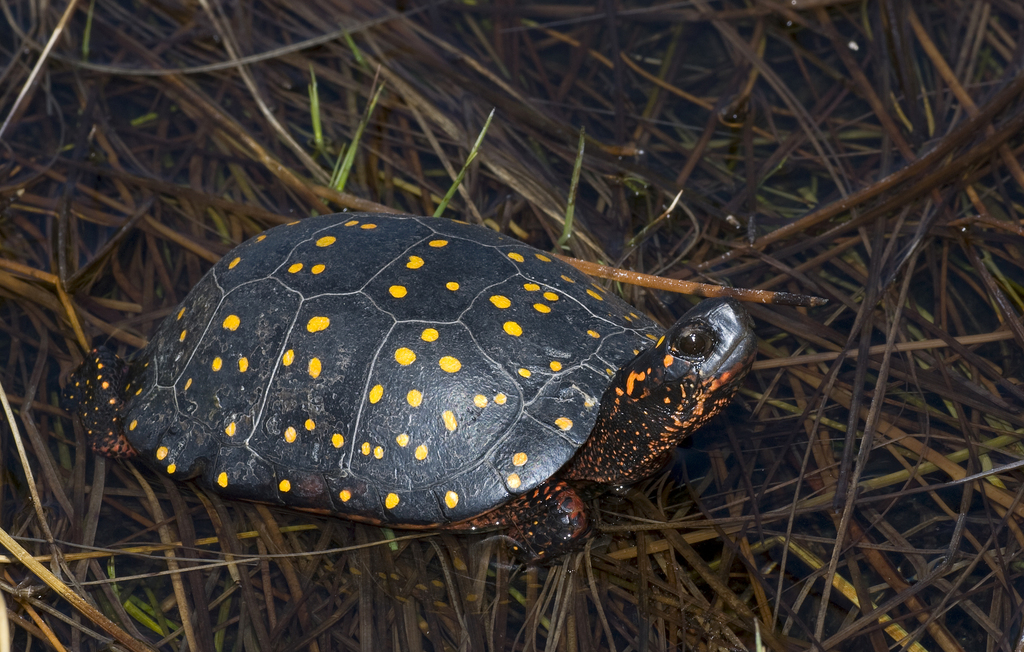
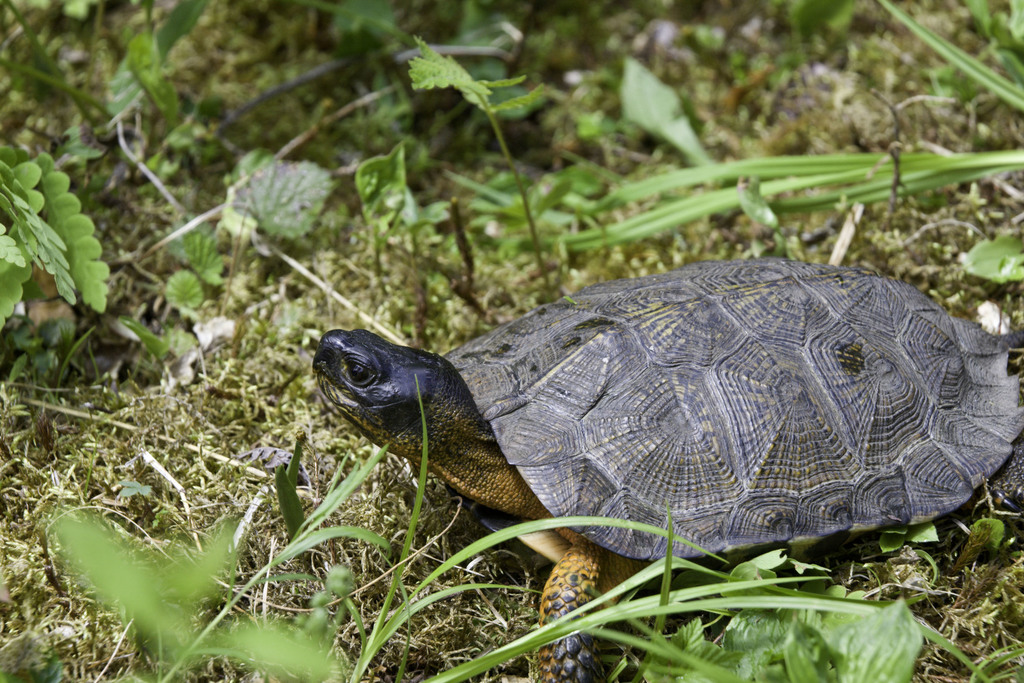
Two distinctive turtles of the northeastern US that share pond, stream, and wetland habitats. Spotted Turtle: small (4-5 in.), smooth black shell with round yellow spots (number varies by individual); orange or yellow markings on head; found in bogs, wet meadows, and shallow ponds. Wood Turtle: larger (7-9 in.), each scute has concentric growth rings that form a sculpted pyramid shape — unlike any other turtle; head is plain brown; orange-red wash on neck and legs; semi-terrestrial and regularly wanders far from water.
Desert Tortoises (Gopherus)
TurtlesKey mark: range and gular horn shape
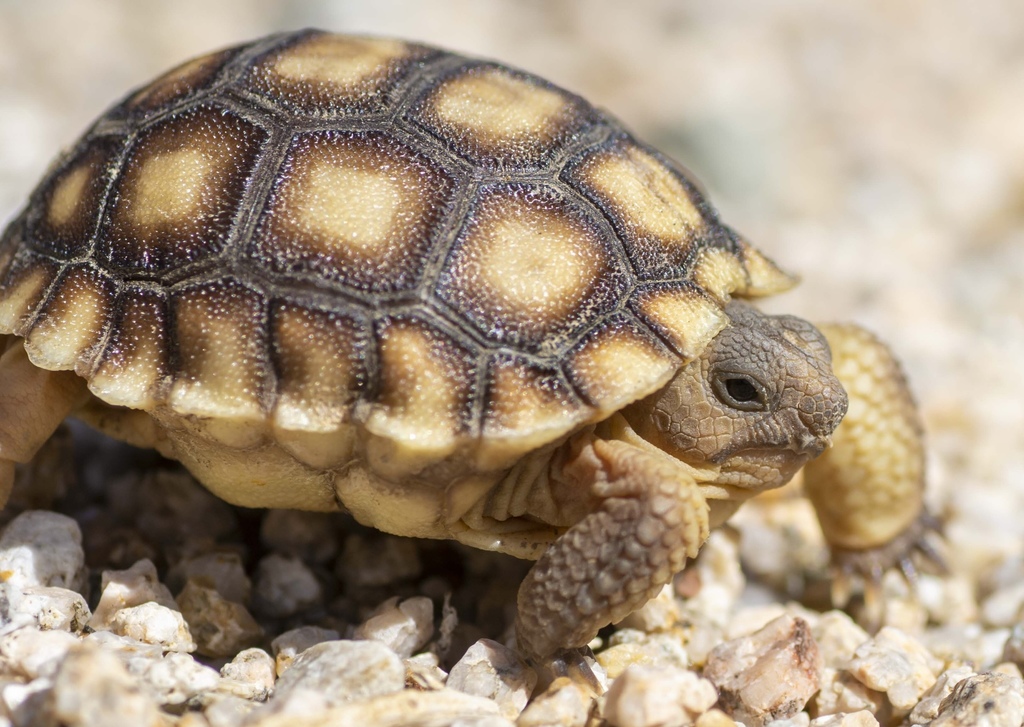
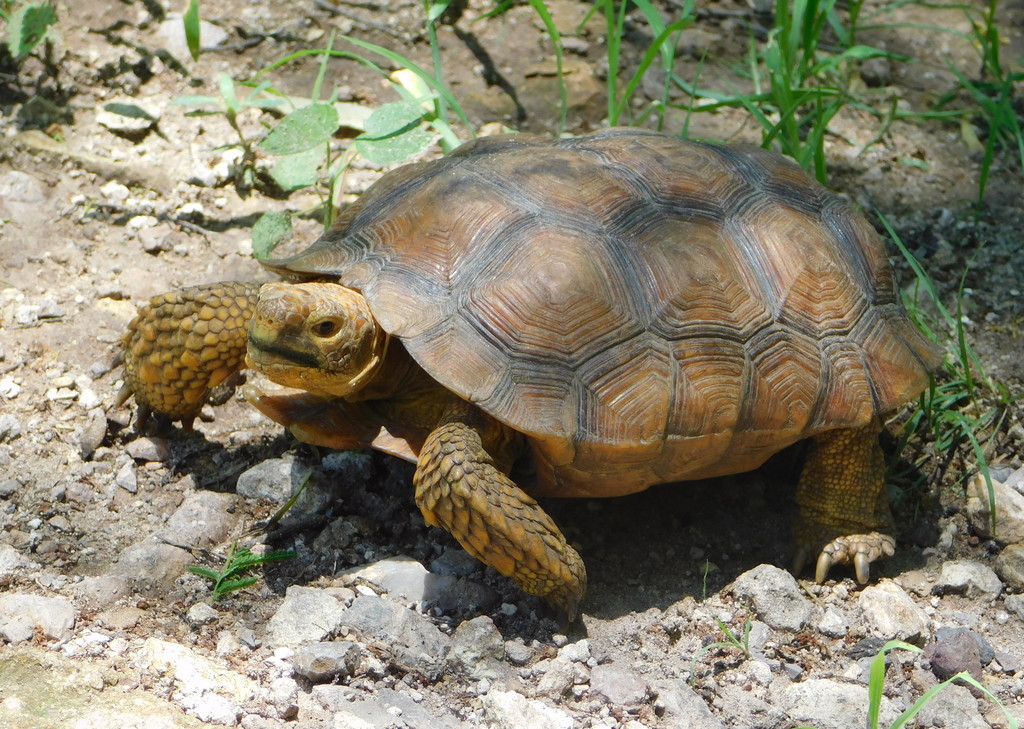
Two desert tortoise species were formerly considered one. Mojave Desert Tortoise: found west of the Colorado River in California, Nevada, Utah, and Arizona; tends to have a longer, more pointed gular horn (the scute projecting forward between the front legs). Goode's Thornscrub Tortoise: found east of the Colorado River in Arizona and Sonora, Mexico; slightly smaller and more rounded gular; associated with thornscrub and tropical deciduous forest rather than Mojave/Sonoran desert flats. Where range is unknown, the two are very difficult to distinguish without locality data.
Sliders, Cooters & Chicken Turtle
TurtlesKey mark: ear patch, neck length, and plastron color
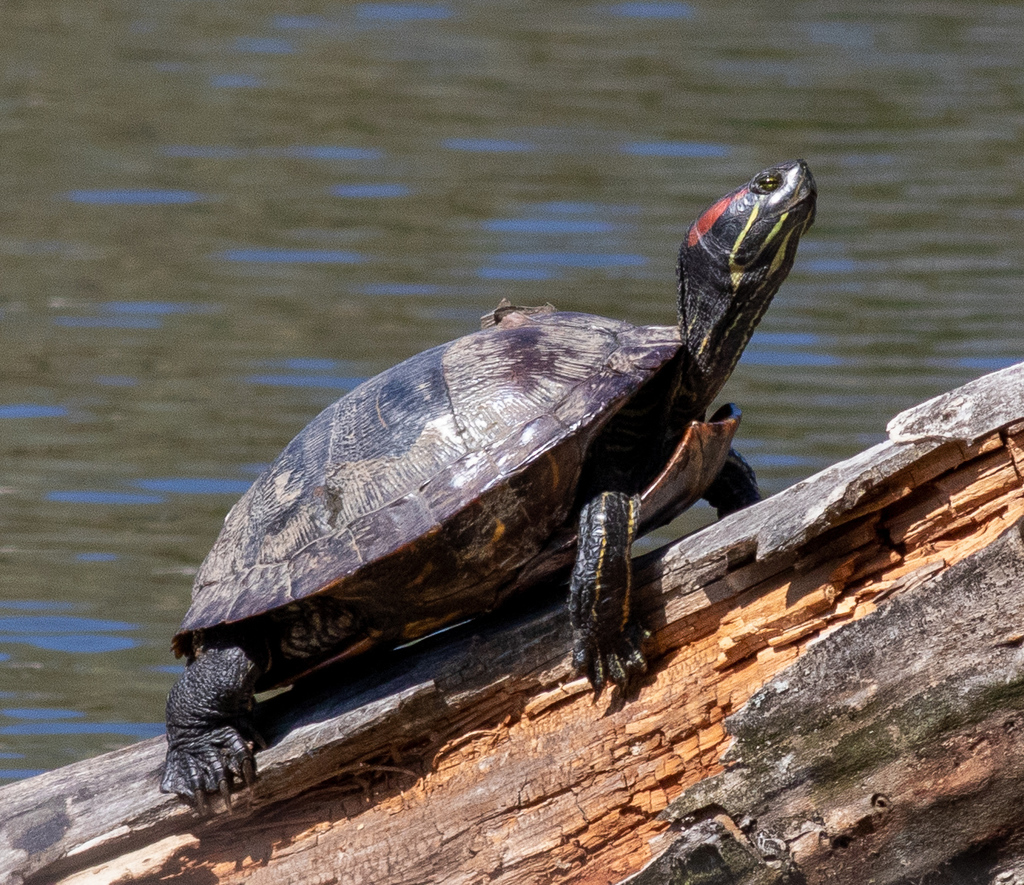
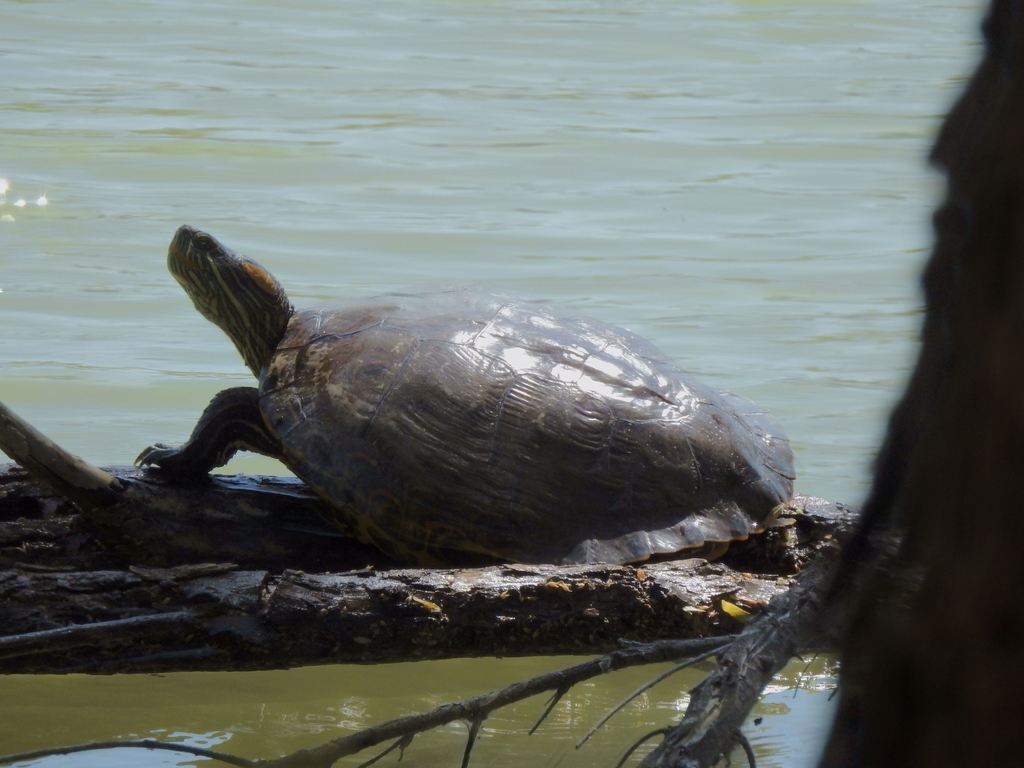
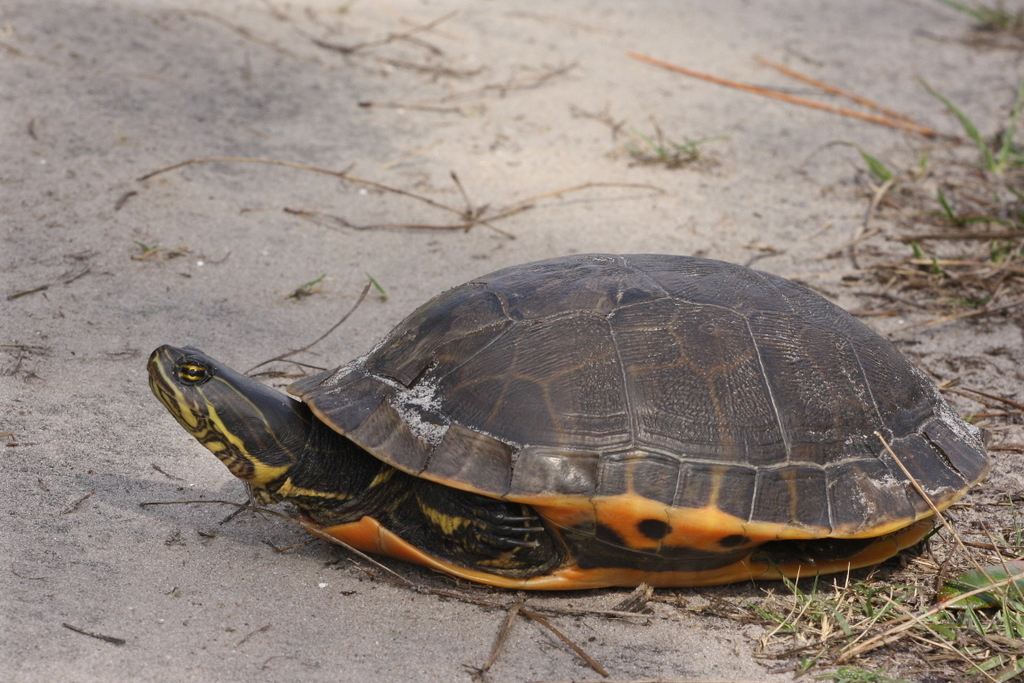
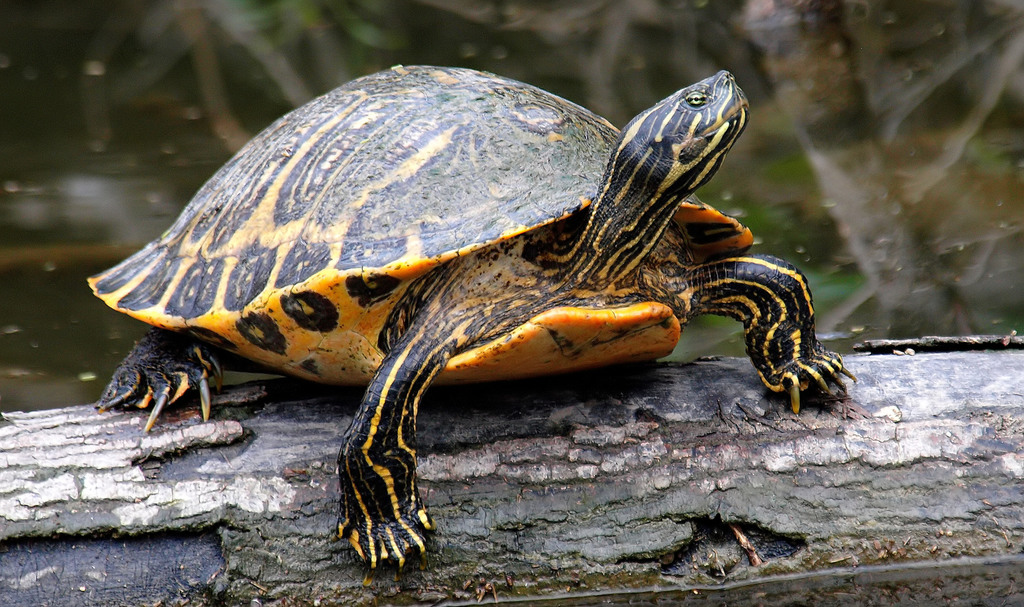
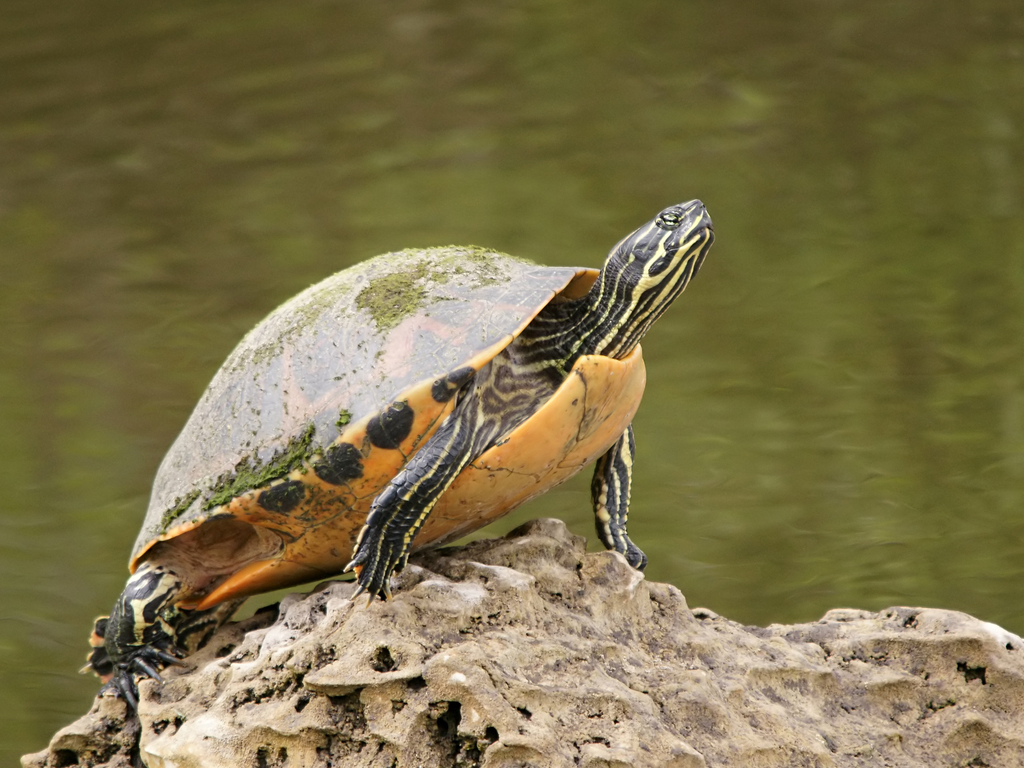
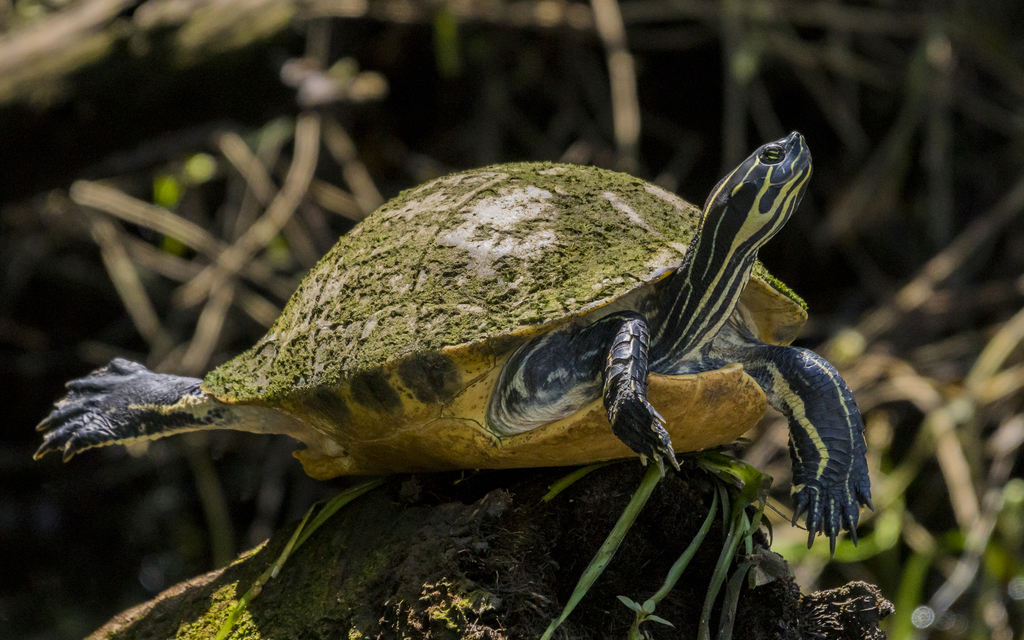
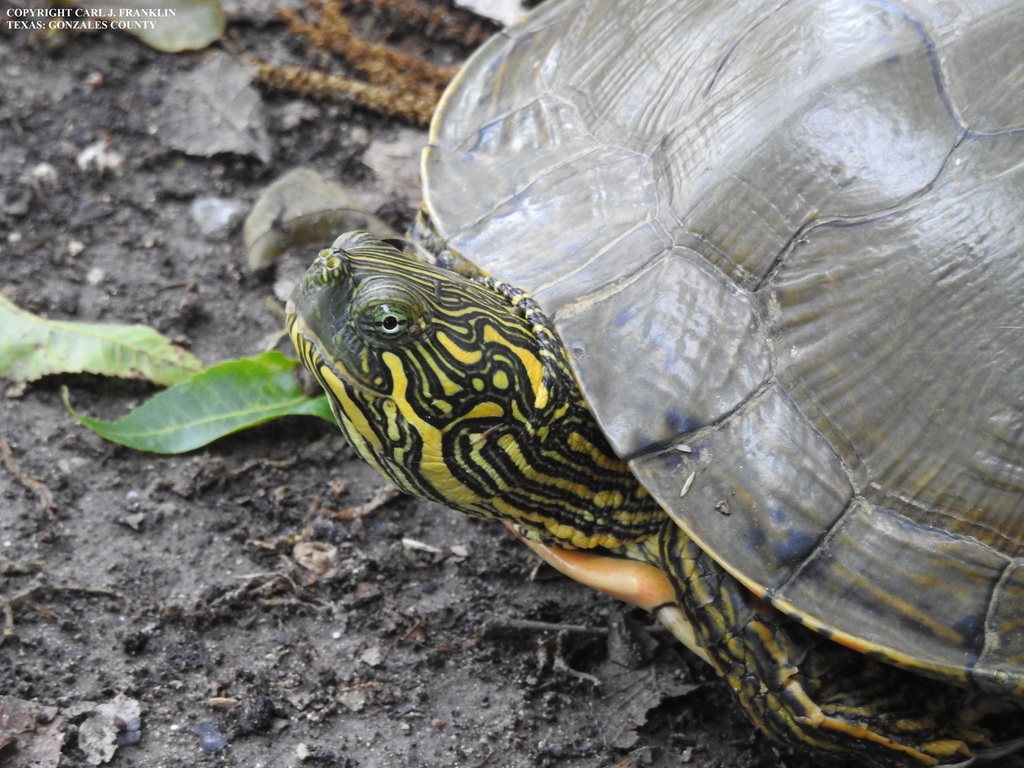
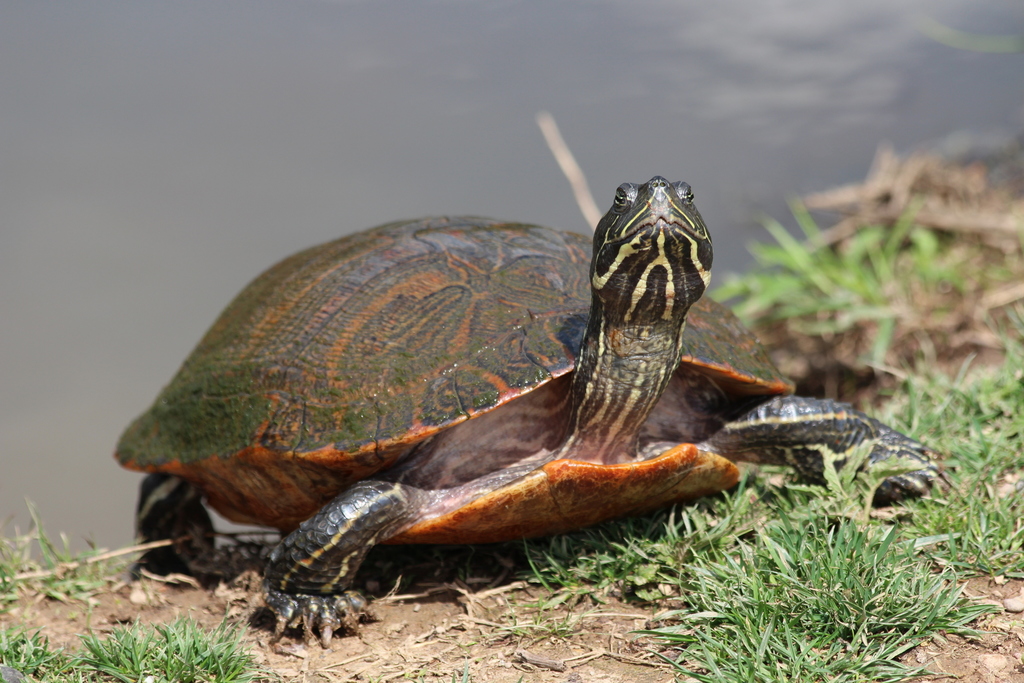
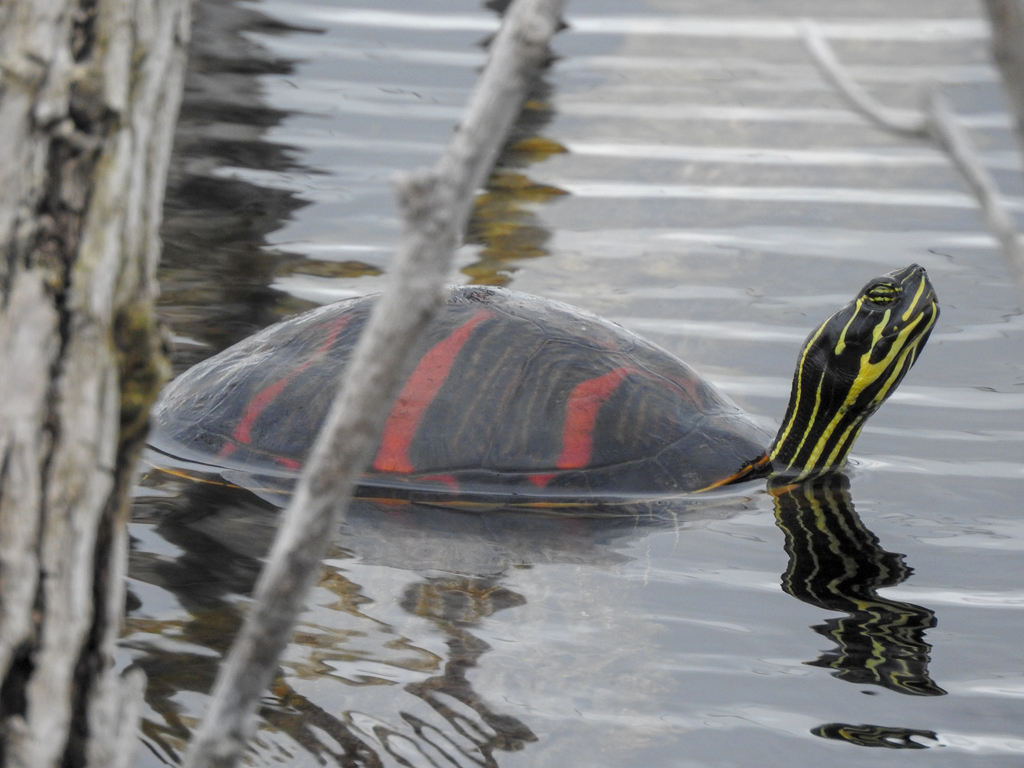
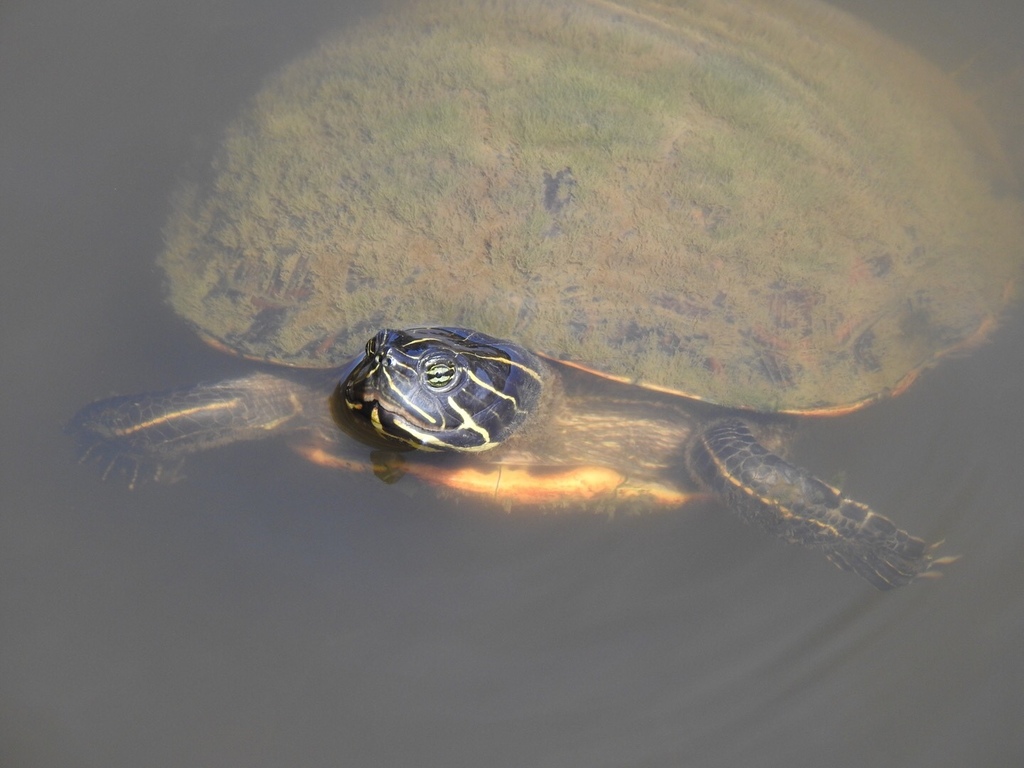
These basking pond turtles all share striped necks and similar body shapes — look at three things. First, neck length: Chicken Turtle has a remarkably long neck (often longer than the shell width) and very broad leg stripes. Second, ear patch: Sliders (Trachemys) typically have a bold ear patch — red in Red-eared Slider, yellow in Yellow-bellied. Cooters (Pseudemys) lack an ear patch and instead show complex hairpin or C-shaped head markings. Third, plastron: Red-bellied Cooters (nelsoni, rubriventris, alabamensis) have orange-red on the plastron; River and Florida Cooters are plain yellow below.

Skinks (Plestiodon)
LizardsKey mark: scale count & head size
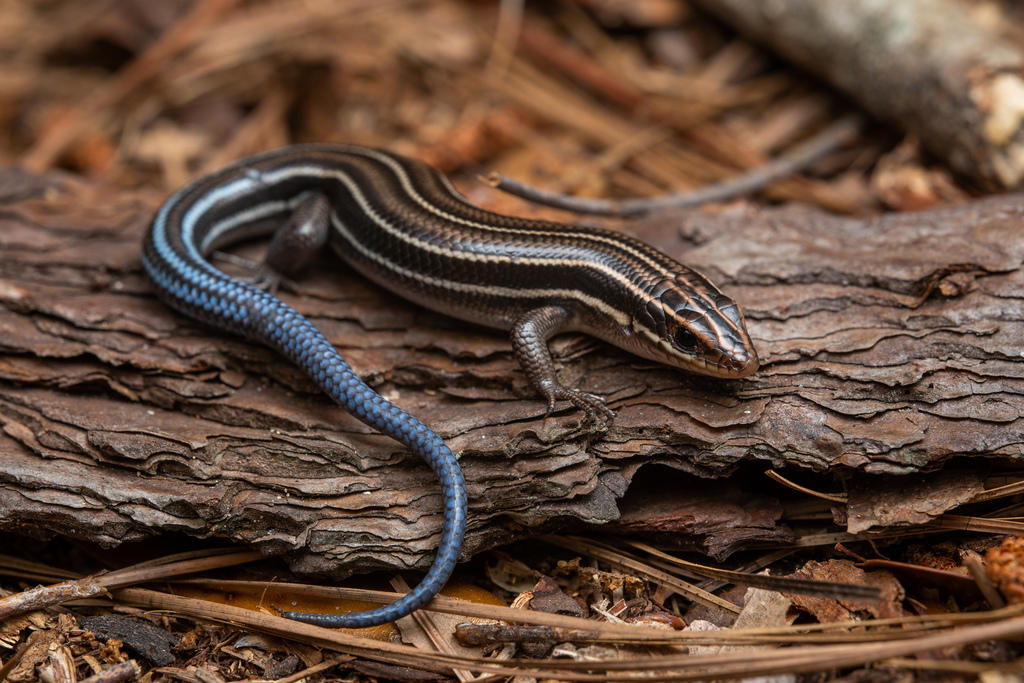
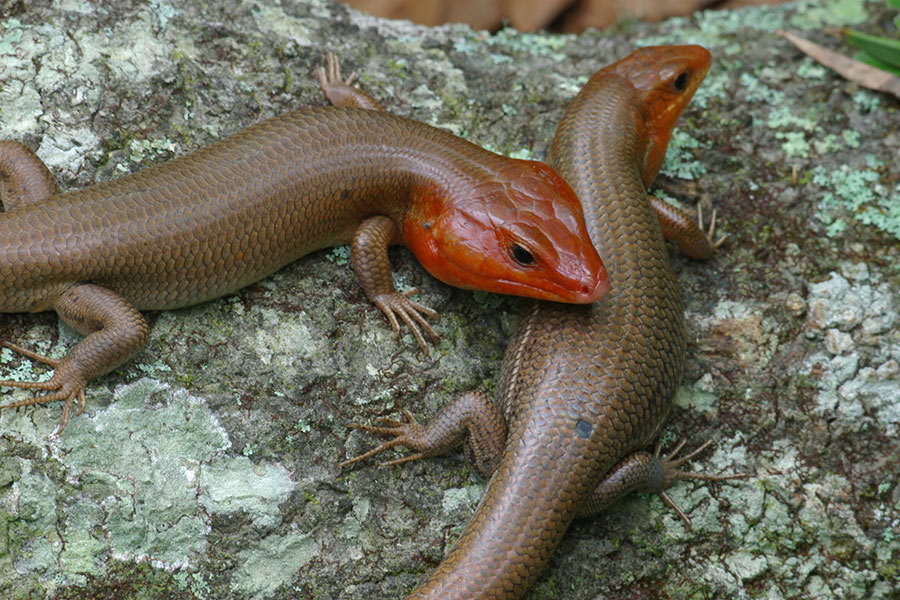
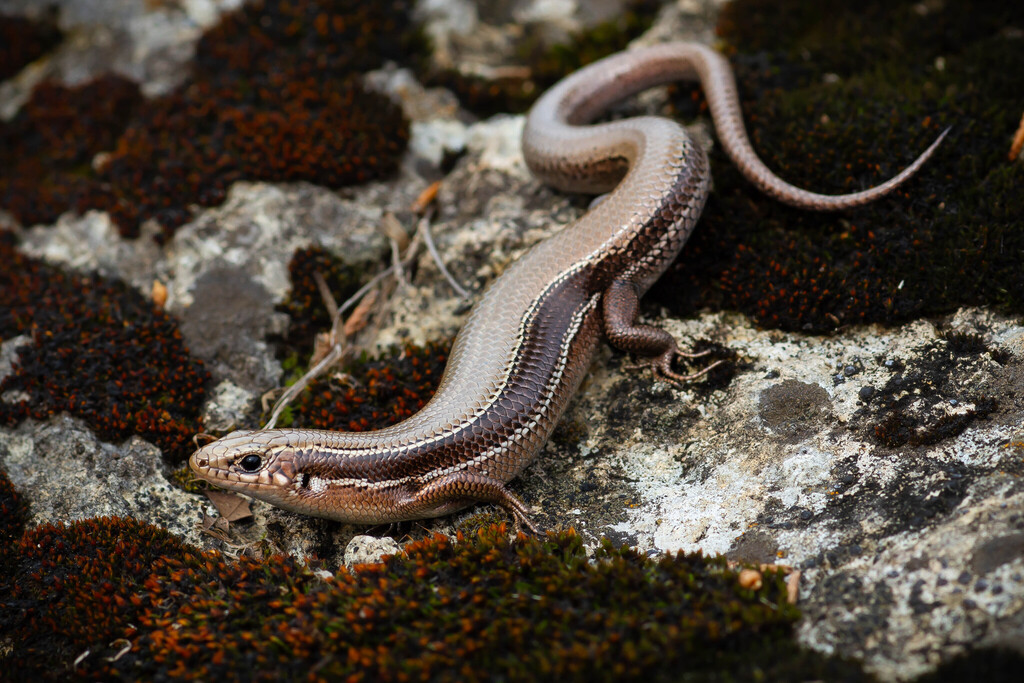
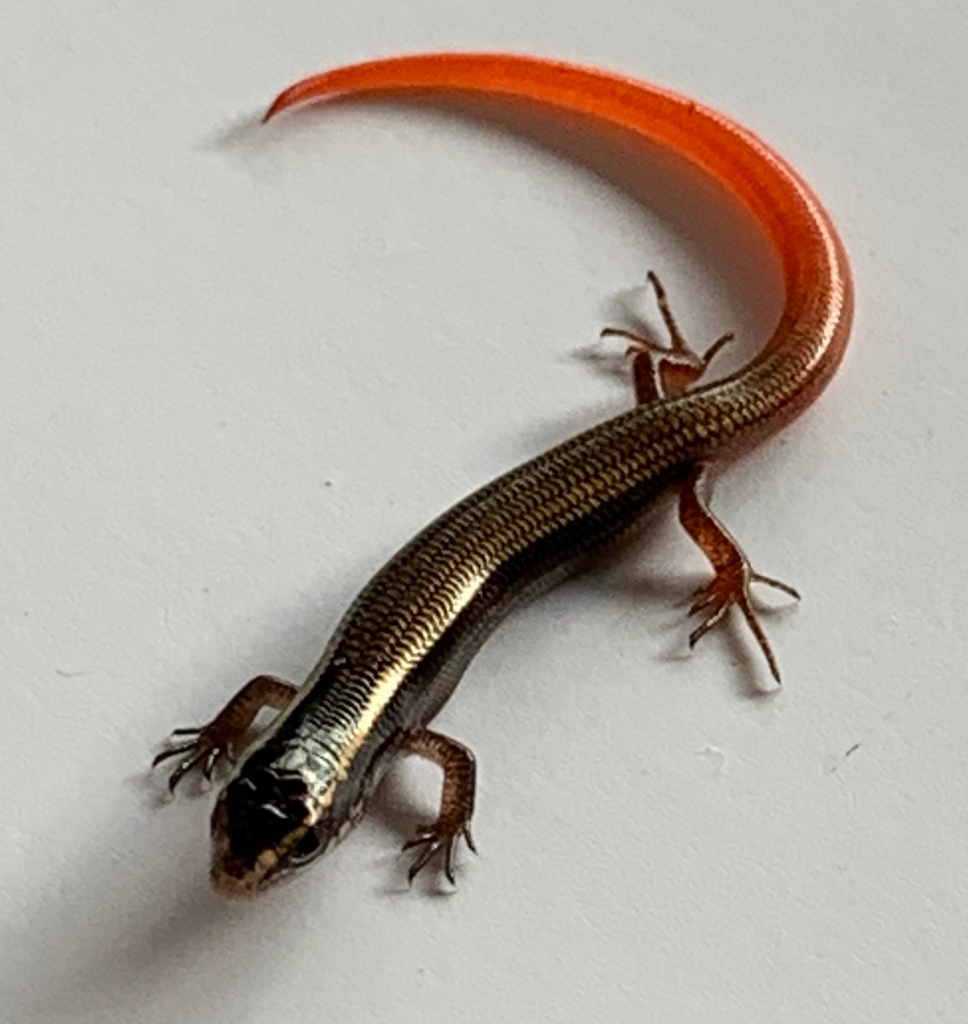
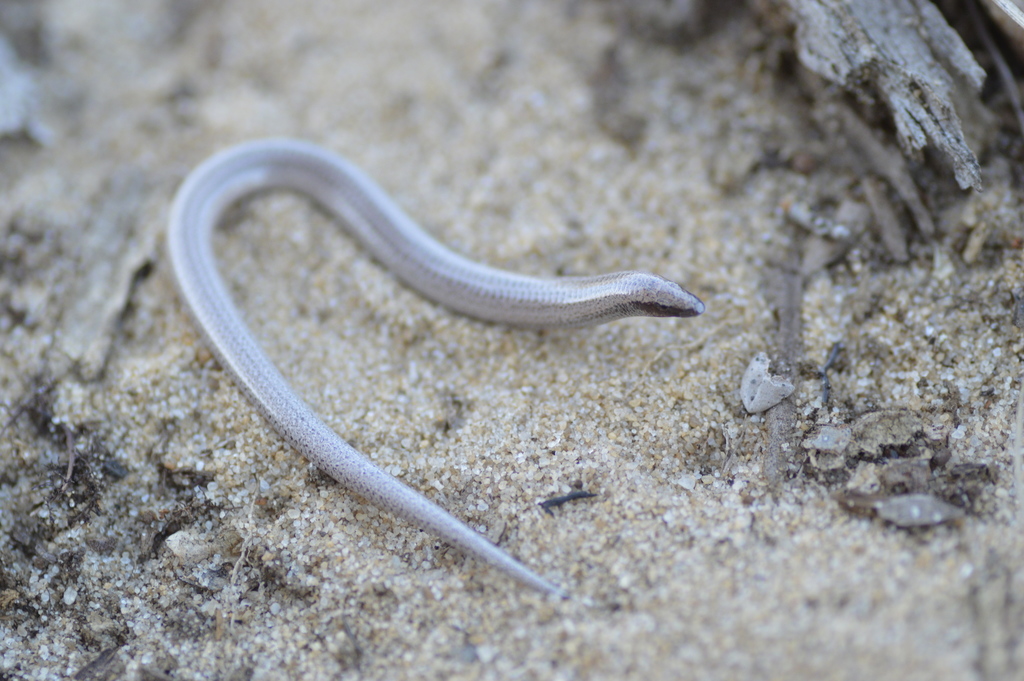
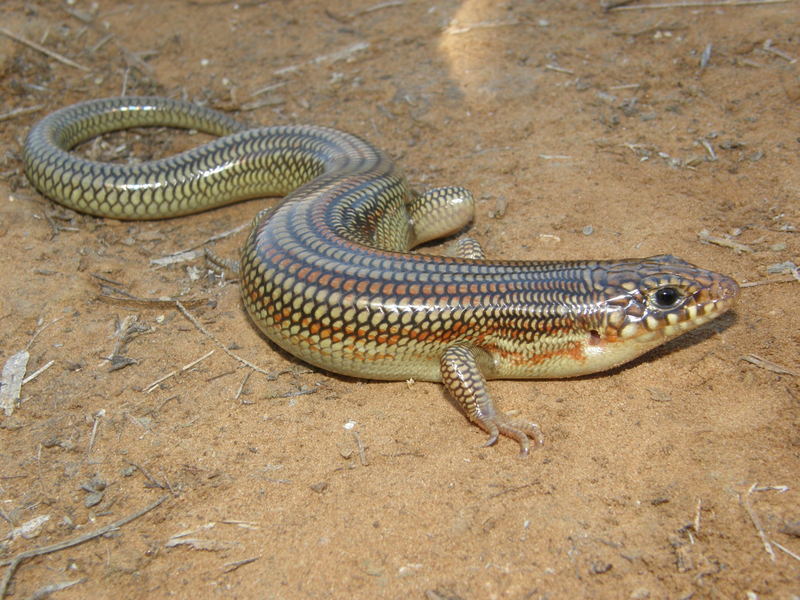
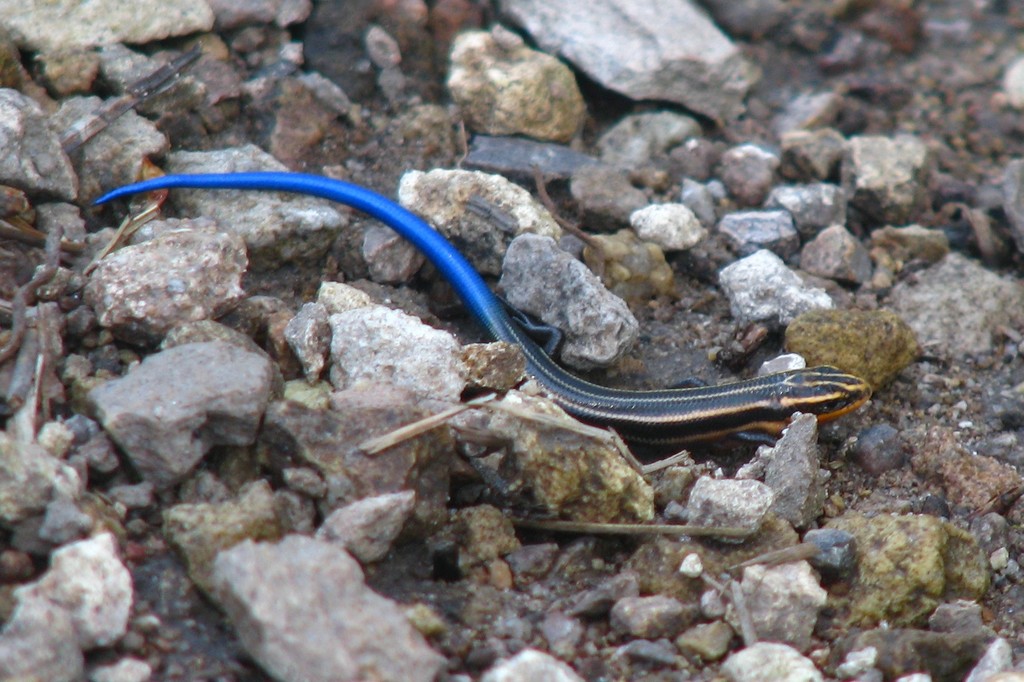
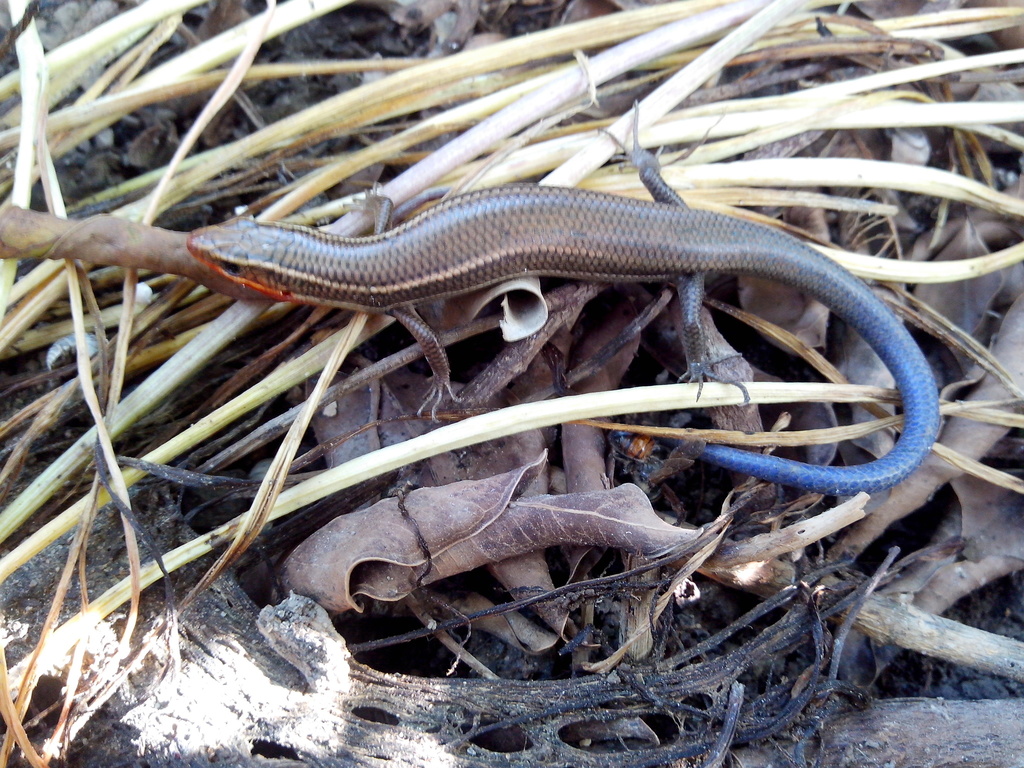
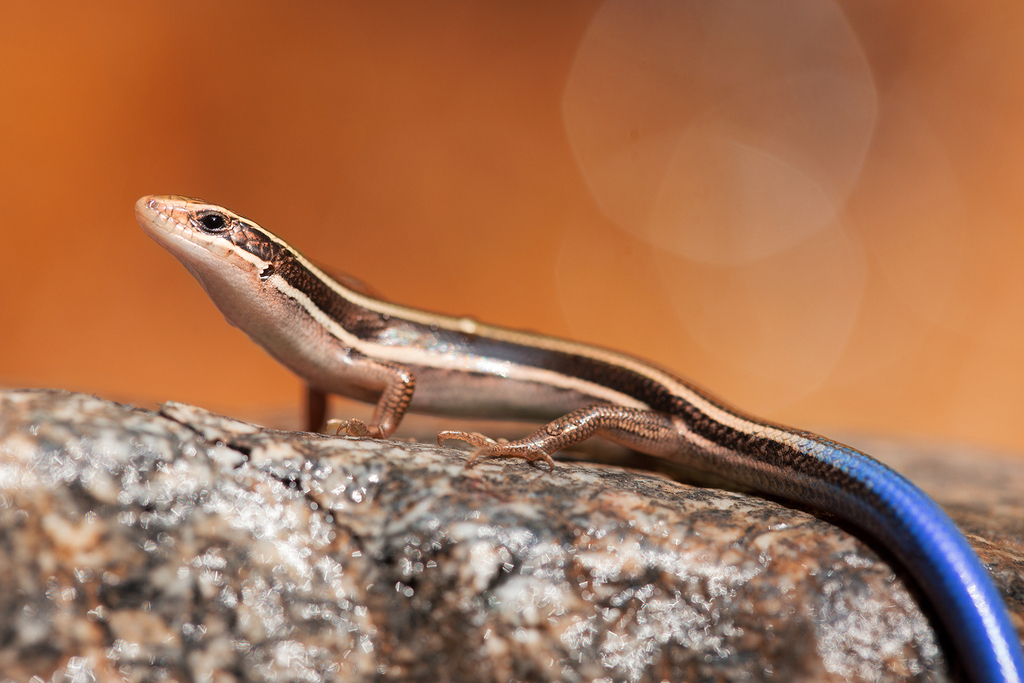
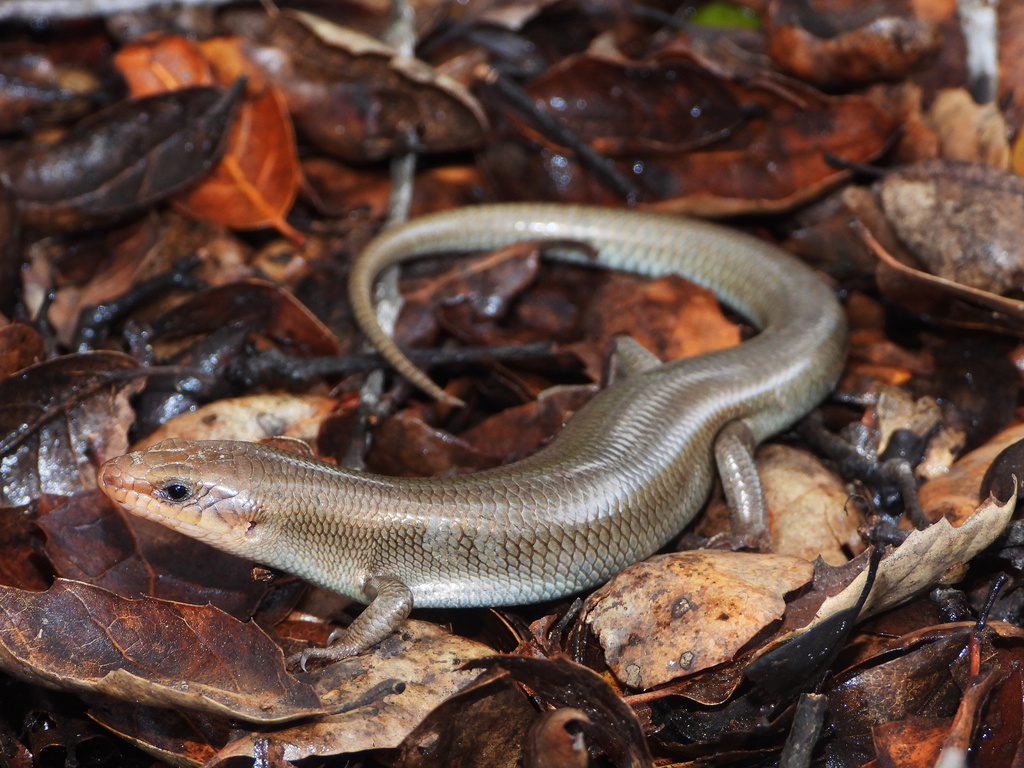
Juveniles of the eastern species (Five-lined, Southeastern Five-lined, Broad-headed, Coal) are nearly identical — dark with five cream stripes and a vivid blue tail. As adults: Broad-headed is the largest (up to 13") with a massive orange head in breeding males; Five-lined and Southeastern Five-lined retain faint stripes and are told apart by scale counts (7 vs. 4 upper labials between the postlabial and the eye); Coal Skink lacks a mid-dorsal stripe and has a broader dark lateral band. Western species differ by region: Great Plains Skink is large with irregular scales; Many-lined Skink has numerous narrow stripes; Western Skink has a blue tail into adulthood; Gilbert's Skink is the large western species. Mole Skink is small and slender with a pink or red tail. Florida Sand Skink is nearly legless with tiny limbs — unmistakable.

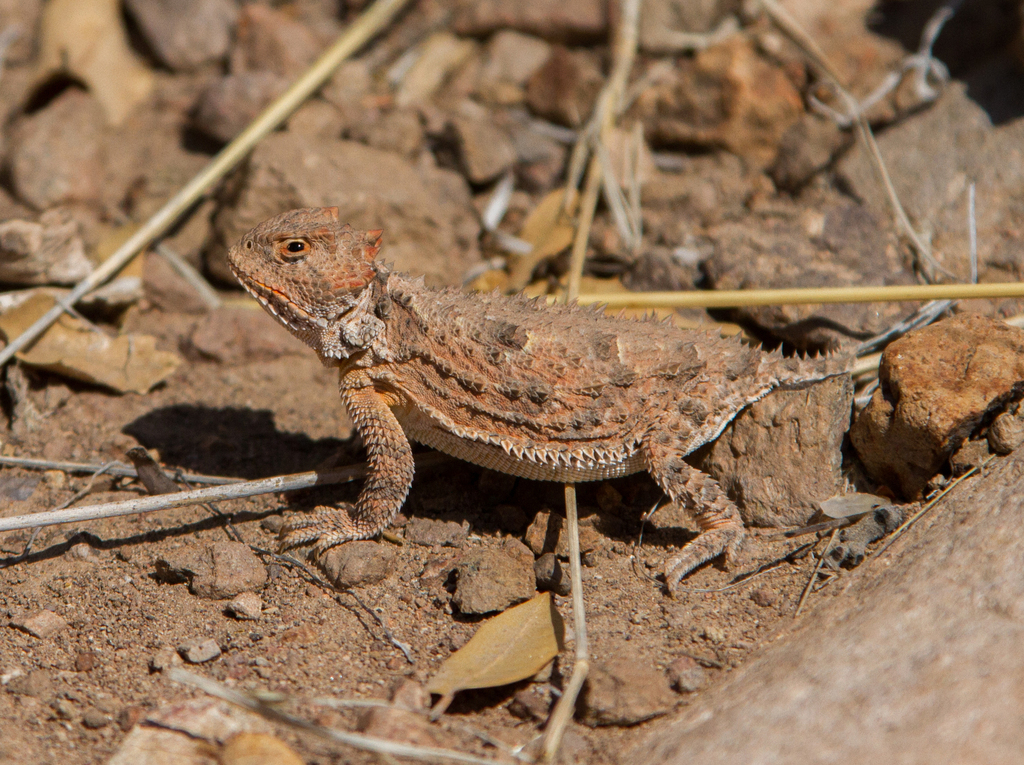
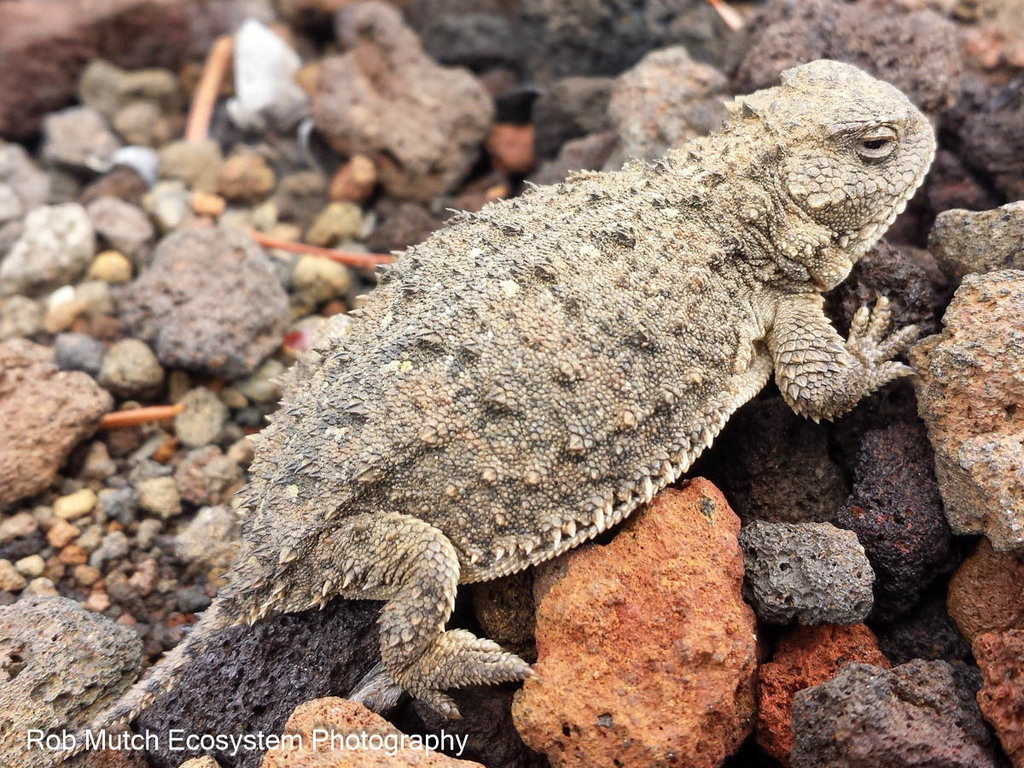
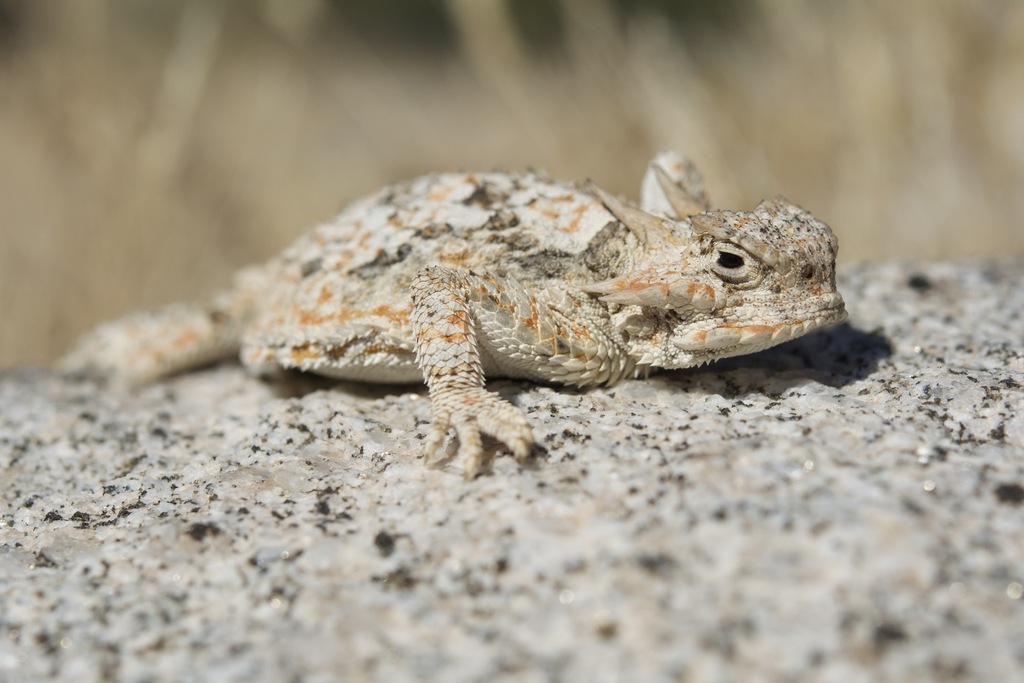
Horned Lizards (Phrynosoma)
LizardsKey mark: horn arrangement and body shape
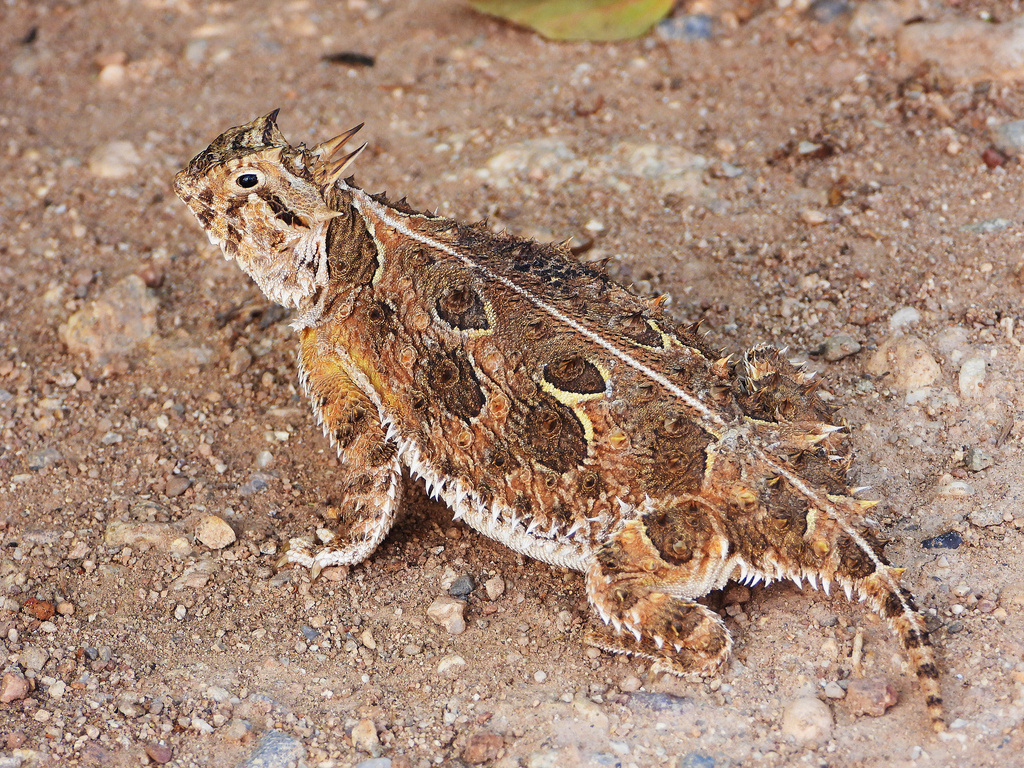
Horned lizards (often called horny toads) are flat-bodied, spiny lizards with a crown of true horns on the head. Texas Horned Lizard: two large central horns much longer than the surrounding ones; red, brown, or gray; common in the south-central US. Greater Short-horned Lizard: all horns short and roughly equal in length; mountain grasslands and high desert. Pygmy Short-horned Lizard: similar to Greater but smaller; more northern distribution. Desert Horned Lizard: two large central horns plus well-developed side fringe of scales; Great Basin and Mojave.
Anoles
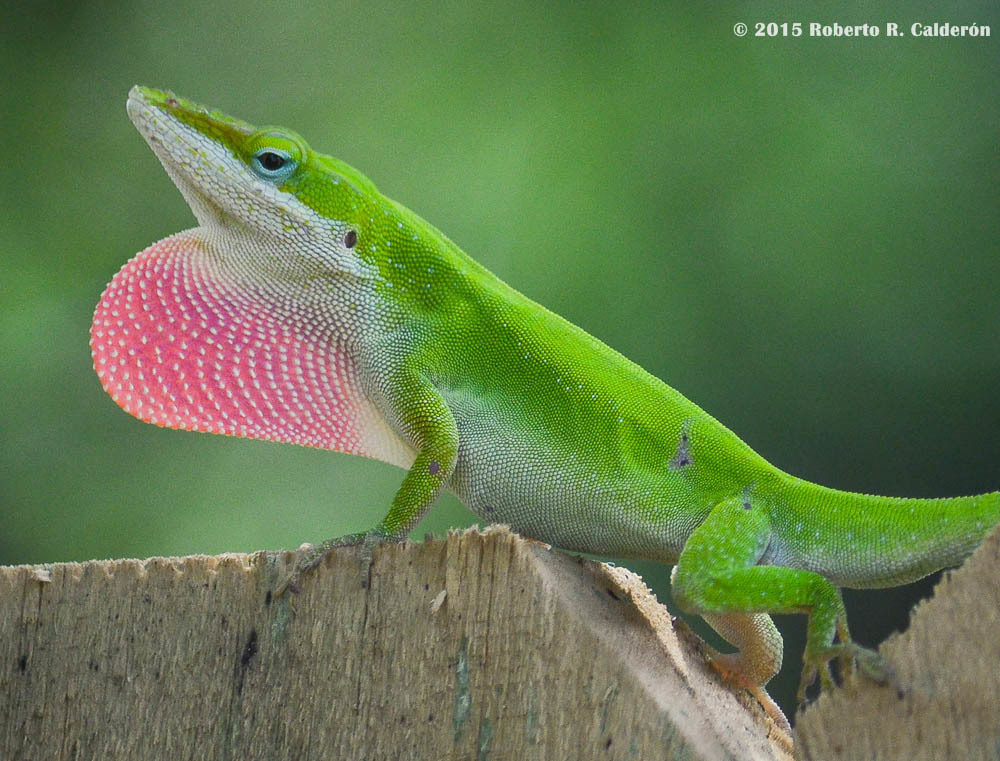
LizardsKey mark: dewlap color and toe pads
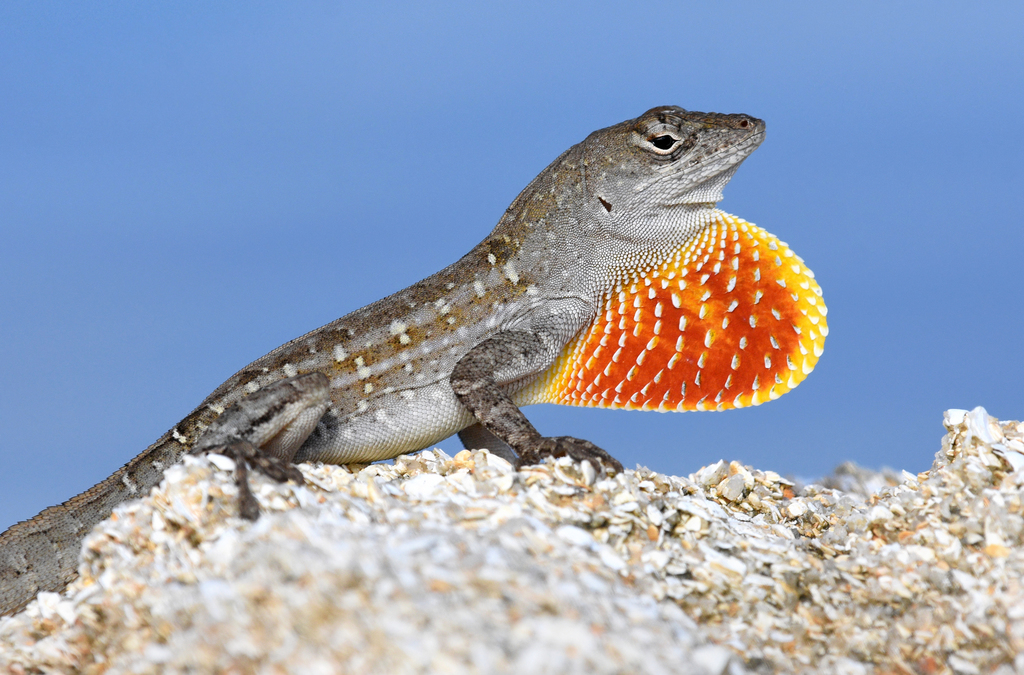
Green Anole is the only anole native to the US mainland; Brown Anole is an invasive species from Cuba now established across the Southeast. Both can change color — Green Anoles turn brown when cold or stressed, which is the most common source of confusion. Key marks: Green Anole has a pink dewlap (throat fan), a pointed snout, and slender build; it is arboreal and prefers shrubs and trees. Brown Anole has an orange dewlap with white edges, a stockier build, and tends to stay low on the ground, walls, and shrubs. Where they co-occur in Florida, Brown Anole has largely displaced Green Anole from lower perches.
Fence Lizards (Sceloporus)
LizardsKey mark: blue belly patches and scale texture
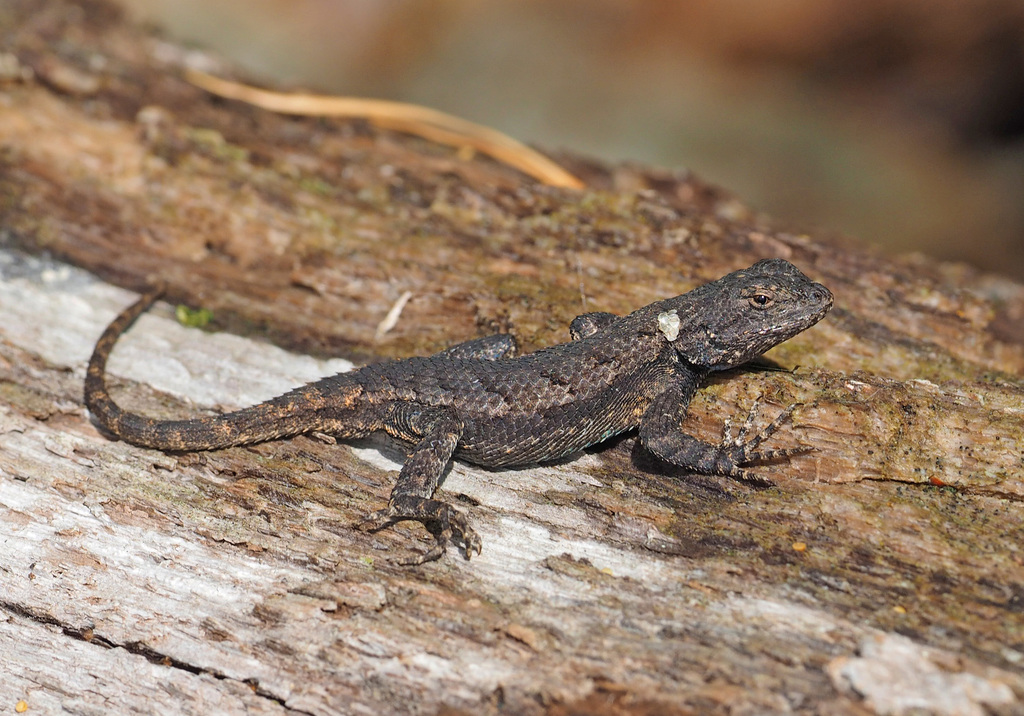
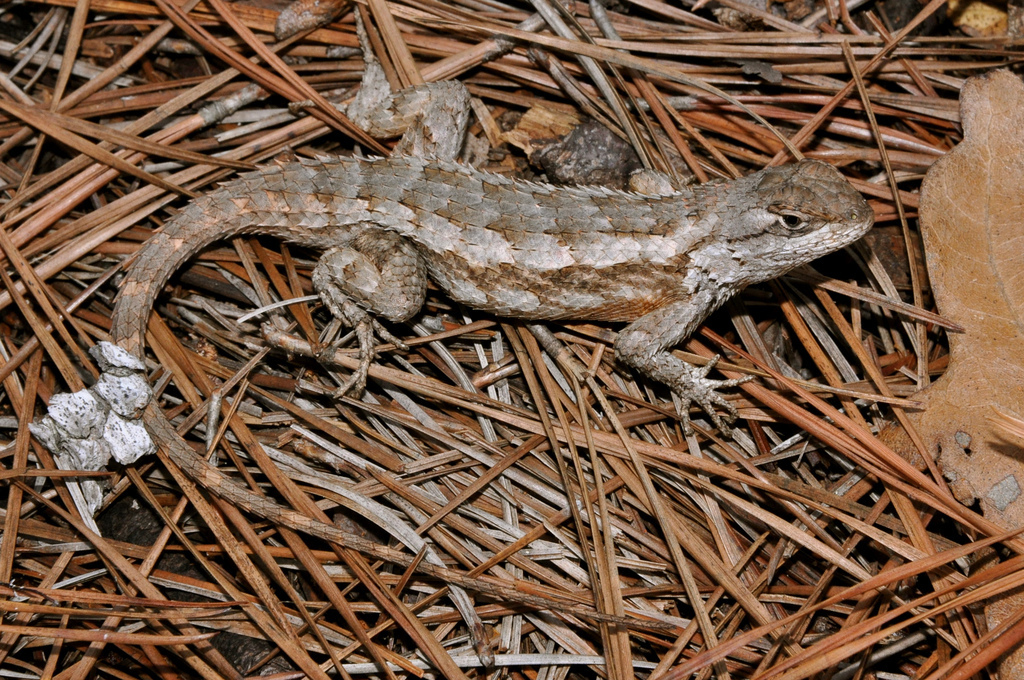
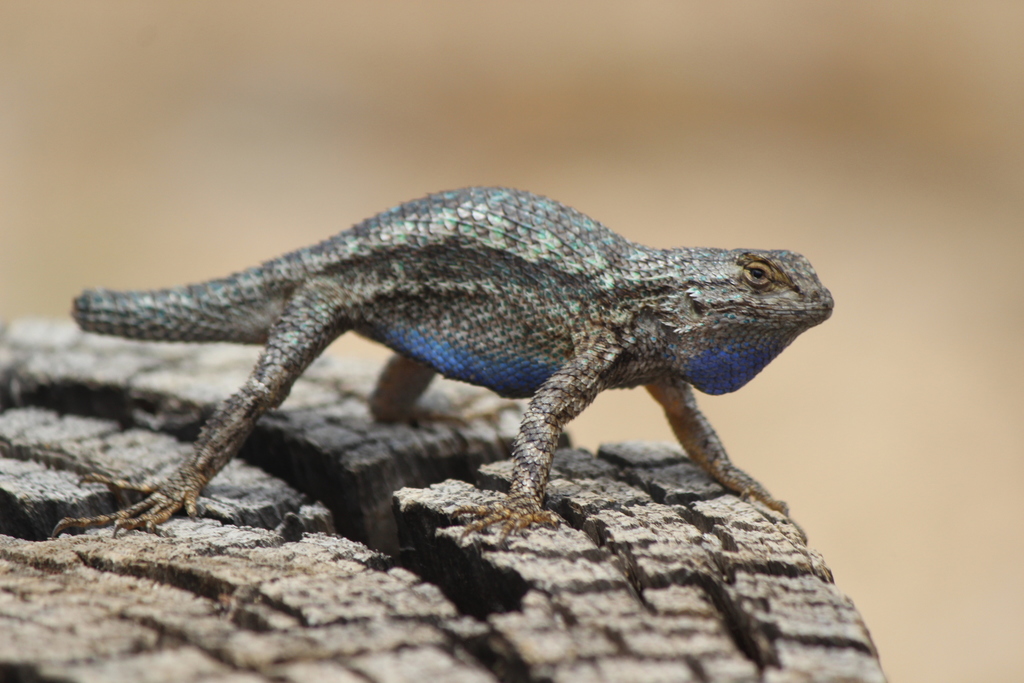
Fence lizards are keeled-scaled, fast-moving lizards that bask prominently on rocks, fences, and tree trunks. Males of most species have blue belly patches used in territorial displays. Eastern Fence Lizard: brown to gray, chevron back pattern, eastern US. Prairie Lizard: very similar to Eastern but often smaller with more distinct striping; south-central US. Western Fence Lizard (Blue-belly): bright blue belly and throat in males; Pacific states and Great Basin. Florida Scrub Lizard: restricted to Florida scrub habitat; pointed head.
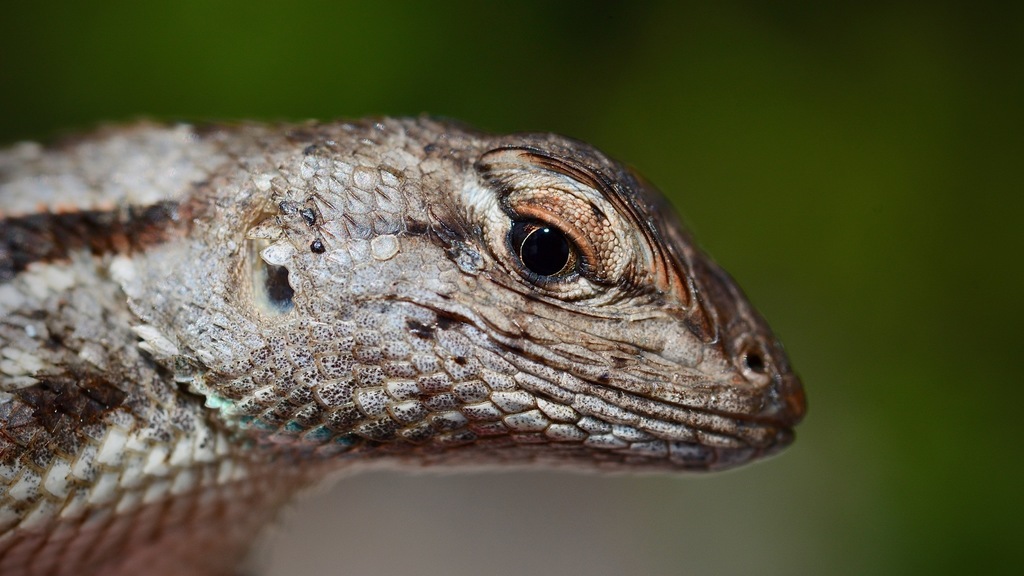
Alligator Lizards (Elgaria)
LizardsKey mark: lateral fold and coloration
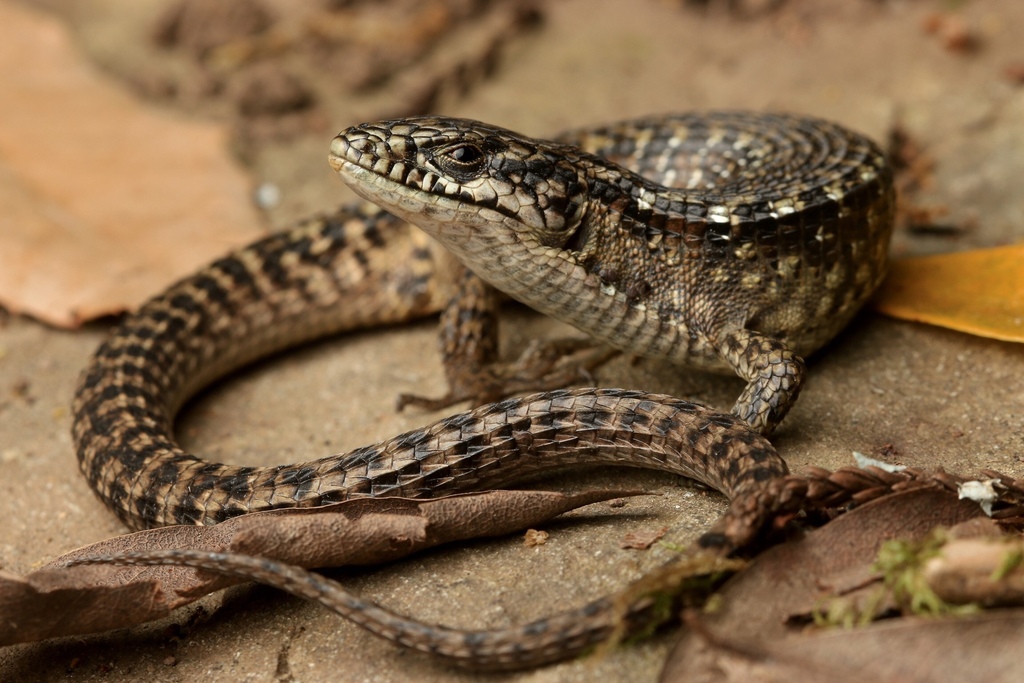
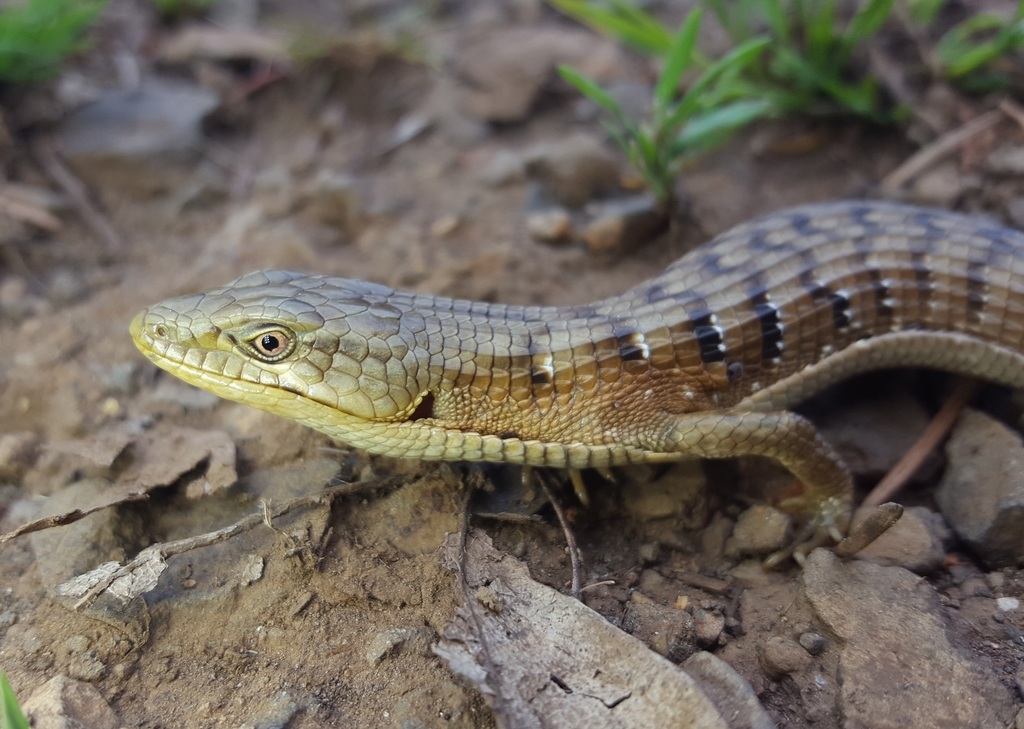
Alligator lizards are named for their heavily keeled, overlapping scales that look like alligator armor. Both western species are long-bodied with short legs and a lateral fold (groove) of granular scales along the side. Northern Alligator Lizard: found along the Pacific coast and into the Cascades/Sierra Nevada; brown with irregular banding; eye is often yellow. Southern Alligator Lizard: found in coastal California; often has reddish or brown striping; eye is typically yellow with a dark stripe through the pupil. Both are found under debris, rocks, and in dense vegetation.
Glass Lizards (Ophisaurus)
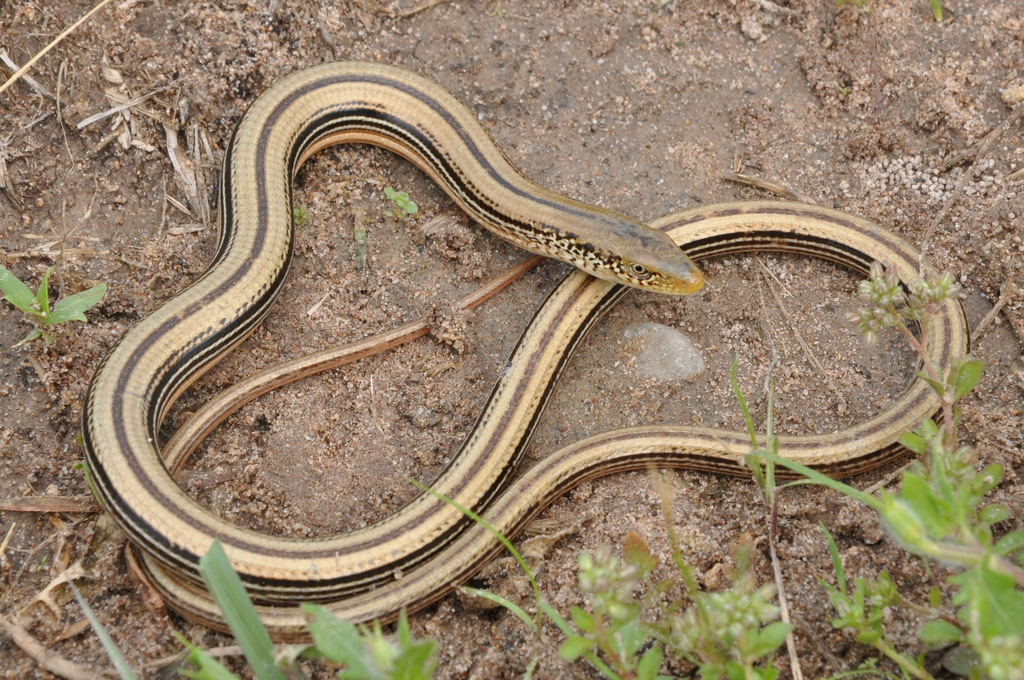
LizardsKey mark: lateral groove and tail fragility
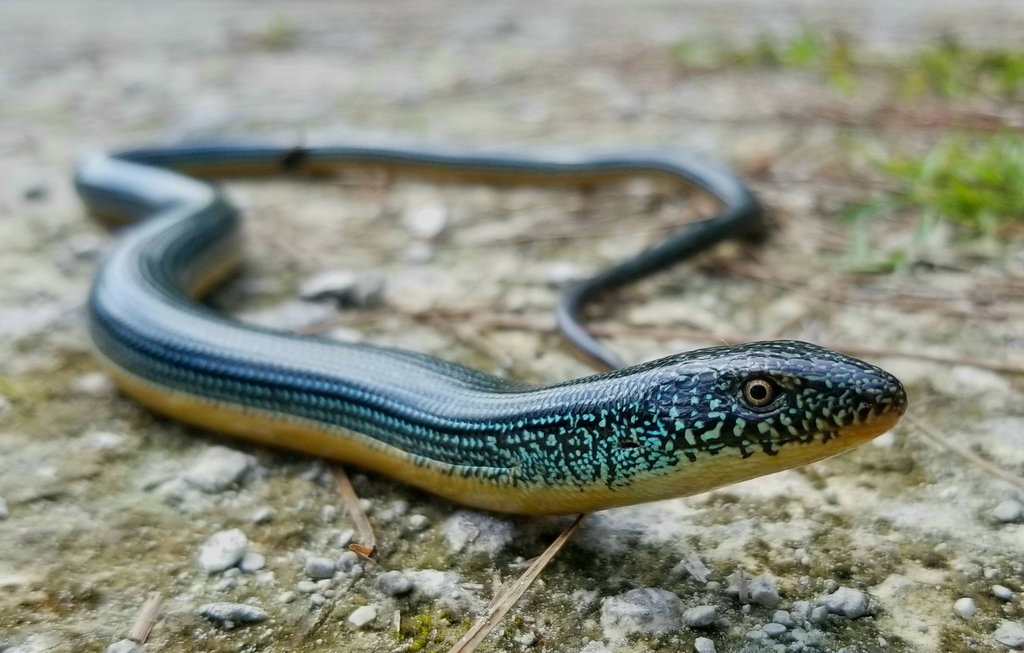
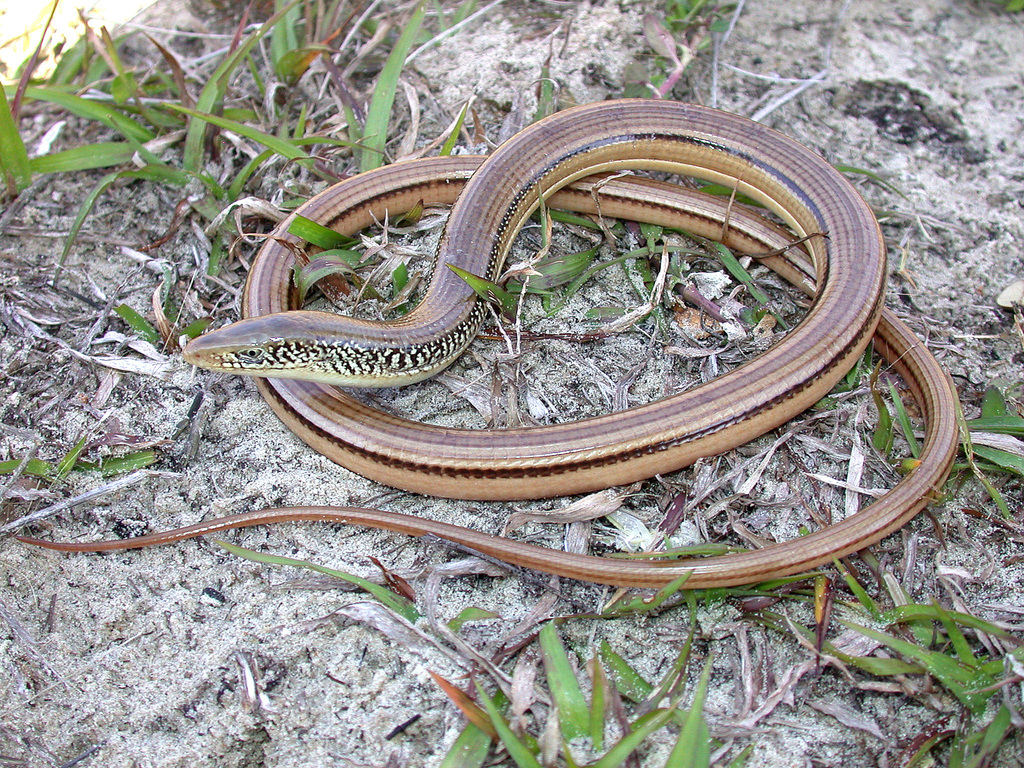
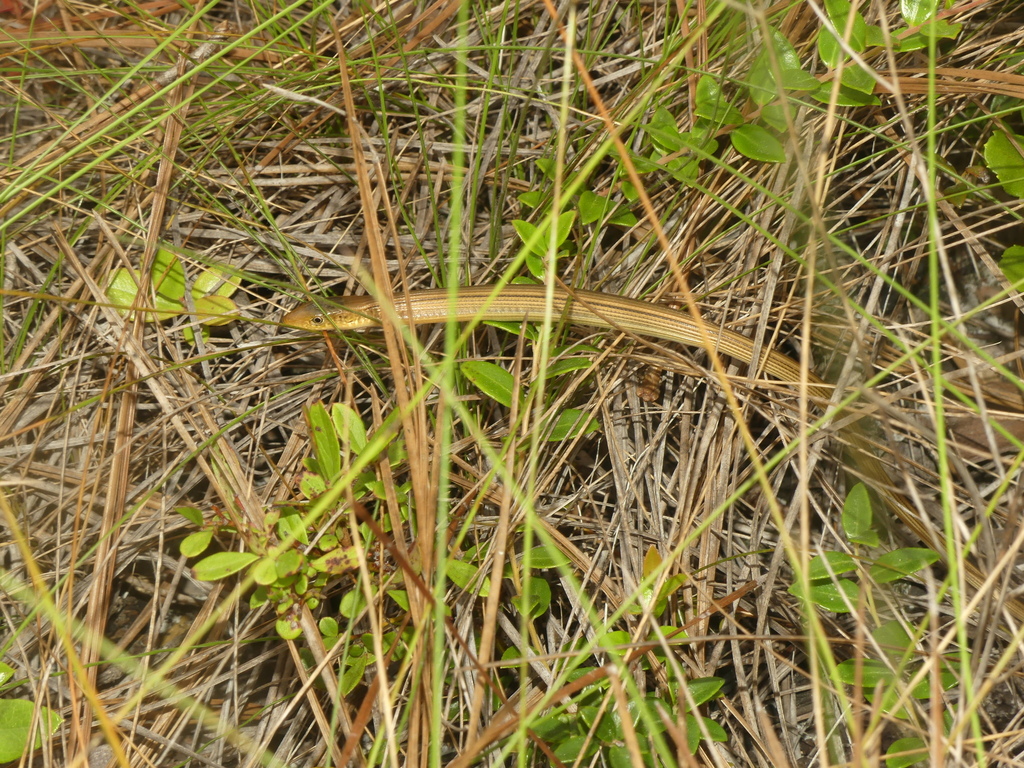
Glass lizards are legless lizards frequently mistaken for snakes. The key to separating them from snakes: glass lizards have visible ear openings, moveable eyelids, and a deep lateral groove (a fold of skin) running the length of the body. The tail (which can exceed 2/3 of total length) breaks off easily — most adults have a regenerated tail. Eastern Glass Lizard: no lateral stripes below the groove, found in moist habitats. Slender Glass Lizard: dark stripes below the lateral groove; drier upland habitats; most widespread species. Island and Mimic Glass Lizards are more restricted to the coastal Southeast.
Whiptails (Aspidoscelis)
LizardsKey mark: stripe count and granular dorsal scales
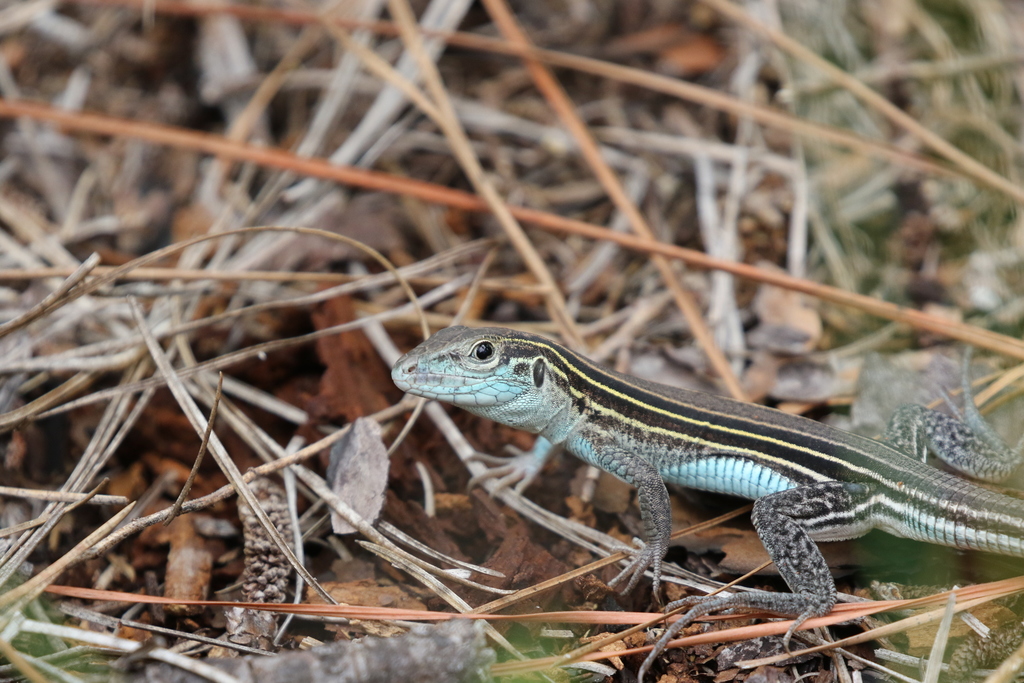
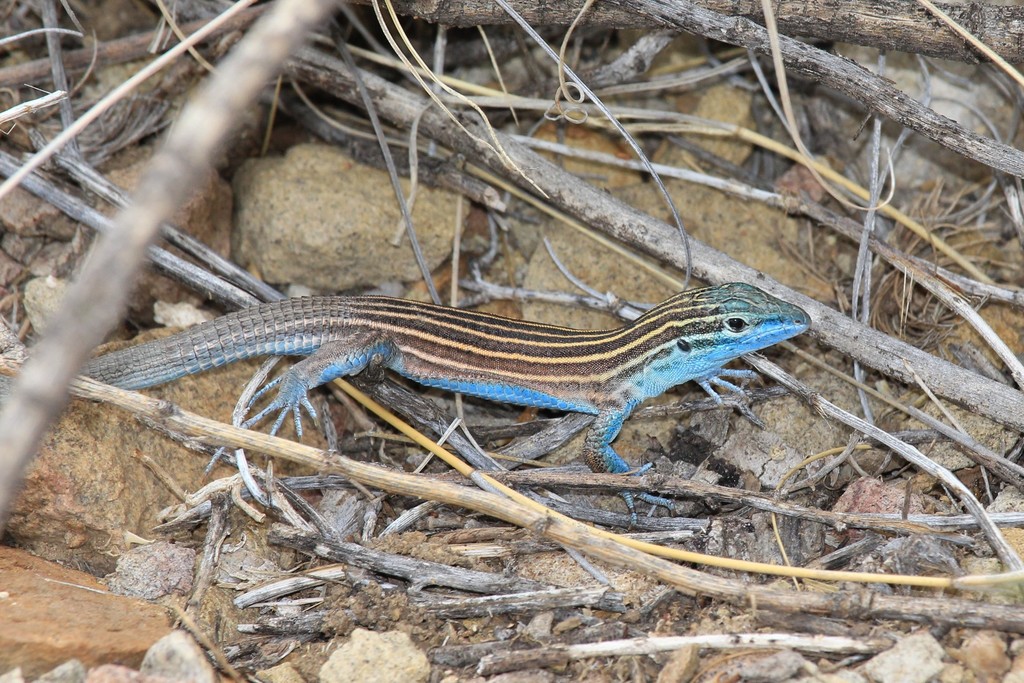
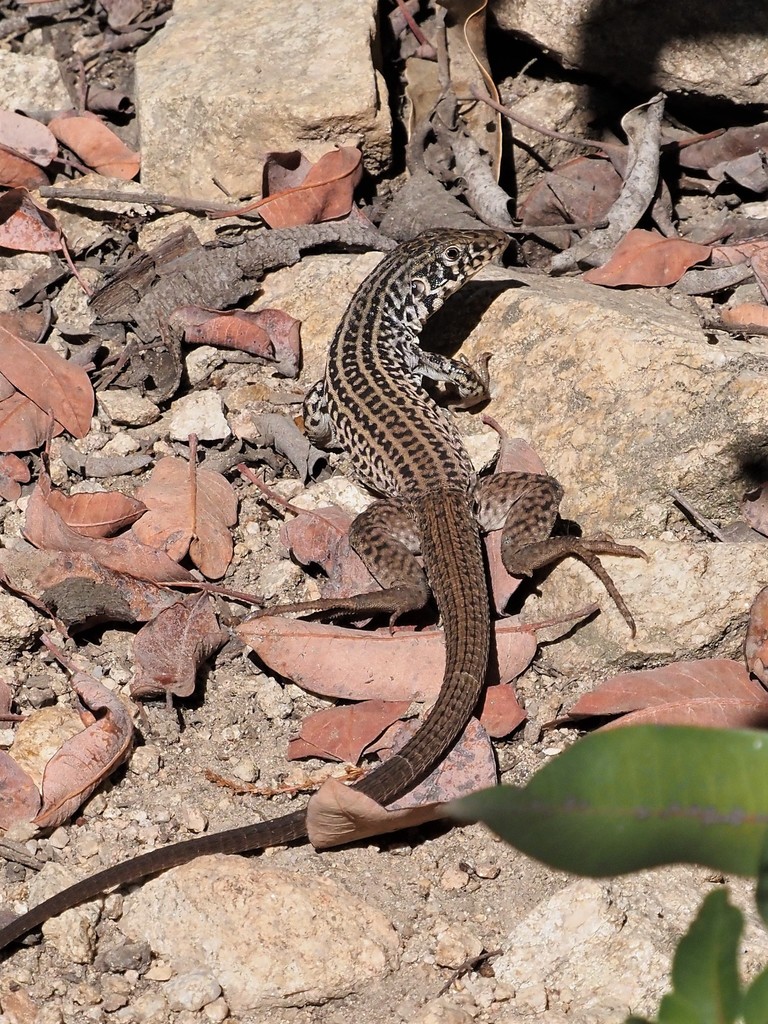
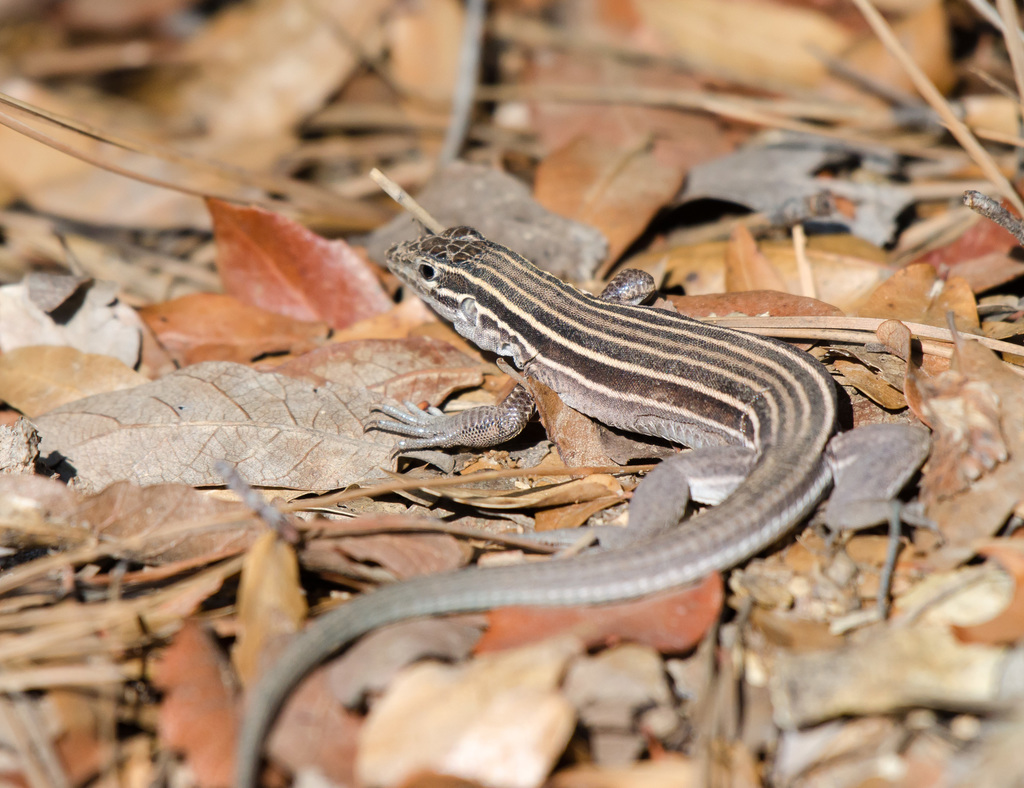
Whiptails are slender, fast lizards with very long tails, granular (not keeled) dorsal scales, and a characteristic foraging behavior of constantly flicking the tongue and digging in leaf litter. Many species are all-female (parthenogenetic) and nearly identical to each other — stripe count and pattern are the main field marks. Six-lined Racerunner: 6-7 pale stripes on dark background; widespread in eastern and central US. Little Striped Whiptail: 7 stripes, blue tail; Desert Southwest. Western Whiptail: spots or broken stripes; patterned belly; Great Basin and West.
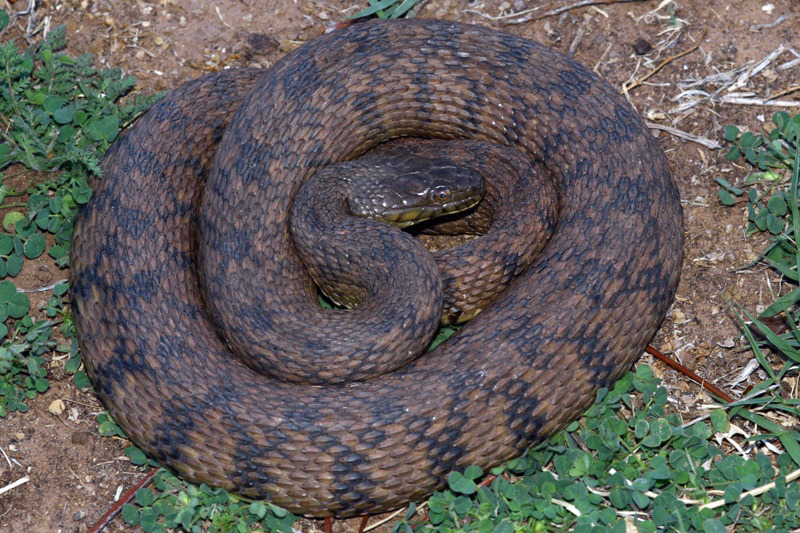
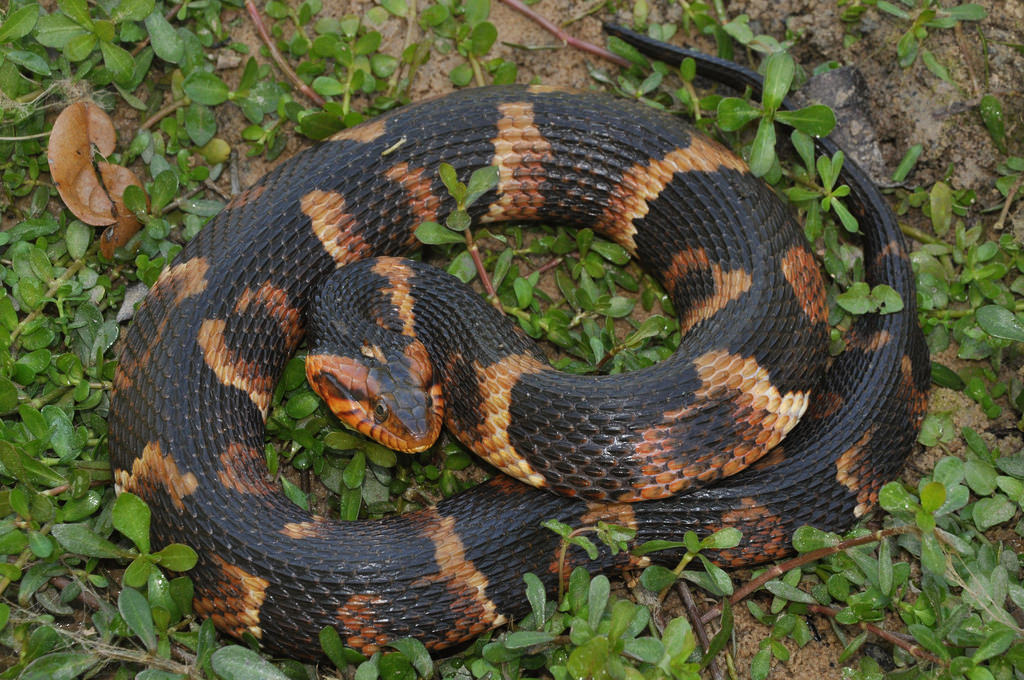
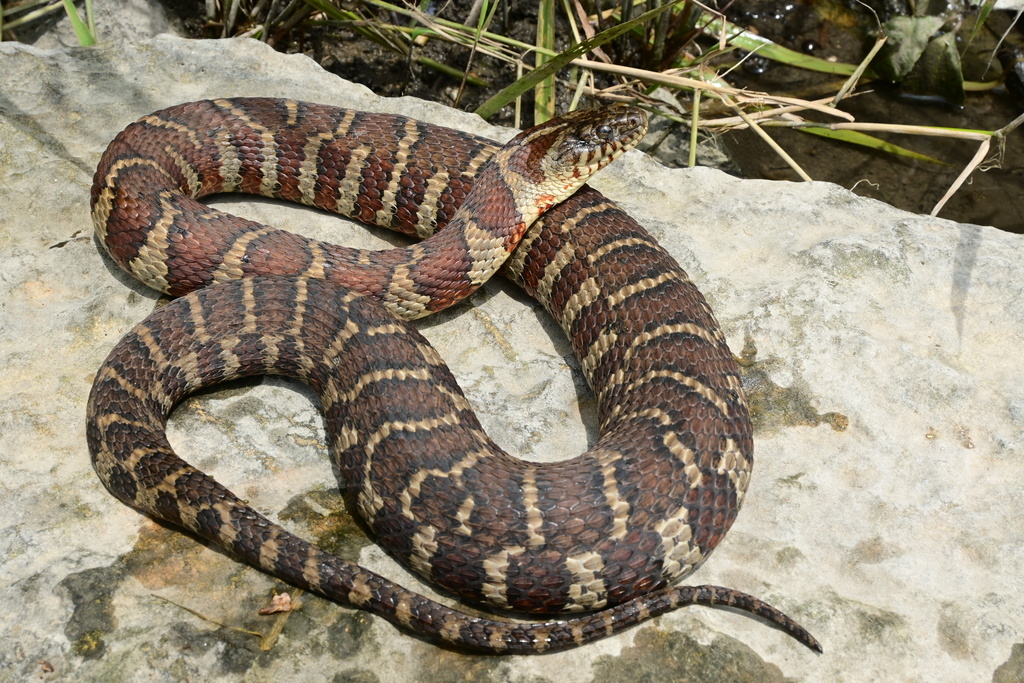
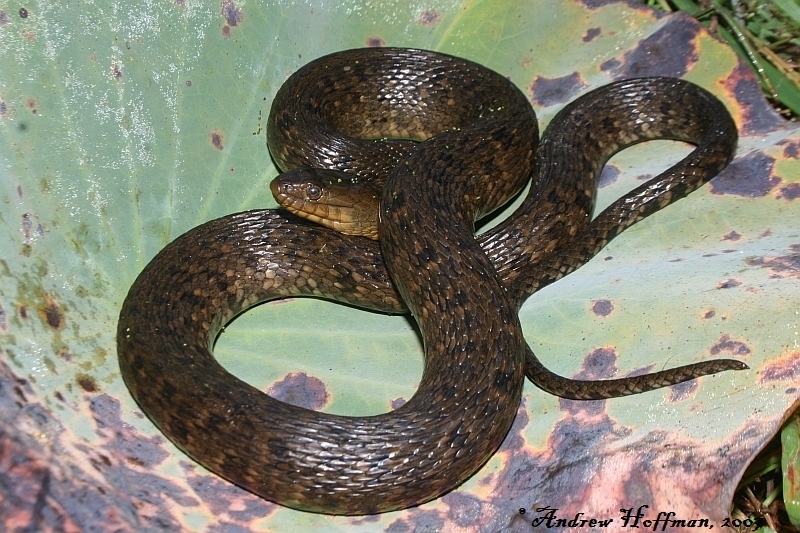
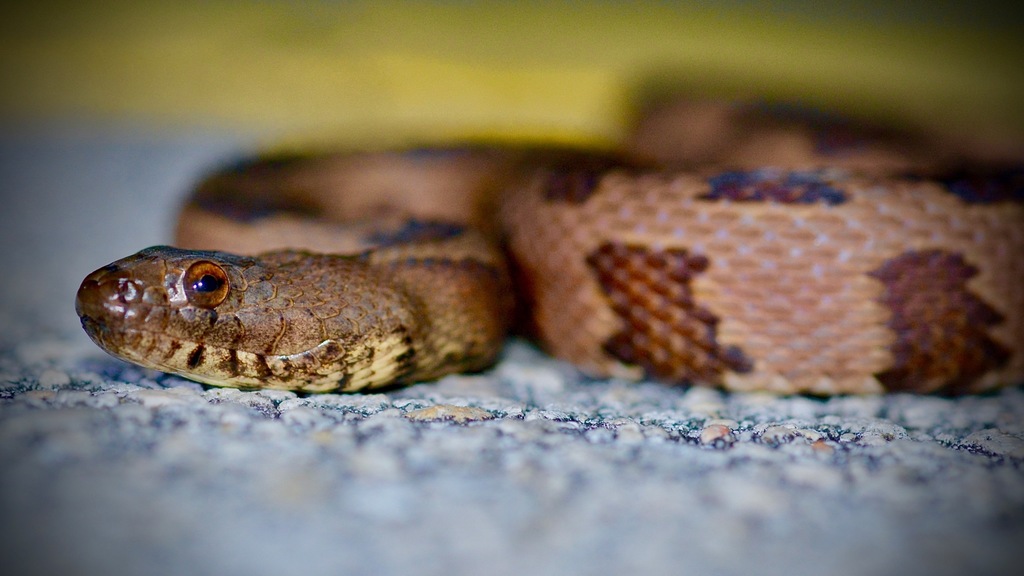
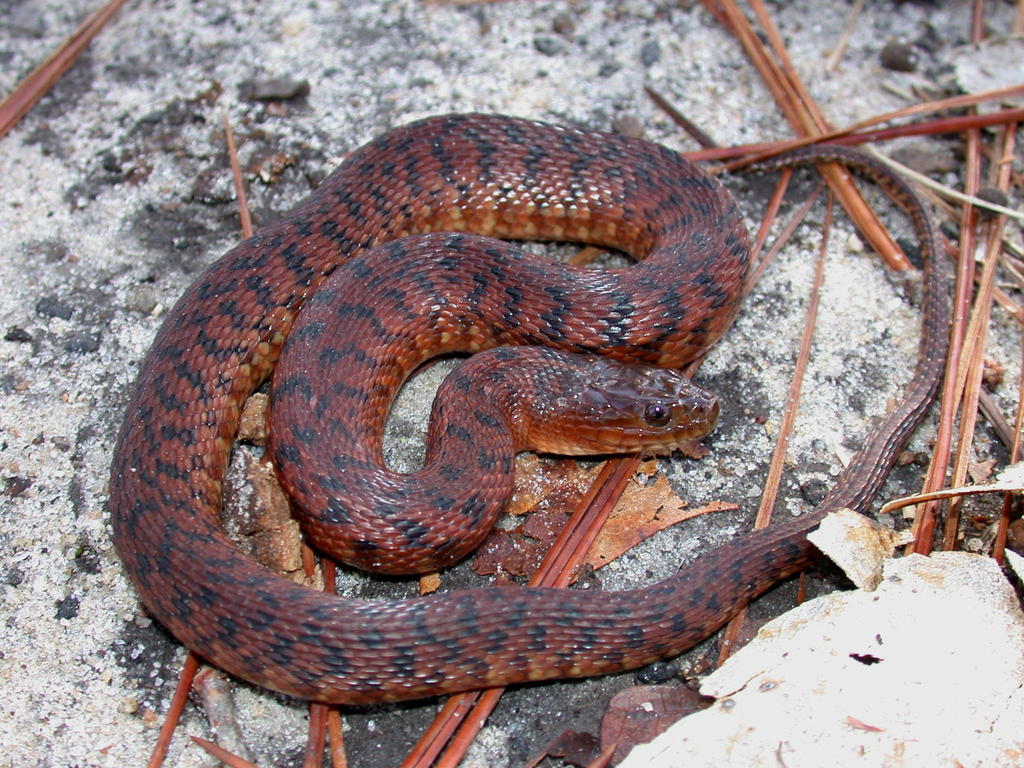
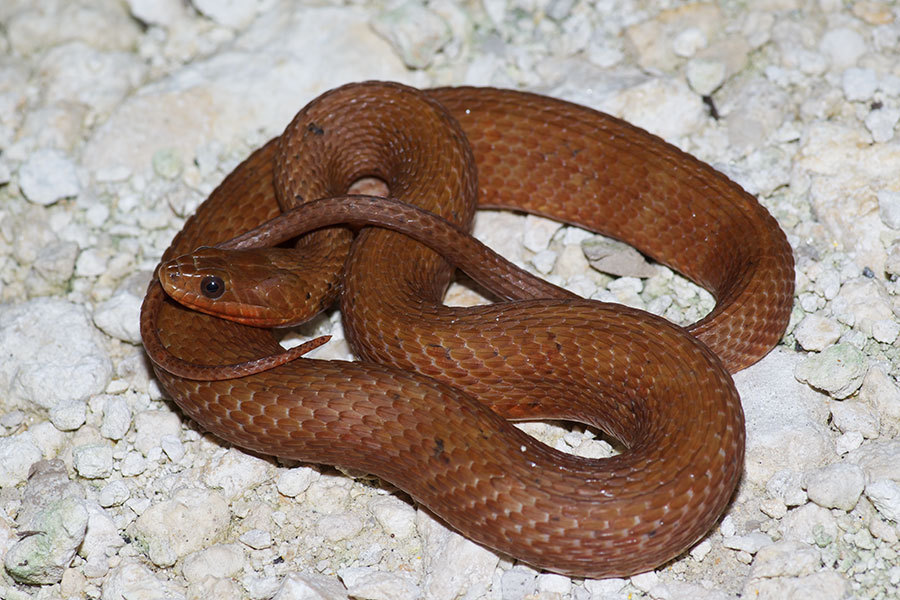
Watersnakes (Nerodia)
SnakesKey mark: belly pattern
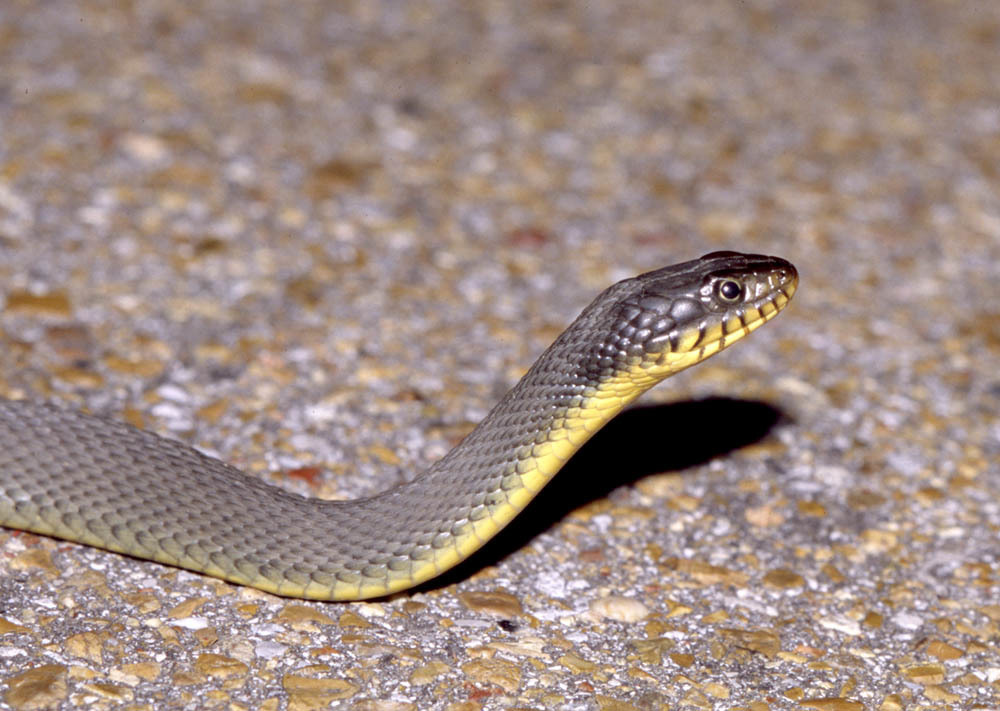
Flip it over — belly pattern is the fastest field mark for Nerodia. Plain-bellied: solid orange, red, or yellow, no markings. Diamondback: chain-link or half-moon dark marks on cream. Banded: dark crossbands that wrap strongly onto the belly, matching the dorsal pattern. Northern/Midland: dark squares or blotches on a lighter ground. Mississippi Green: row of dark half-moon spots along the belly margins. Florida Green: belly pale to white with minimal markings — even plainer than Plain-bellied. Brown Watersnake: bold alternating rectangular blotches on both sides of the belly. Salt Marsh: highly variable — plain, spotted, or striped by subspecies and location.
Kingsnakes & Milk Snakes (Lampropeltis)
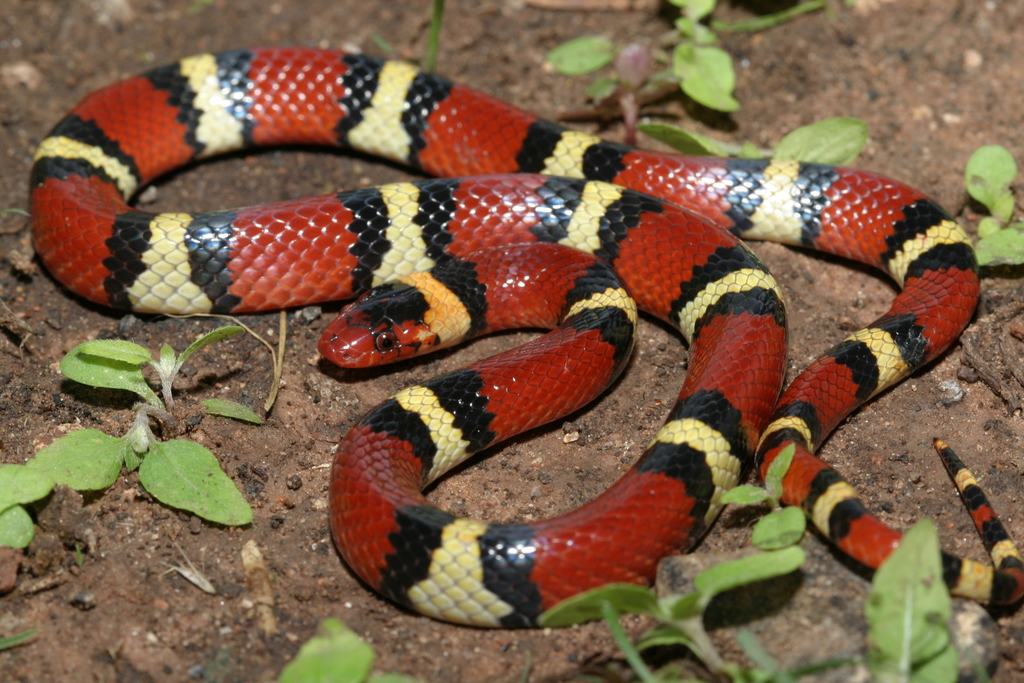
SnakesKey mark: band order and snout color
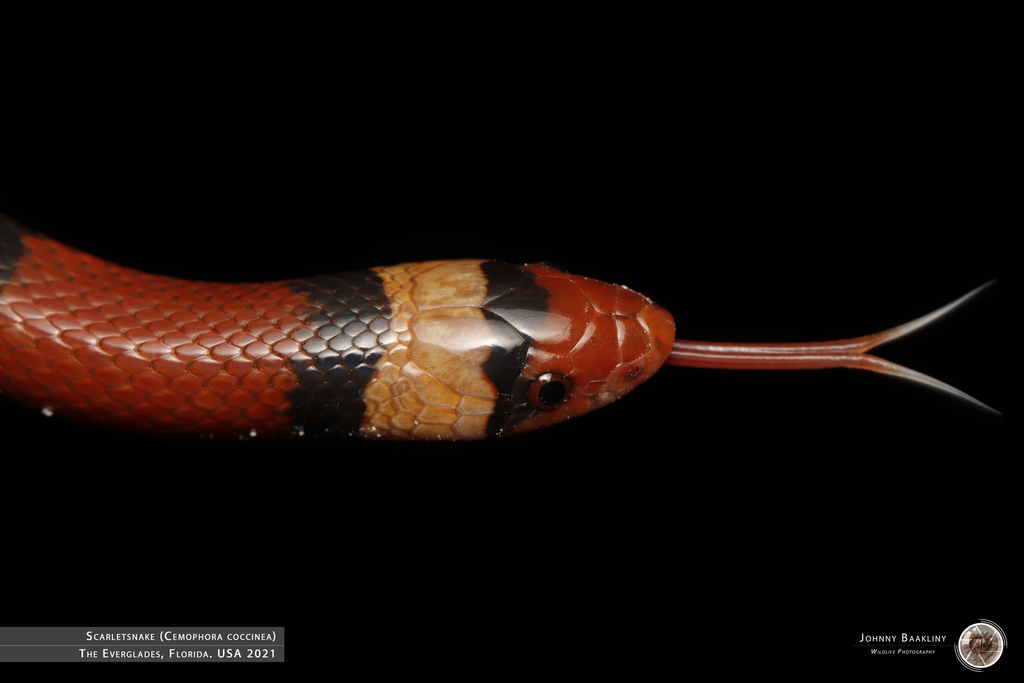
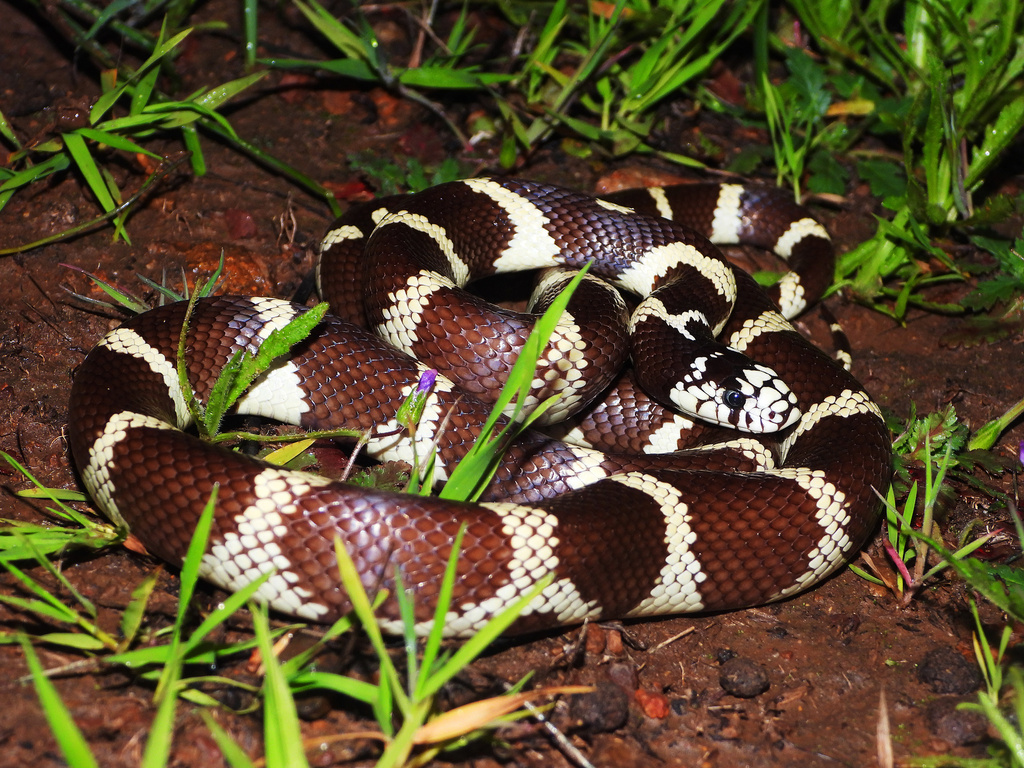
All have bold red, black, and white or yellow banding — but the arrangement differs. Scarlet Kingsnake: red snout, red-black-yellow bands (red touches yellow). Eastern Milk Snake: blotched in the North, banded in the South; light snout. Scarlet Snake (not a Lampropeltis): red snout, but belly is plain white — not banded through to the underside. Eastern Kingsnake: black with white or yellow chain-link crossbands — not a red-banded snake at all. Where coral snakes occur: red touches yellow = venomous; red touches black = harmless.
Rat Snakes (Pantherophis)
SnakesKey mark: blotch pattern and belly checkering
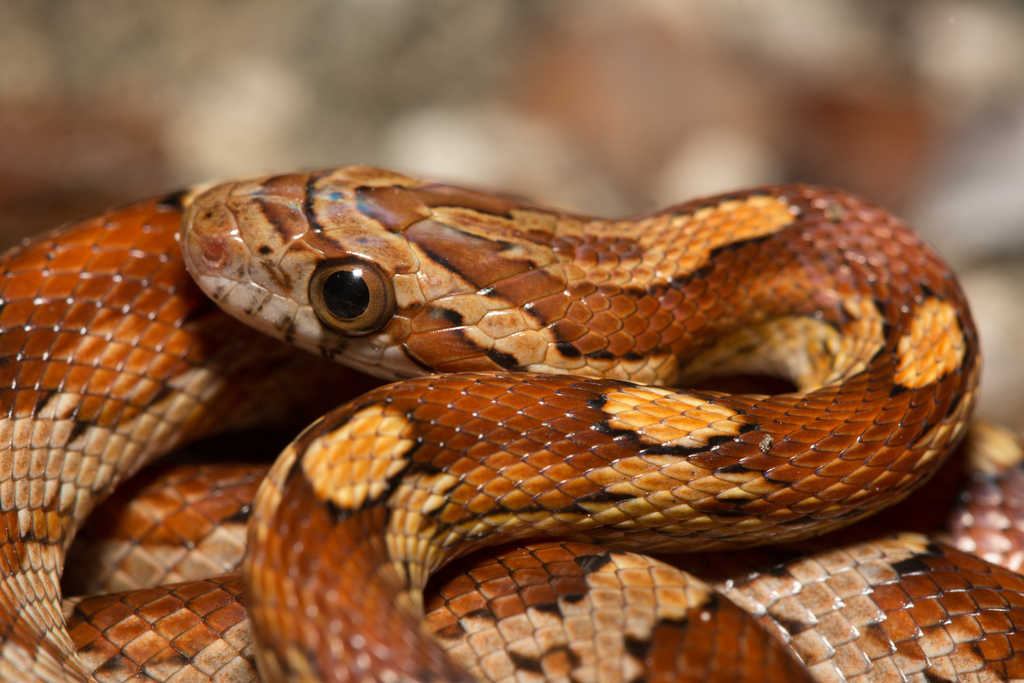
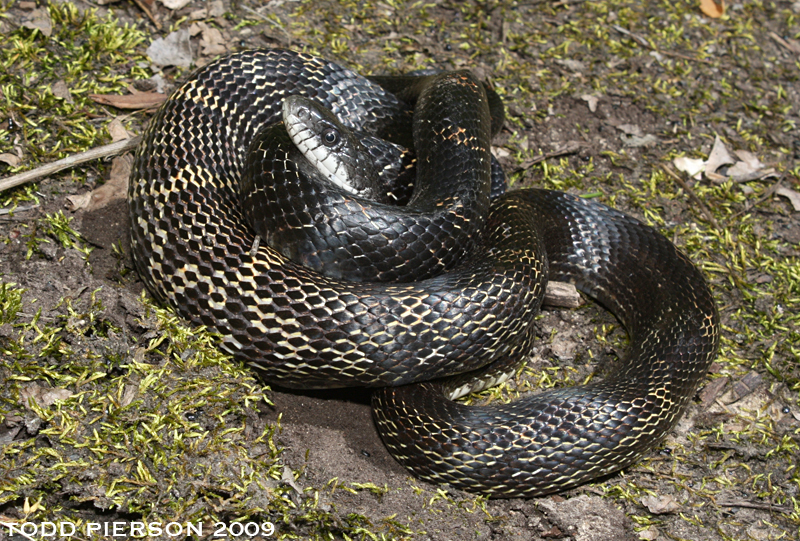
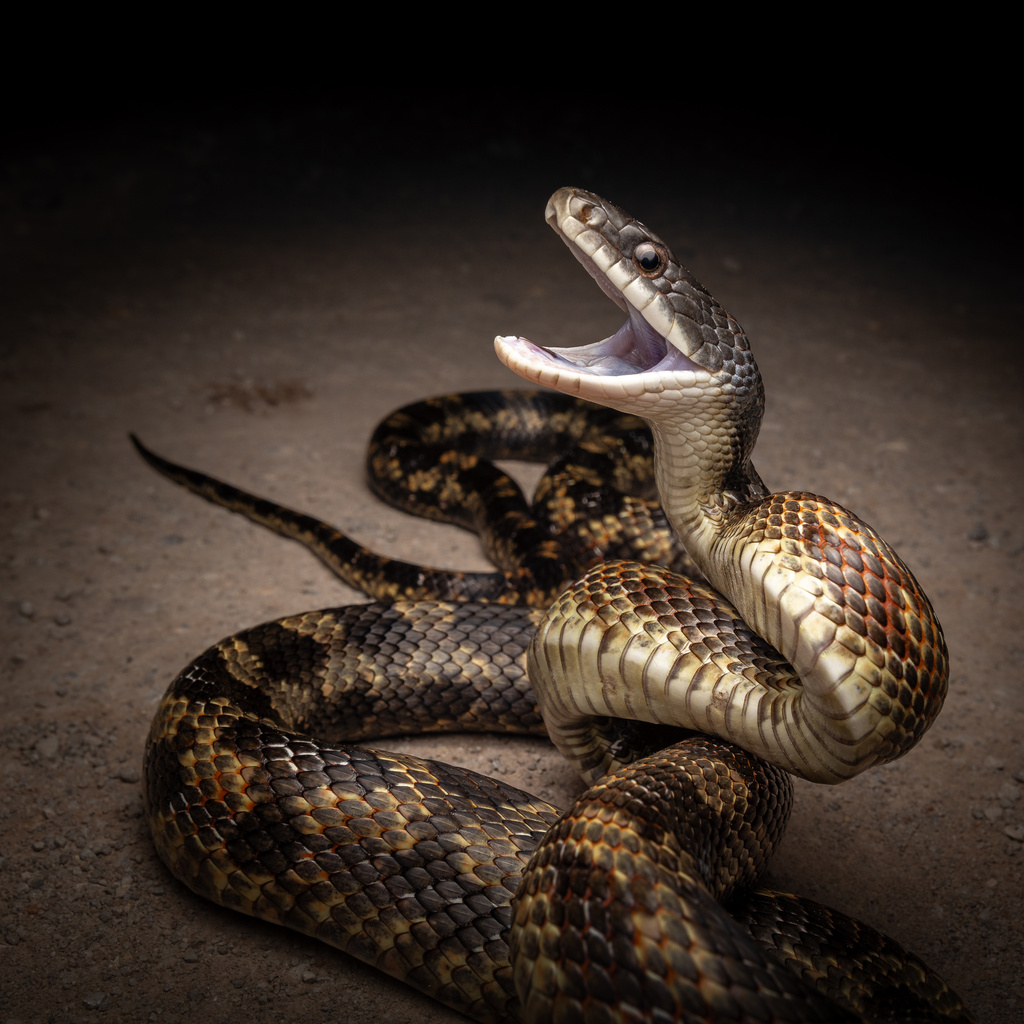
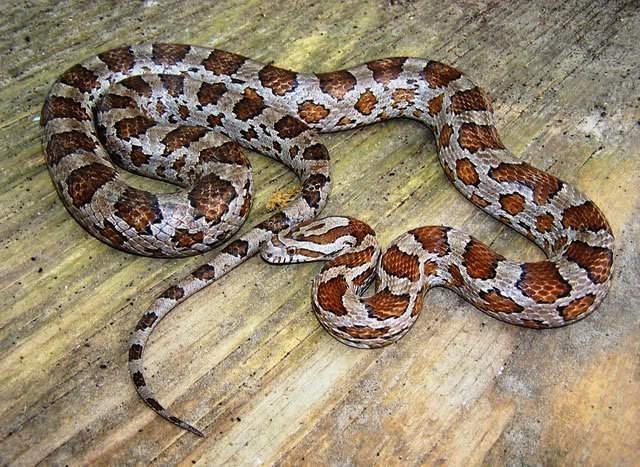
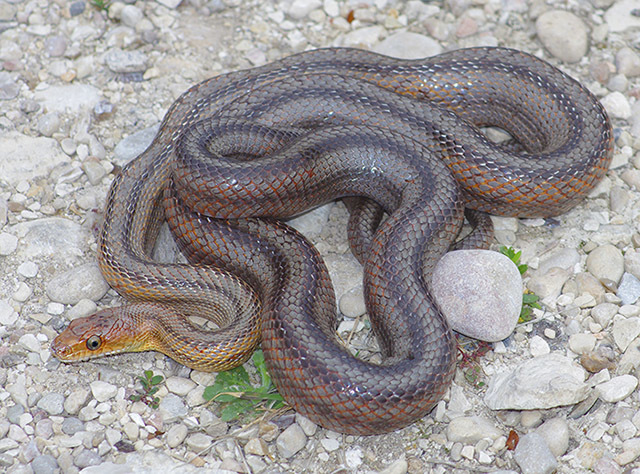
Juveniles of all Pantherophis are blotched and look nearly identical — adults diverge. Corn Snake: vivid orange-red blotches, bold black-and-white checkered belly, orange spear-point head mark. Gray Rat Snake: gray or brown blotches that persist into adulthood; most common in the Southeast. Eastern Rat Snake: adults often solid black with faint blotching; juveniles gray-blotched. Great Plains Rat Snake: paler, washed-out blotches; extends onto the central plains. Baird's Rat Snake: adults develop faint orange striping with a salmon wash; Texas and Mexico only.

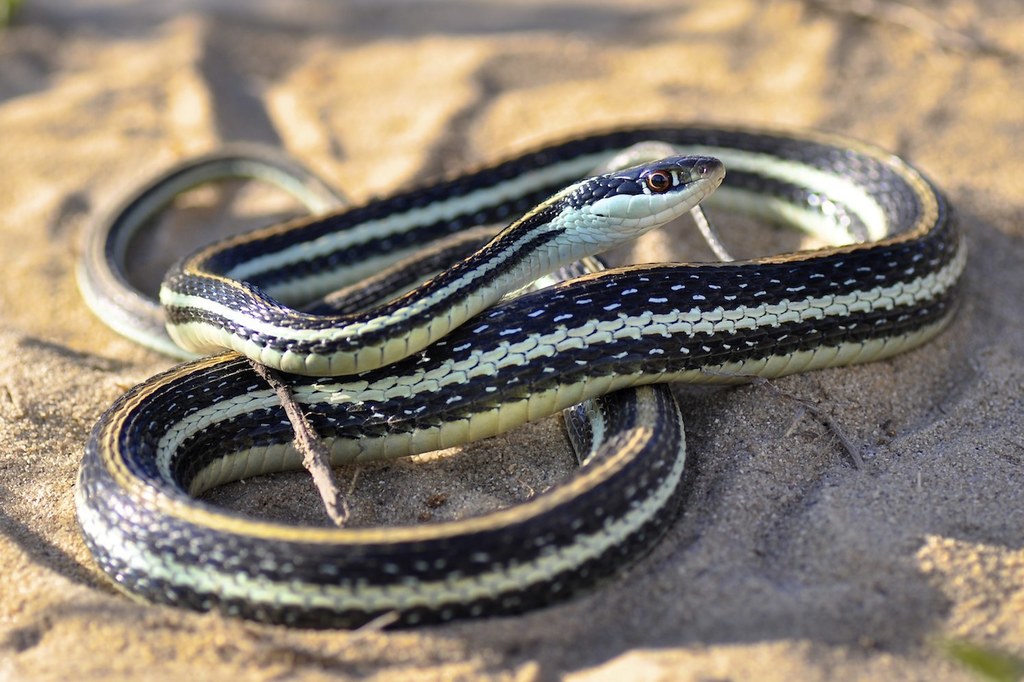
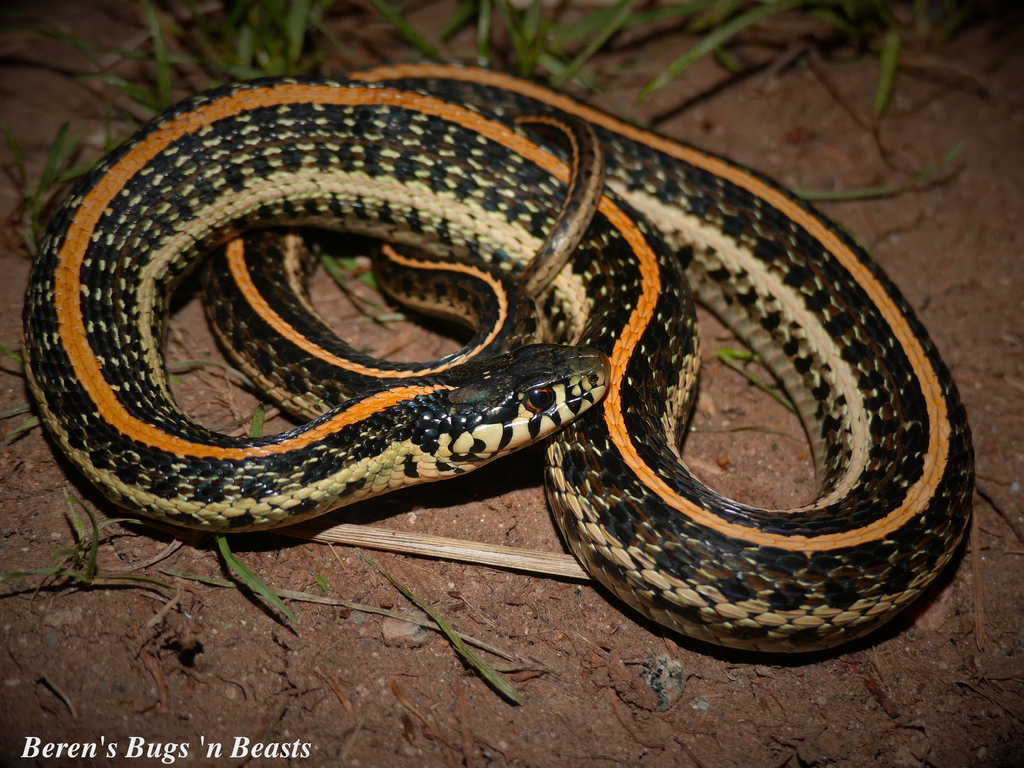
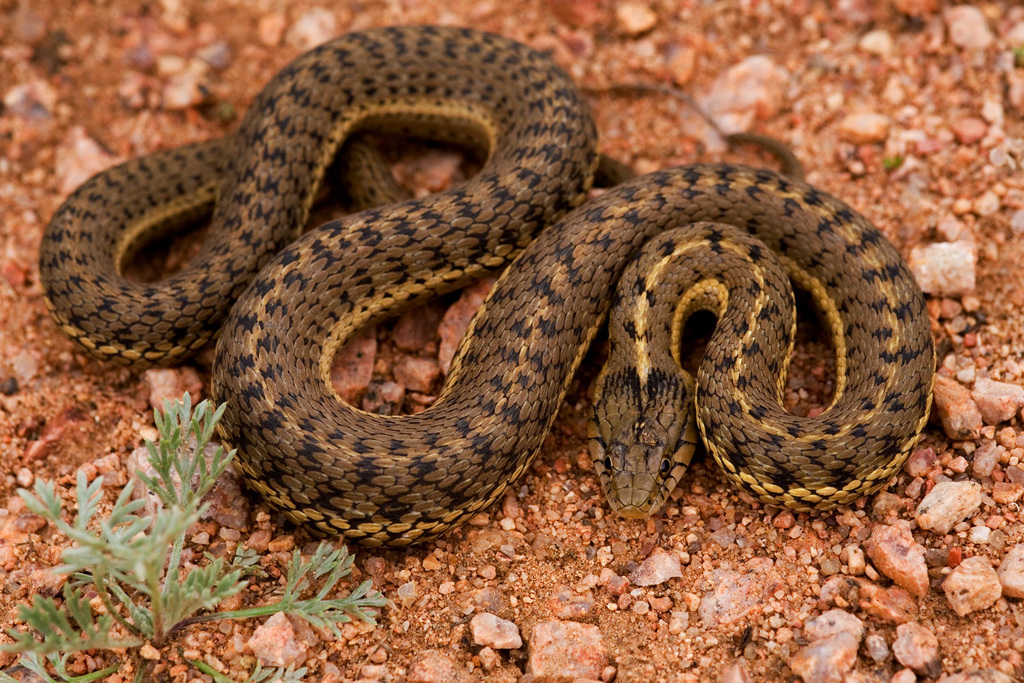
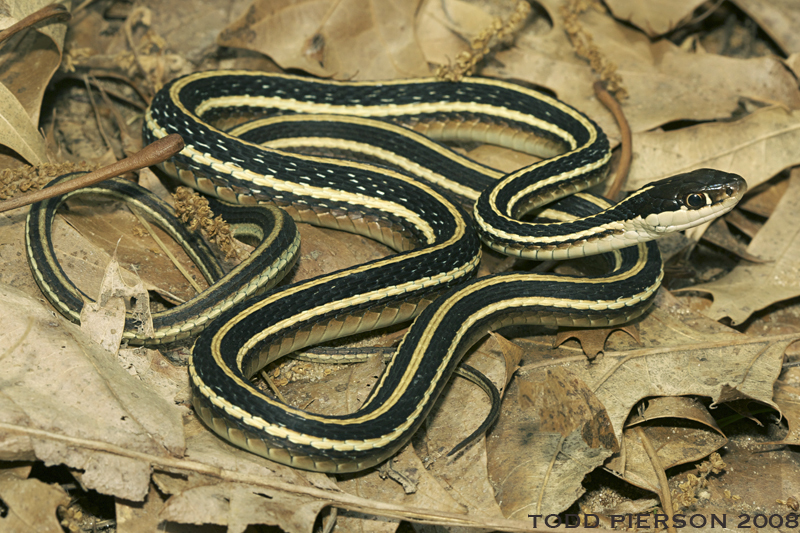
Garter & Ribbon Snakes (Thamnophis)
SnakesKey mark: stripe row position and body proportions
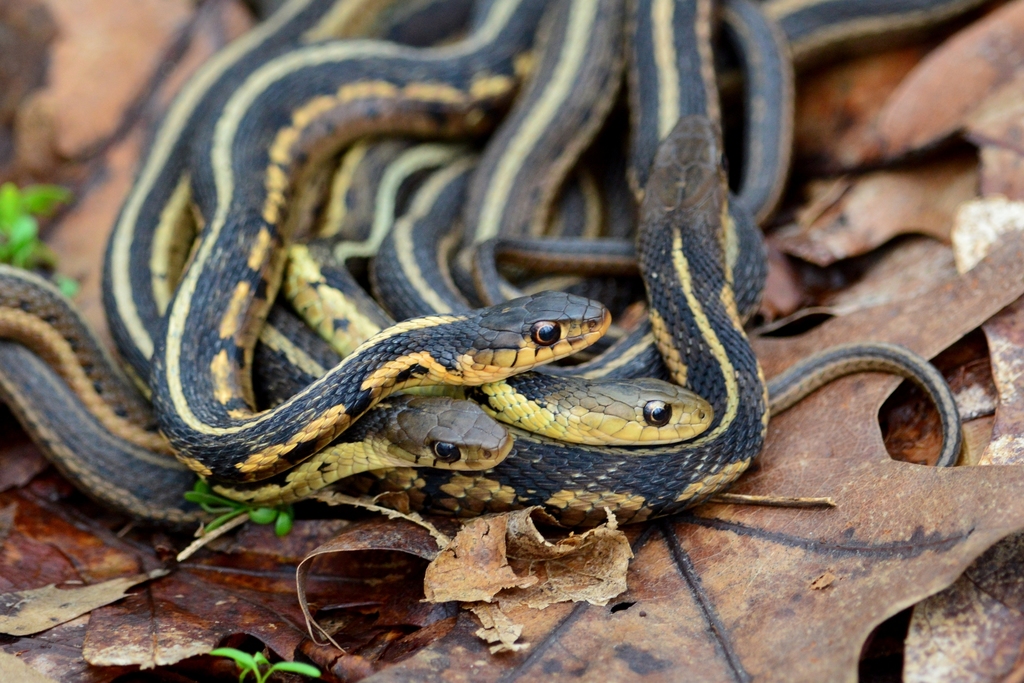
All have longitudinal stripes but differ in build and stripe placement (counted from belly up). Common Garter Snake: lateral stripes on scale rows 2–3, stocky build, highly variable pattern and color. Eastern Ribbon Snake: lateral stripes on rows 3–4, extremely slender with a tail that is 1/3+ of total length, crisp white lip stripe. Western Ribbon Snake: nearly identical to Eastern but ranges further west and onto the plains. Plains Garter Snake: orange or red lateral stripes, dark bars on lip scales; common on the Great Plains.
Cottonmouth vs. Watersnakes
SnakesKey mark: head shape and pupil
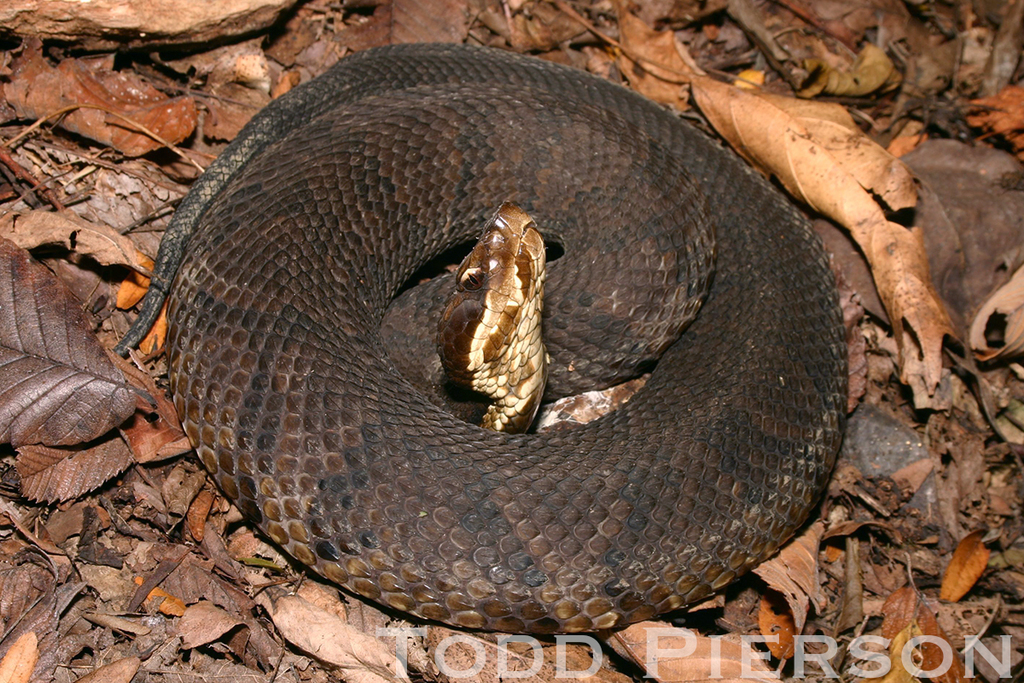
Cottonmouth is by far the most over-reported snake in North America — nearly every watersnake gets called one. True cottonmouths have a triangular head with jowls that are clearly wider than the neck, a cat-eye (elliptical) pupil visible at close range, and will gape to show the white mouth lining. Watersnakes (Nerodia) have a round pupil, narrower head, and no white mouth. Both will flatten their bodies when alarmed. Juvenile cottonmouths have banded patterns and yellow tail tips. Range matters: cottonmouths are absent from much of the North.
Copperhead vs. Look-alikes
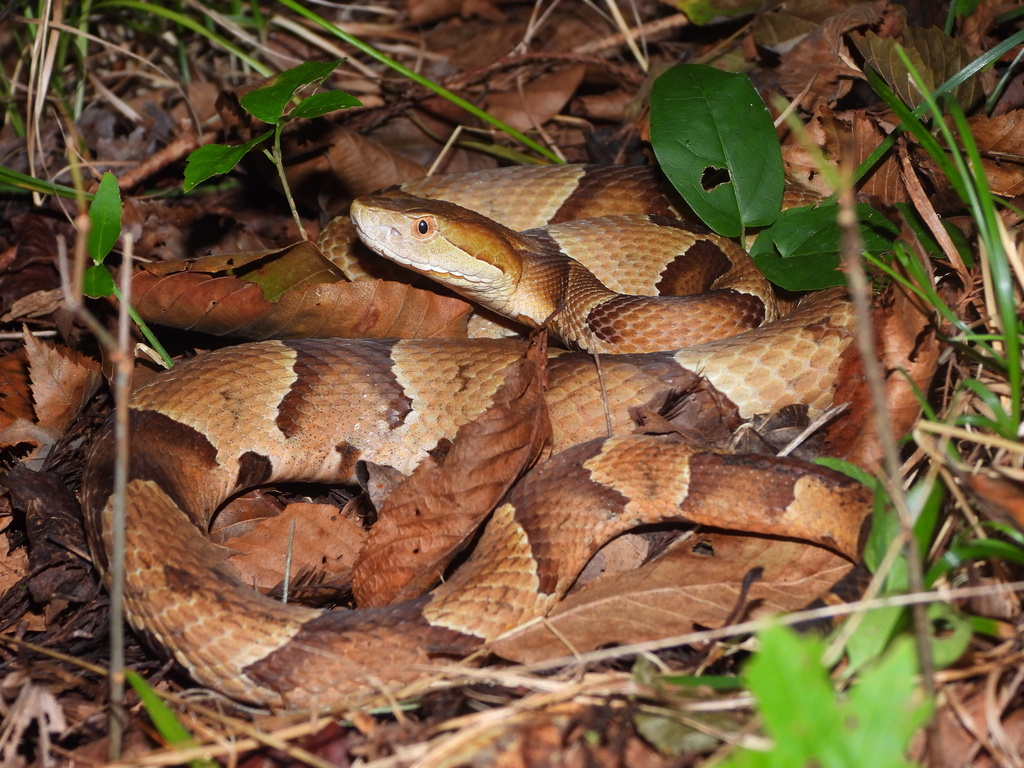
SnakesKey mark: hourglass crossbands
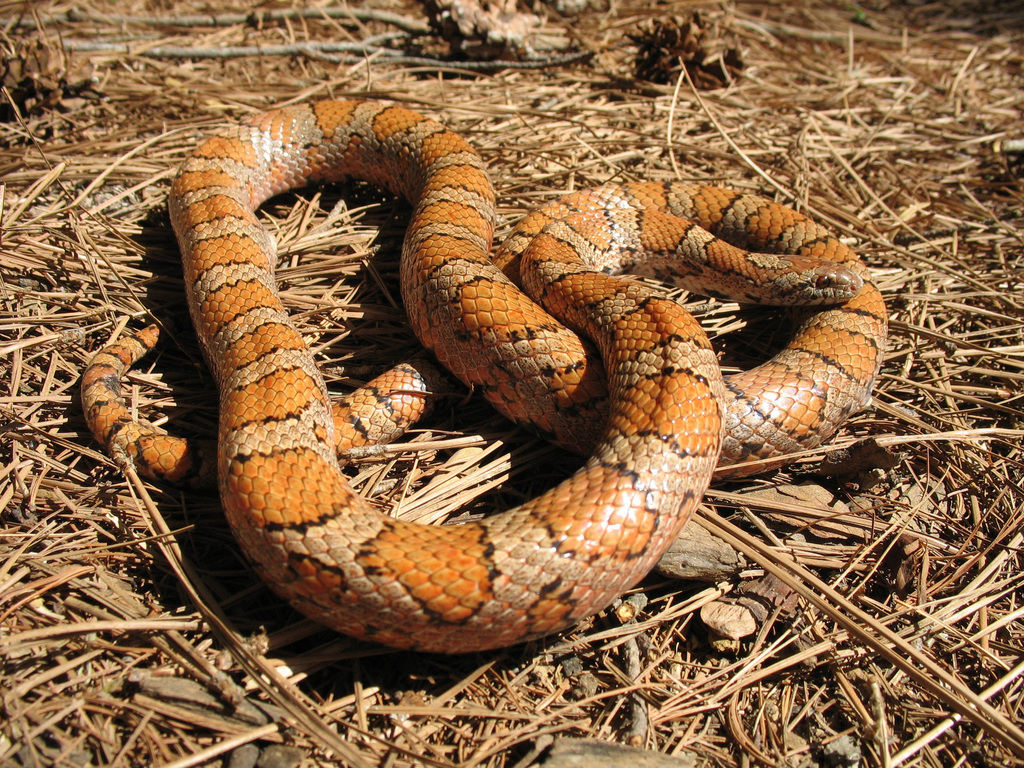
Copperheads have a very distinctive pattern — bold hourglass-shaped crossbands that are widest on the sides and pinch to a narrow waist at the midline. The head is copper-colored and distinctly triangular. Juvenile copperheads have a bright yellow tail tip. Corn snake and milk snake patterns have saddle-shaped blotches that are widest at the midline, not the sides — the opposite of a copperhead. Hognose snakes have an upturned snout and will play dead. Eastern ratsnake juveniles are blotched, not hourglass-banded.
Hognose Snakes (Heterodon)
SnakesKey mark: snout shape and underside
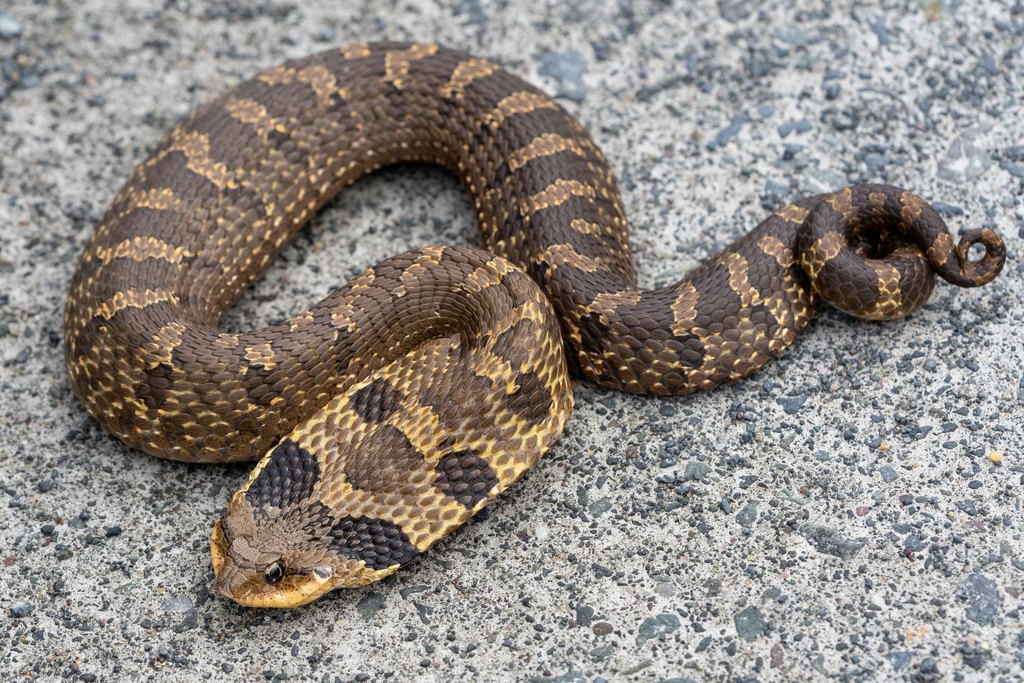
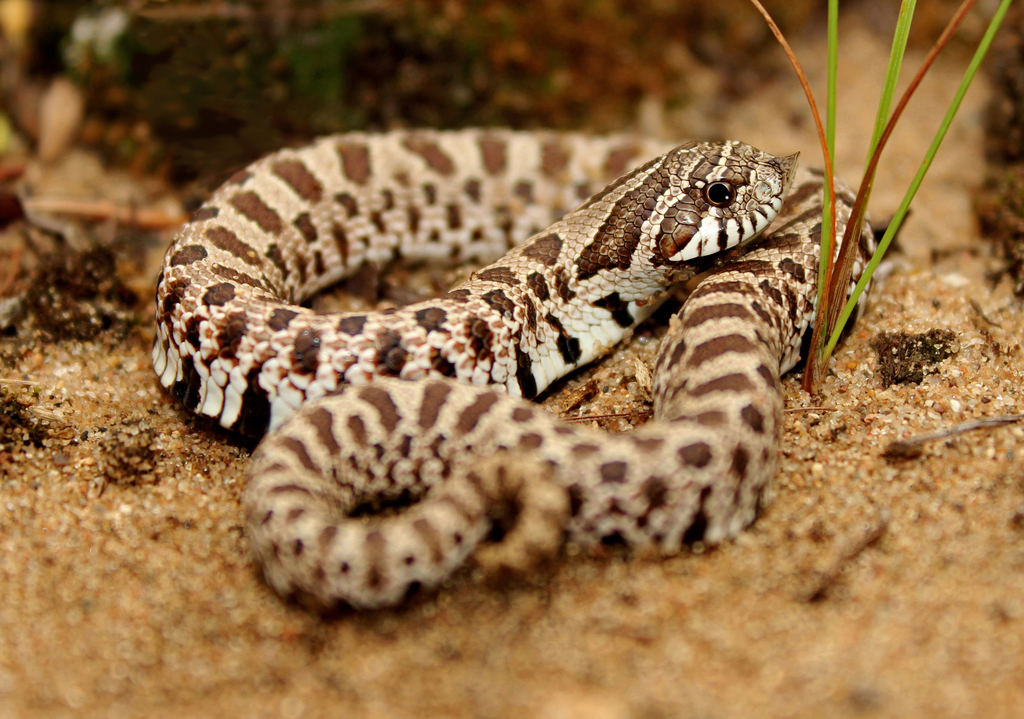
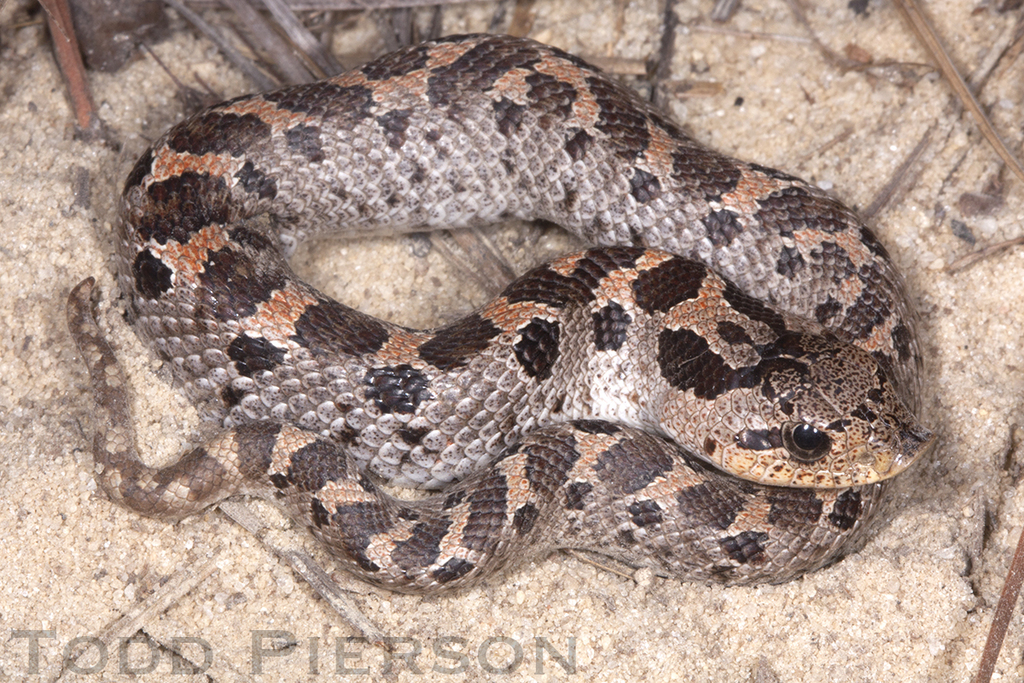
All hognose snakes have a distinctive upturned snout used for digging. They are famous for their bluff displays — flattening the neck cobra-style, hissing loudly, and playing dead by rolling onto their back with mouth open. Eastern Hognose: larger, variable (yellow, gray, brown, or black), checkered belly often yellow or cream; upturned snout. Western Hognose: more strongly keeled scales, sharper upturned snout, spotted pattern, patterned underside. Southern Hognose: smallest of the three; ranges limited to sandhills of the Southeast; snout most sharply upturned.
Racer vs. Coachwhip
SnakesKey mark: scale texture and tail pattern
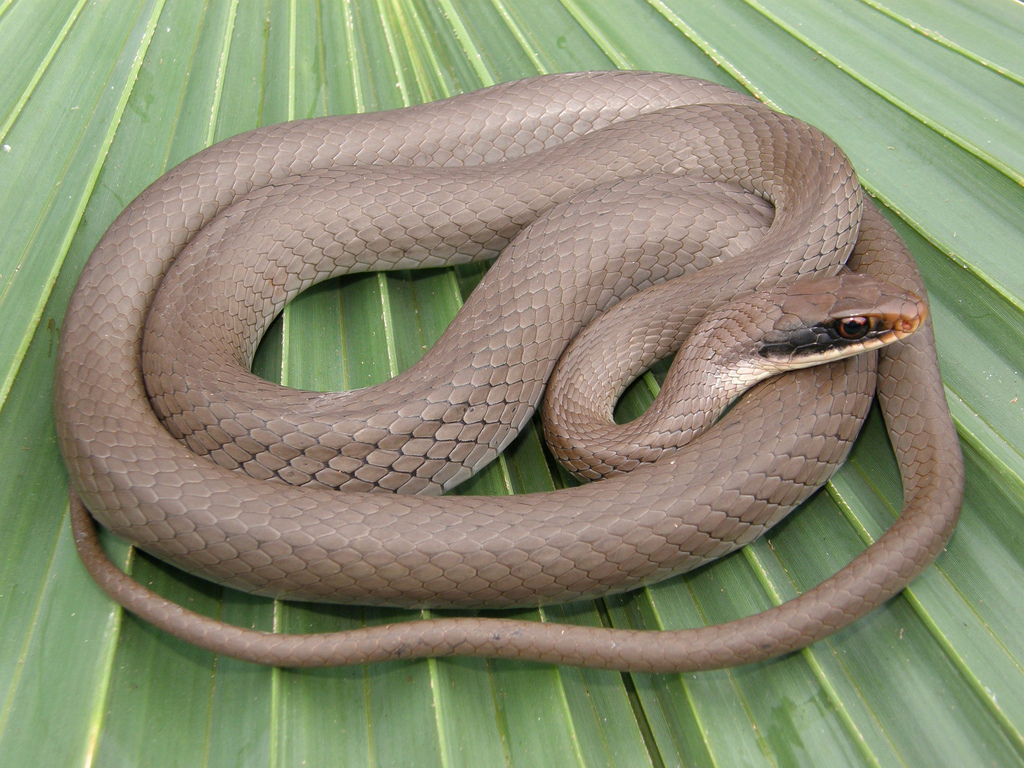
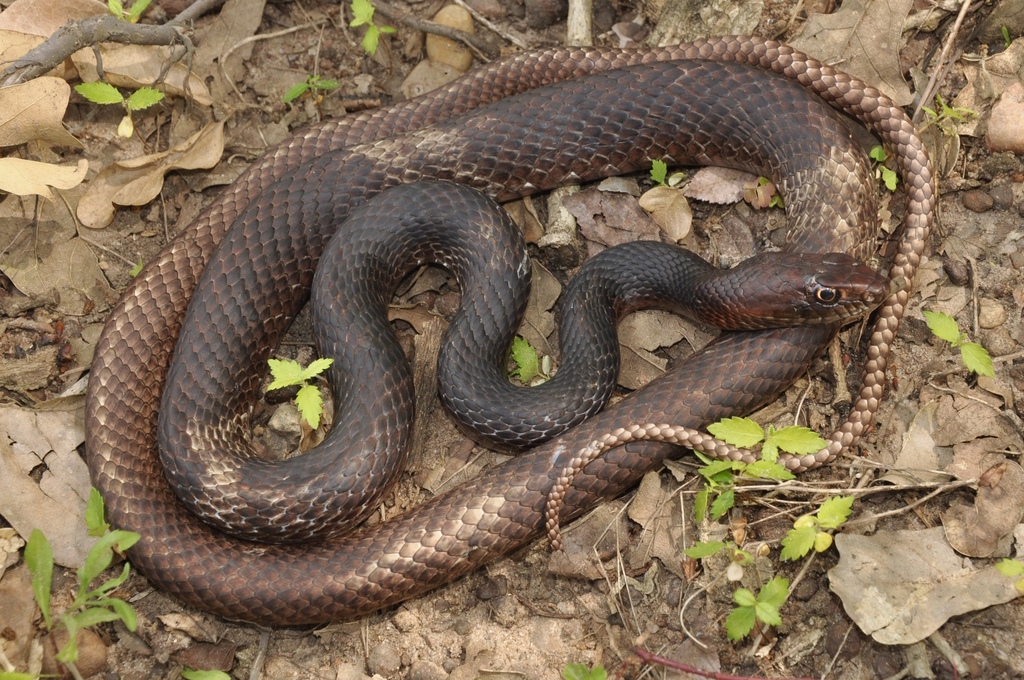
Both are long, slender, fast-moving snakes that are among the most commonly seen across North America. North American Racer: smooth scales, uniform blue-gray to black above (adults), cream to white chin, round pupil; typically under 5 feet. Coachwhip: also smooth scales but the tail has a distinctive braided whip-like pattern with scales arranged in a woven look — the key field mark. Coachwhip is generally longer (up to 8 feet) and holds its head higher when moving. Both flee quickly and will bite if caught.
Eastern Small Rattlesnakes
SnakesKey mark: rattle size and head markings
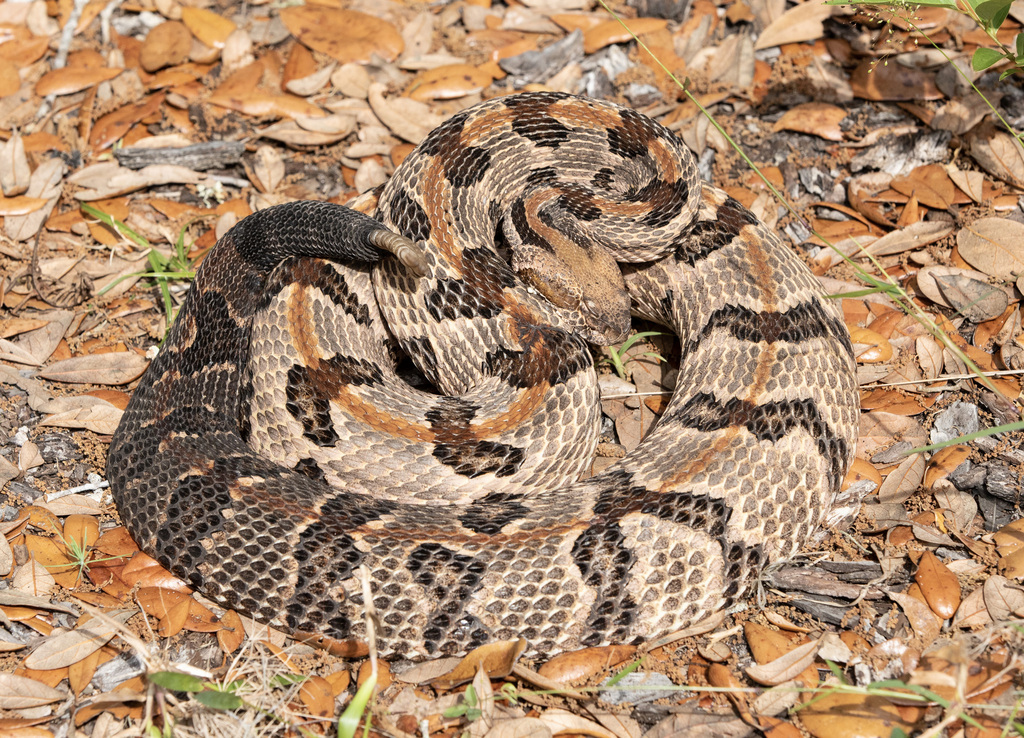
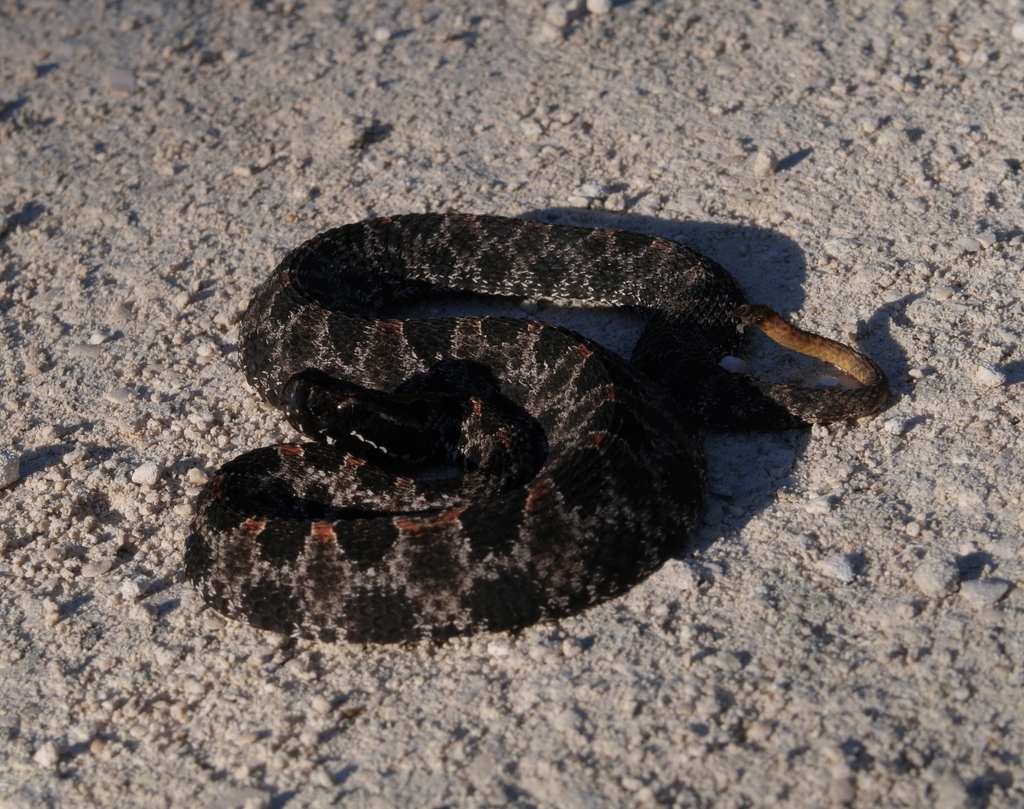
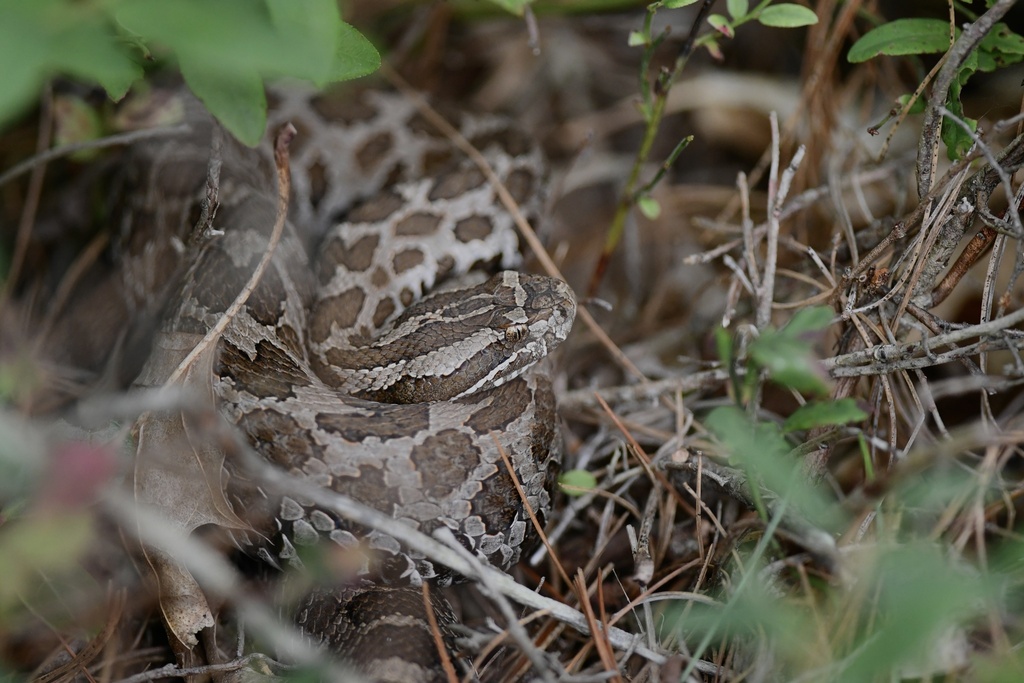
Three rattlesnakes in the eastern US are small to medium-sized and frequently confused. Timber Rattlesnake: the largest of the three (up to 5 ft), chevron-shaped crossbands, plain gray or yellow head with no facial line, no facial pit mask. Pygmy Rattlesnake: tiny (under 2 ft), faint rattle (sounds like an insect buzz), slender reddish-brown dorsal stripe, found in SE lowlands. Eastern Massasauga: medium-sized, heart-shaped head, distinct dark mask through the eye, round dark blotches, northern wetlands and prairies.
Western Rattlesnakes (Crotalus)
SnakesKey mark: tail pattern and facial markings
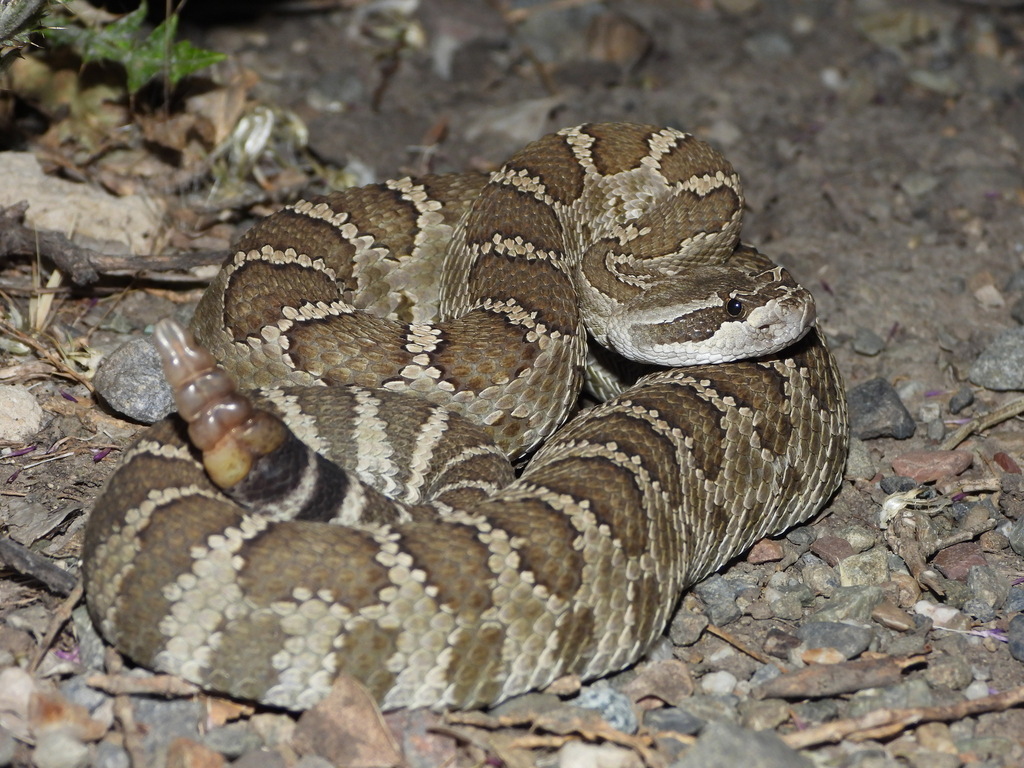
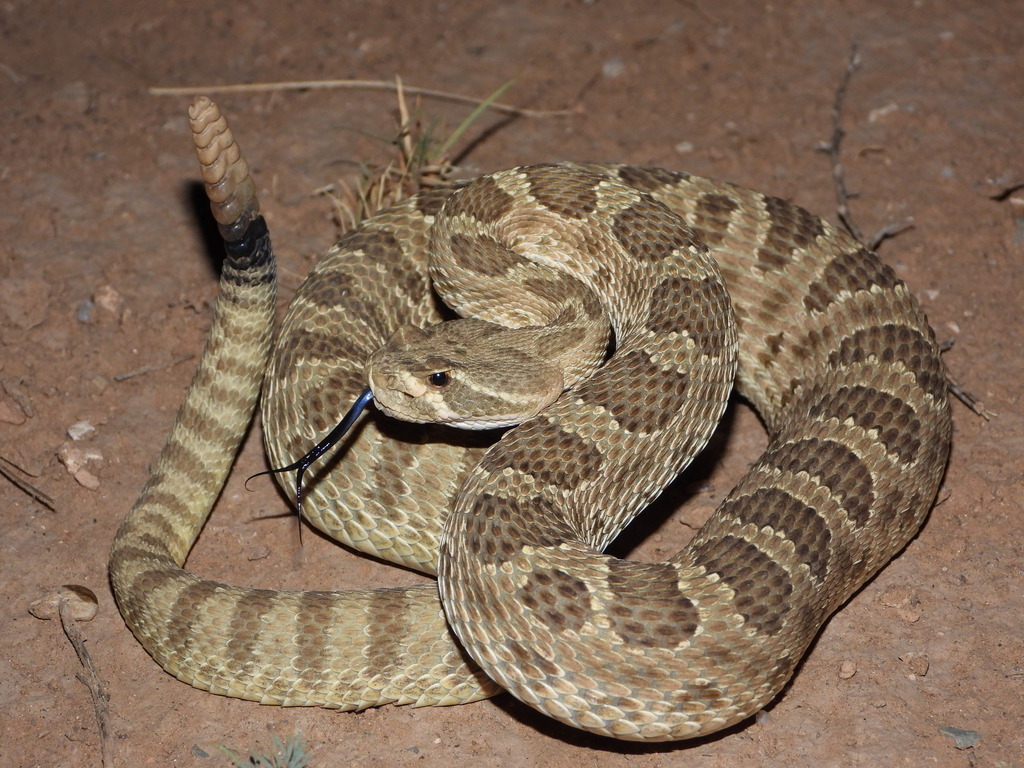
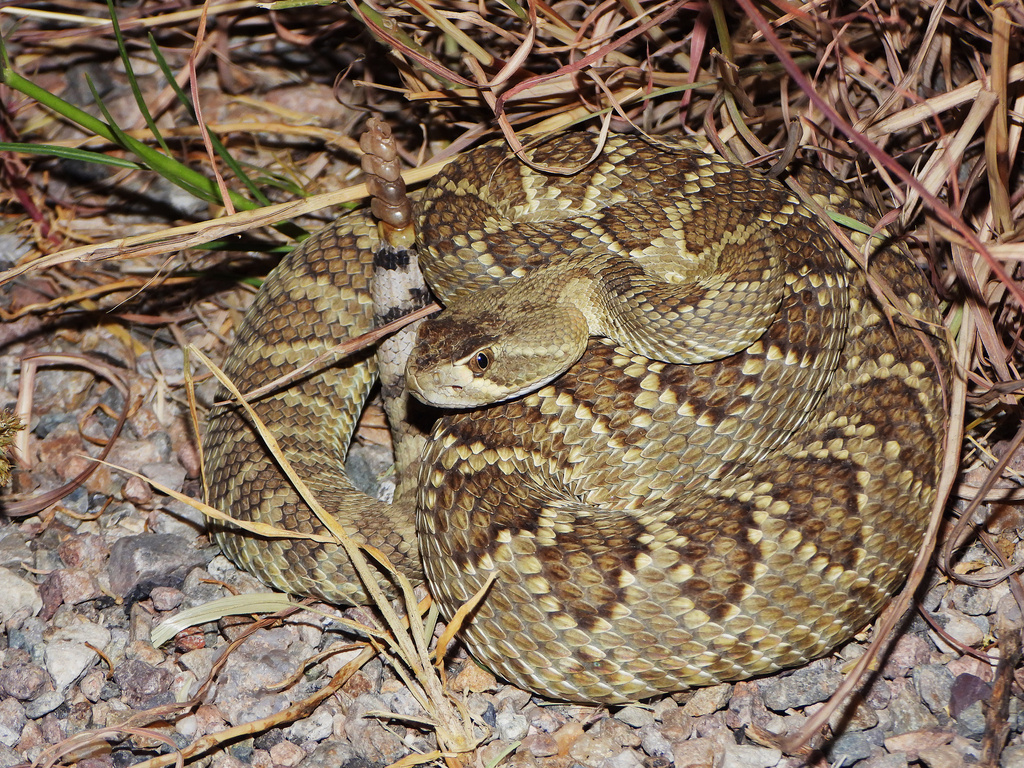
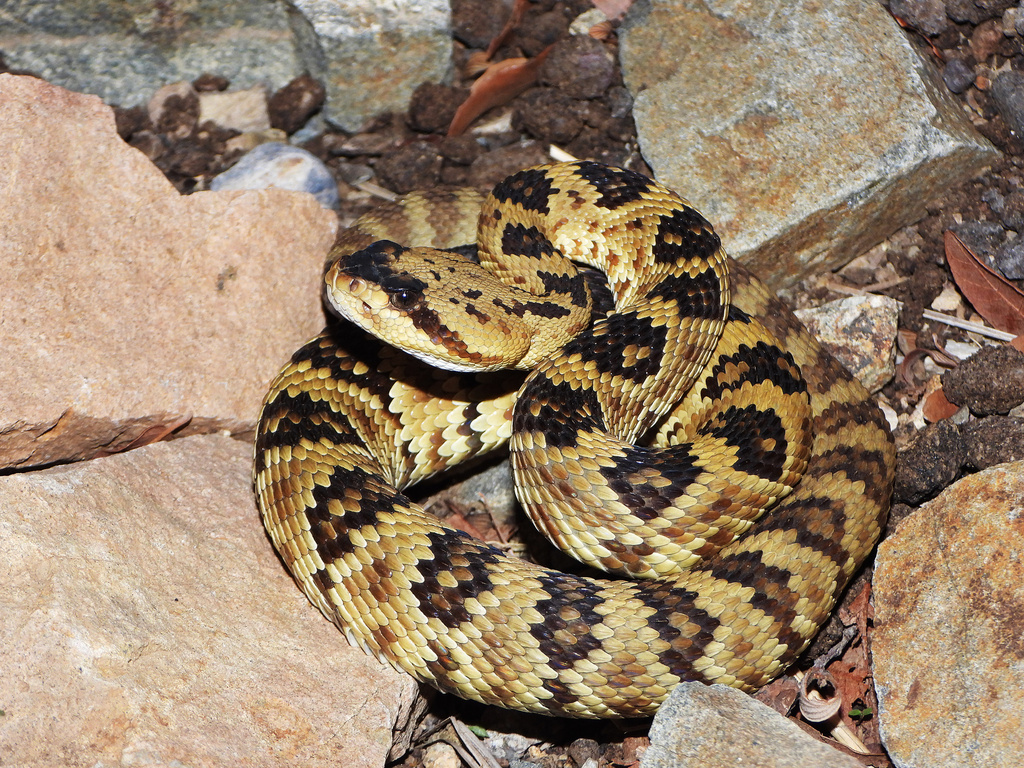
The western US has far more rattlesnake diversity than the east — multiple species co-occur across much of the range. Western Rattlesnake (oreganus) complex: variable, brown or gray with dark blotches, widespread from coast to Rockies. Prairie Rattlesnake: greenish or gray with well-defined round blotches, Great Plains. Mojave Rattlesnake: distinctive black-and-white tail rings (white rings wider than black), green or gray coloring, triangular light stripe behind eye — the most dangerous of the four. Western Black-tailed: jet-black tail contrasting with the body, Chihuahuan desert.