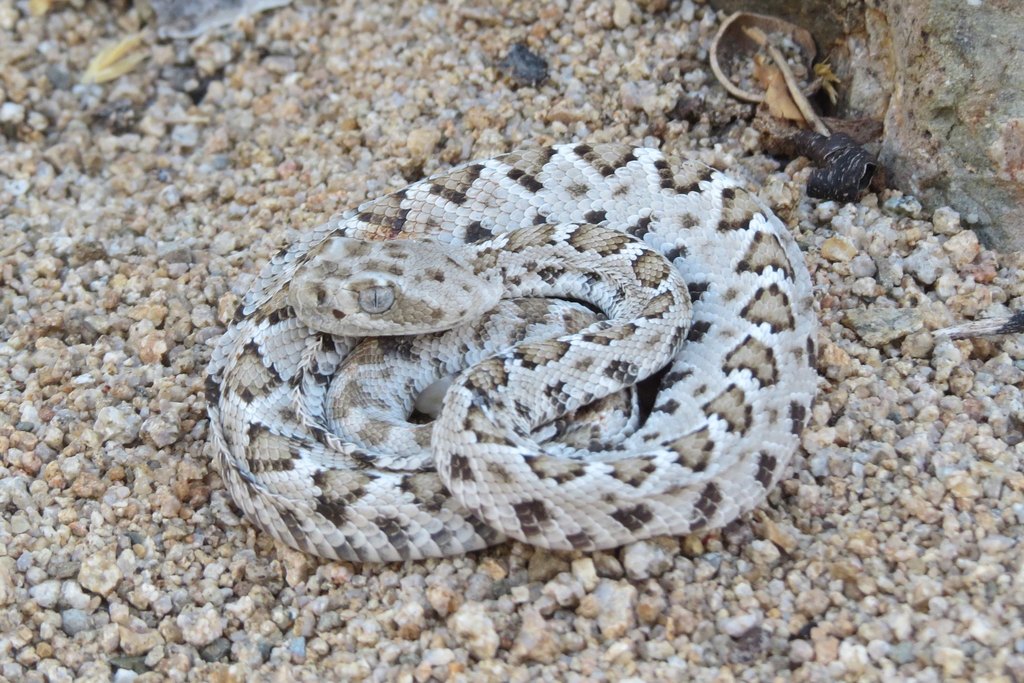
Santa Catalina Island Rattlesnake
Crotalus catalinensis
 SnakeViperidaemedium⚠ VENOMOUSCritically Endangered
Quick ID
Field Notes
A small, slender pit viper typically measuring 16–24 inches (41–61 cm) in total length. Body is notably gracile and lightweight compared to most other rattlesnakes, with a relatively small, slightly flattened head only moderately set off from the neck. Dorsal coloration is generally gray, tan, or light brown, overlaid with a series of dark brown to blackish crossbands or blotches that are often indistinct or faded, particularly in older individuals. The pattern may become obscured with age, and some specimens appear nearly uniform. Scales are keeled, giving the body a somewhat rough texture. Vertical pupils and prominent loreal pits are clearly visible. The tail is relatively short and terminates in a distinctive rattle, typically dark in color. Ventral surface is cream to pale yellow, often with scattered dark mottling or irregular spotting. Juveniles resemble adults but typically exhibit more contrasting and distinct dorsal patterning.
Endemically restricted to Santa Catalina Island (Isla Santa Catalina) off the coast of Baja California, Mexico, where it inhabits arid and semi-arid scrub habitats, rocky foothills, and arroyos with sparse vegetation. This species is highly specialized for its insular environment and is considered one of the rarest rattlesnakes in North America, with a very restricted range. Diet consists primarily of small lizards, particularly side-blotched lizards and other small lacertilians, as well as small mammals and occasionally insects, subdued via envenomation.
Photos
Click any photo to expand · Photos via iNaturalist
Range
Range data © iNaturalist contributors (CC BY 4.0)