Mediterranean House Gecko
Hemidactylus turcicus
 LizardGekkonidaemediumCommon
Quick ID
Field Notes
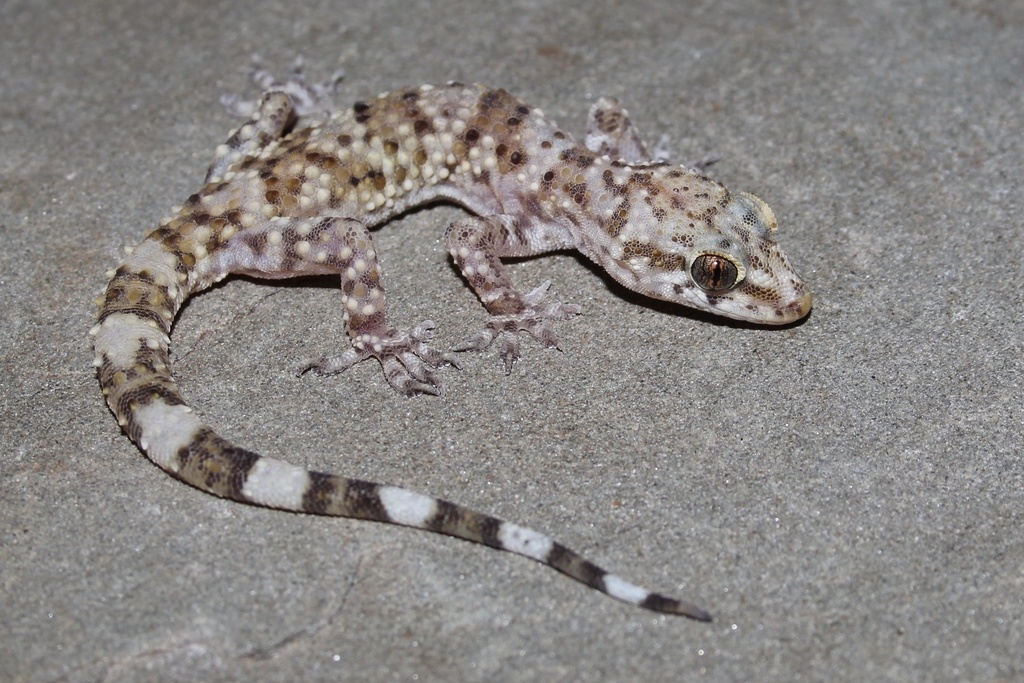
A small, slender gecko typically measuring 3–5 inches (7.6–12.7 cm) in total length. Body is somewhat flattened with a relatively large head, wide eyes, and a moderately long tail. Dorsal coloration is pale gray, tan, or pinkish, often semi-translucent, frequently marked with darker mottling or irregular spots. Skin is soft and covered with small granular scales interspersed with conspicuous, raised tubercles, giving a distinctly bumpy texture. The head is broad with a short snout and large lidless eyes adapted for nocturnal activity. Toes are expanded with well-developed adhesive pads and distinct lamellae, allowing effective climbing on smooth vertical surfaces. Ventral surface is pale and typically unmarked. Tail is cylindrical and capable of autotomy. Commonly inhabits urban and suburban environments, frequently found on buildings, walls, fences, and rock surfaces, often sheltering in crevices during the day. Strictly nocturnal and commonly observed around artificial lights where insects congregate. Diet consists primarily of insects and other small arthropods.
Similar species: Tropical House Gecko (Hemidactylus mabouia) is generally more robust with a broader head and less pronounced dorsal tubercles; Asian House Gecko (Hemidactylus frenatus) has a smoother appearance with finer tubercles and often more uniform coloration; Native Banded Geckos (Coleonyx spp.) lack adhesive toe pads and possess movable eyelids.
Photos
Click any photo to expand · Photos via iNaturalist
Seasonal Activity
Individuals recorded by month
Range
Introduced (non-native) in highlighted regions
Range data © iNaturalist contributors (CC BY 4.0)