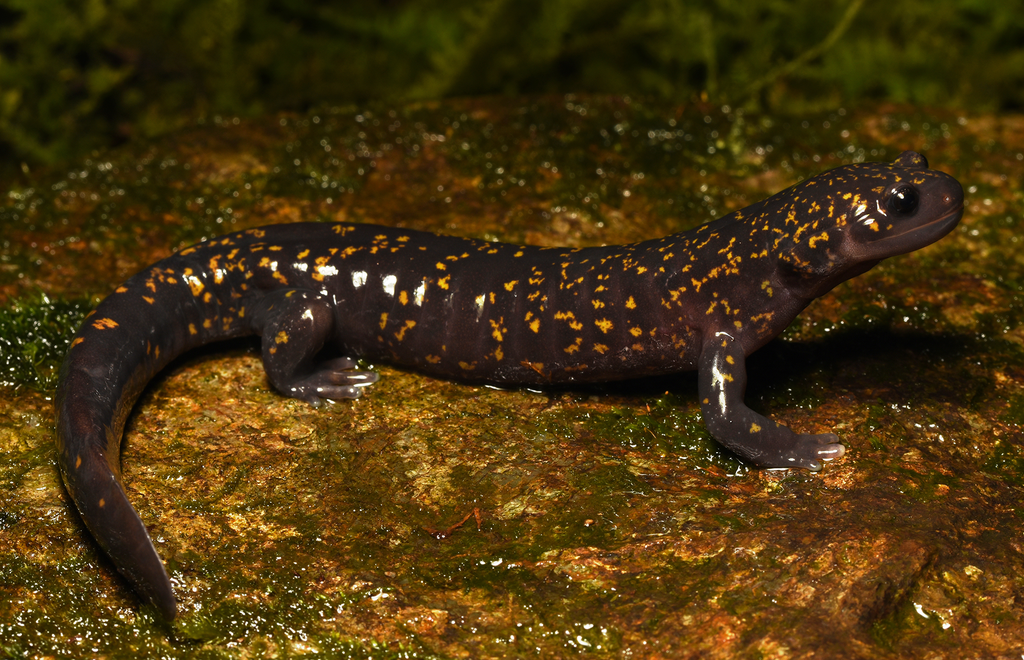
Mount Hinode Salamander
Hynobius fossigenus
 SalamanderHynobiidaesmallVery Rare
Quick ID
Field Notes
A small, slender salamander typically measuring 3.5–5.0 inches (9–13 cm) in total length. Body is elongate and relatively gracile with short limbs. Dorsal coloration is dark brown to nearly black, often with a reddish or coppery vertebral stripe running from head to tail tip; this stripe may be discontinuous or broken into short segments. Dorsolateral regions are typically slightly lighter, sometimes appearing grayish-brown. The head is small and flattened, with relatively large eyes. Costal grooves are well-developed, numbering approximately 11–13 between the forelimbs and hind limbs. Dorsal surface is smooth to slightly granular. The tail is compressed laterally and relatively long, comprising roughly half of the total length. Ventral surface is pale gray to whitish, sometimes with faint dark mottling. A distinctive feature characteristic of Hynobius fossigenus is the presence of a distinct costal groove pattern and the specific vertebral stripe configuration, which may appear as a series of dashes or spots rather than a continuous line. Primarily inhabits cool, moist montane forest microhabitats, particularly areas associated with leaf litter, moss-covered logs, and damp soil near small streams and seepage areas. Endemic to Mount Hinode in central Japan, occurring at moderate to higher elevations in mixed deciduous and coniferous forests. Rarely encountered due to cryptic, secretive habits and highly restricted range. Diet consists of small invertebrates including springtails, mites, and other tiny arthropods found within the leaf litter and soil.
Photos
Click any photo to expand · Photos via iNaturalist
Range
Range data © iNaturalist contributors (CC BY 4.0)