Hida Salamander
Hynobius kimurae
 SalamanderHynobiidaesmallRare
Quick ID
Field Notes
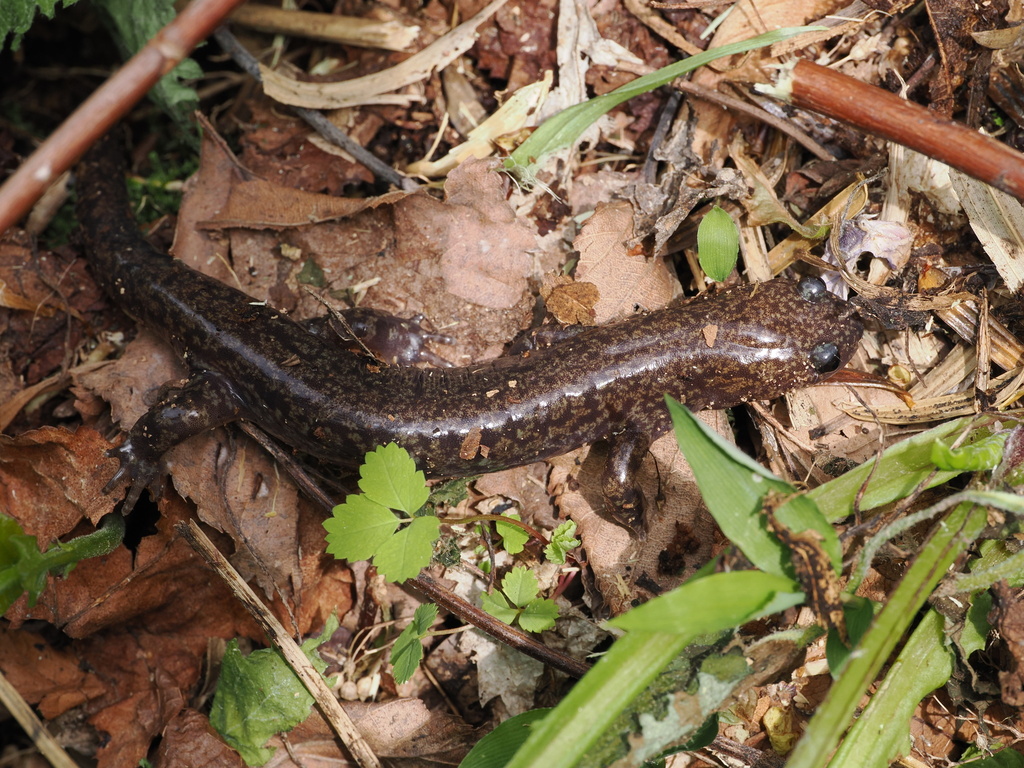
A small, slender salamander typically measuring 3.5–5.0 inches (9–13 cm) in total length. Body is elongate and graceful with relatively short limbs and a long, laterally compressed tail that comprises roughly half the total length. Dorsal coloration is dark brown to blackish-brown, often with a slightly bronzed or metallic sheen. A narrow, distinct golden or yellowish vertebral stripe runs along the midline of the back from the head to the base of the tail, sometimes widening slightly posteriorly. The lateral surfaces are somewhat lighter than the dorsum, with fine dark reticulation or flecking. The head is moderately flattened with a small mouth and dark eye. Nasolabial grooves are present, characteristic of the family Hynobiidae. Costal grooves are clearly visible along the sides, typically numbering 13–14 between limbs. Skin is smooth and somewhat glossy. Ventral surface is gray to dark gray, sometimes with fine pale speckling. Limbs are relatively short and weak, with fingers and toes only moderately webbed. Tail is finless, tapering to a fine point. Primarily inhabits cool, clear mountain streams, seepage areas, and adjacent moist forests in high-elevation regions of central Japan, particularly in the Hida Mountains of Gifu Prefecture. Strongly associated with flowing water and dense moss-covered habitats. Diet consists of small aquatic and terrestrial invertebrates, including small crustaceans, insects, and other arthropods encountered in leaf litter and stream margins.
Similar species: Japanese Clawed Salamander (Onychodactylus japonicus) is generally more slender with a more prominent gold or orange vertebral stripe and lacks the bronzed dorsal coloration; Hynobius dunni (Hynobius dunni) occurs at lower elevations and lacks the distinctly metallic sheen and typically has a less prominent vertebral stripe; Oriental Salamander (Hynobius leechii) is somewhat larger and has more extensively reticulated ventral surfaces with less distinct vertebral marking.
Photos
Click any photo to expand · Photos via iNaturalist
Range
Range data © iNaturalist contributors (CC BY 4.0)