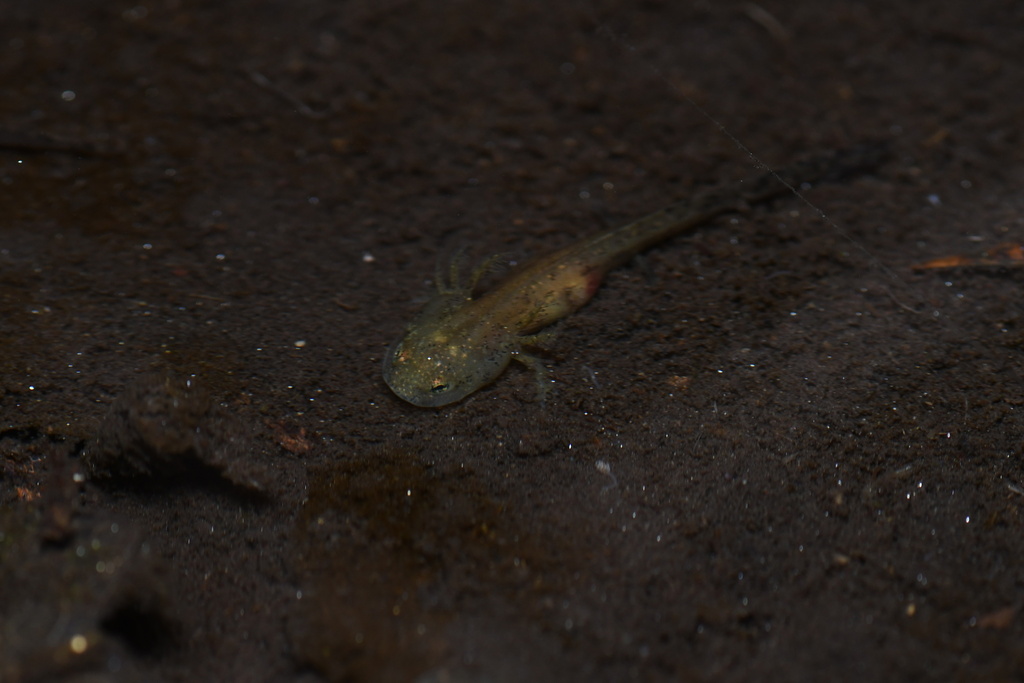
Izumo Salamander
Hynobius kunibiki
 SalamanderHynobiidaesmallVery Rare
Quick ID
Field Notes
A small, slender salamander typically measuring 3.5–5.0 inches (8.9–12.7 cm) in total length. Body is elongate and gracile with relatively short limbs and a moderately long tail comprising approximately 40–50% of total length. Dorsal coloration is typically dark brown to blackish-brown, often with a reddish or copper-tinged vertebral stripe running the length of the back from head to tail tip. The vertebral stripe may be continuous or broken into a series of spots. Flanks are slightly lighter, ranging from brown to grayish-brown. The head is relatively small with a blunt snout. Costal grooves are distinct, typically numbering 13–14 on each side of the body. Skin is smooth and somewhat glossy. Limbs are short and slender, with digits that are not webbed. Ventral surface is lighter, typically pale gray to cream with darker mottling, particularly along the sides. A key diagnostic feature is the presence of a distinctive light-colored lateral stripe or series of spots along the flanks, contrasting with the darker dorsum. The tail is slender and lacks a prominent crest. This species is endemic to the Shimane Prefecture region of western Honshu, Japan, inhabiting small, cool streams and spring-fed seepage areas within deciduous and mixed forests. Prefers areas with rocky substrates and abundant leaf litter near flowing water. Diet consists of small arthropods, particularly aquatic and semi-aquatic invertebrates such as small insects, amphipods, and copepods.
Similar species: Ussuri Salamander (Hynobius leechii) lacks the distinctive copper-tinged vertebral stripe and has a more uniform dark coloration; Lilypad Salamander (Hynobius retardatus) is typically larger and has more prominent costal grooves with a different vertebral pattern; Japanese Stink Salamander (Hynobius naevius) has a more robust body and lacks the reddish vertebral stripe.
Range
Range data © iNaturalist contributors (CC BY 4.0)