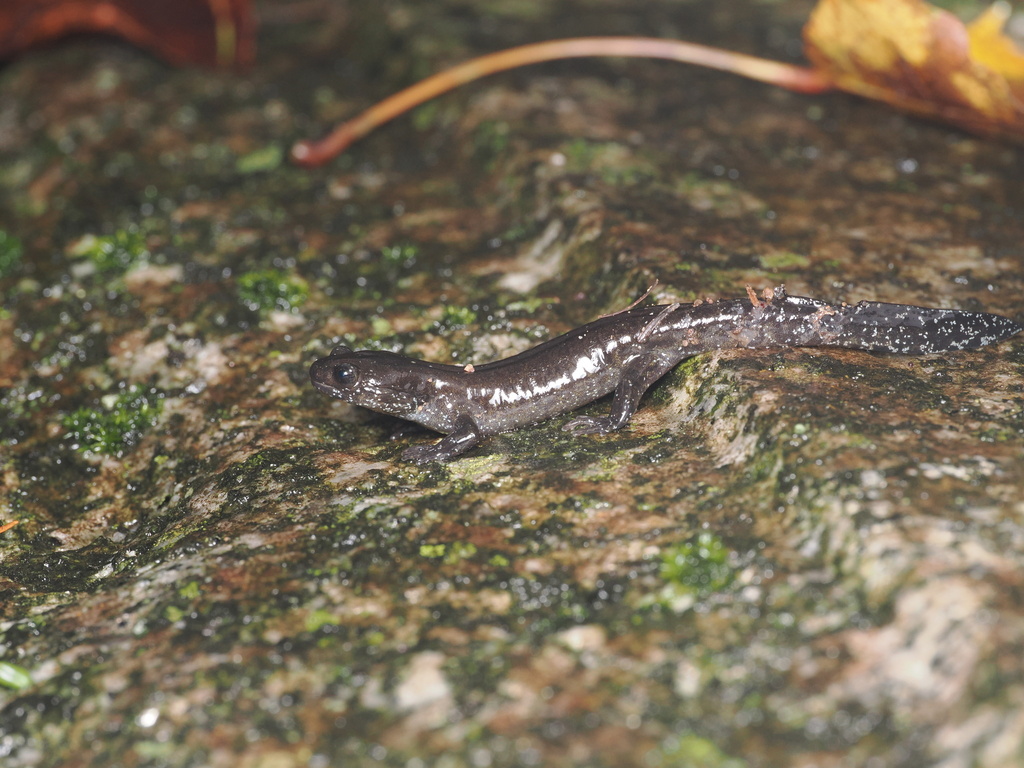
Hokuriku Salamander
Hynobius takedai
 SalamanderHynobiidaesmallRare
Quick ID
Field Notes
A small, slender salamander typically measuring 3.5–5.0 inches (9–13 cm) in total length. Body is elongate and gracile with relatively short limbs. Dorsal coloration is dark brown to blackish-brown, often with a fine reddish or coppery vertebral stripe extending from the head to the tail tip. The vertebral stripe may be broken or continuous and ranges from subtle to moderately prominent depending on individual variation. Dorsal surfaces are typically uniform dark brown without distinct blotches or spots, though some individuals exhibit faint flecking. The head is moderately flattened with small eyes. Costal grooves are well-developed, typically numbering 13–14 between the front and hind limbs. Skin is smooth and slightly moist. Ventral surface is grayish to pale brown, often with darker mottling or spotting, particularly on the chest and belly. The tail is laterally compressed and slightly crested. This species is endemic to mountainous regions of central Honshu in Japan, specifically the Hokuriku and Chubu regions, inhabiting cool, clear mountain streams, seepage areas, and surrounding forested wetlands at higher elevations. Primarily nocturnal and terrestrial outside of breeding season. Diet consists of small invertebrates including insects, mites, and other arthropods found in leaf litter and near moisture seepage.
Similar species: Acherontian Salamander (Hynobius dunni) occurs in different regions and has a more uniform dark coloration without a prominent vertebral stripe; Okayama Salamander (Hynobius okayamensis) lacks the reddish vertebral stripe and is found at lower elevations in western Honshu.
Range
Range data © iNaturalist contributors (CC BY 4.0)