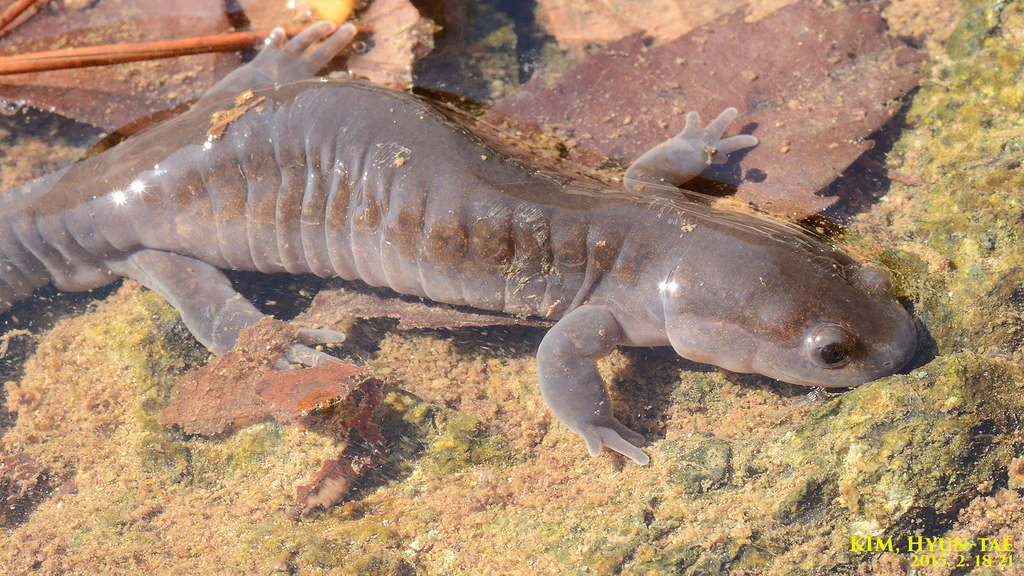
Kori Salamander
Hynobius yangi
 SalamanderHynobiidaesmallRare
Quick ID
Field Notes
A small lungless salamander typically measuring 3.5–5.0 inches (9–13 cm) in total length. Body is slender and elongate with short limbs characteristic of hynobiids. Dorsal coloration is dark brown to blackish-brown with a narrow, well-defined golden-yellow or pale tan vertebral stripe running from the head to the tip of the tail, the stripe typically widest on the trunk. Lateral surfaces are somewhat lighter than the dorsum, often with a faint yellowish tint. The head is relatively small and flattened, with tiny eyes. Costal grooves are typically 13–14, a key diagnostic feature for this species. Skin is smooth and moist. Ventral surface is dark gray to blackish, often with a faint midline paling. Limbs are short and slender, with four fingers and five toes. A distinctive feature is the presence of a rudimentary tail membrane and the overall compact body form. Inhabits cool, forested mountain streams and seepage areas in subtropical to warm temperate regions of eastern Asia, particularly in areas with persistent moisture and flowing water. Typically found among leaf litter, moss, and rocks near water sources. Diet consists of small invertebrates including insects, mites, and other arthropods.
Similar species: Hynobius leechii (Leech's Salamander) differs by having 14–15 costal grooves and a more diffuse vertebral stripe; Hynobius hidalgoi (Hidalgo's Salamander) differs by occurring in different geographic regions and lacking the well-defined golden vertebral stripe; Karsenia asperogenia (Ozark Zigzag Salamander) differs by having a zigzag dorsal pattern rather than a straight stripe and occurring in North American populations.
Photos
Click any photo to expand · Photos via iNaturalist
Range
Range data © iNaturalist contributors (CC BY 4.0)