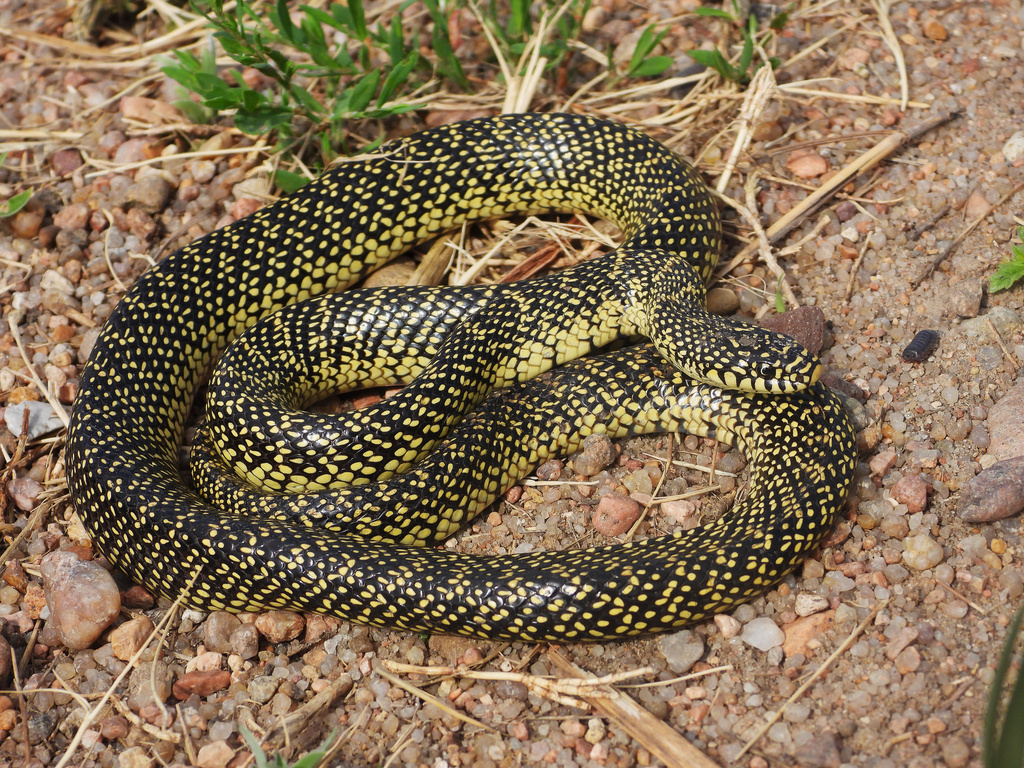
Speckled Kingsnake
Lampropeltis holbrooki
 SnakeColubridaemediumUncommon
Quick ID
Field Notes
A medium to large, stout-bodied colubrid typically measuring 30–48 inches (76–122 cm) in total length, with some individuals exceeding 60 inches (152 cm). Body is robust with a relatively small head that is only slightly distinct from the neck and a moderate tail length. Dorsal coloration is glossy black, marked with numerous small yellow to cream-colored speckles or chain-like markings that may form irregular bands or a broken chain pattern along the body. Pattern is highly variable, ranging from heavily speckled individuals to those with more distinct chain-link bands. Scales are smooth and highly polished, giving a shiny appearance. Eyes are moderate with round pupils. Ventral surface is black and white, often forming a checkered or mottled pattern. Commonly inhabits forests, fields, wetlands, agricultural areas, and suburban environments, often near water but not restricted to aquatic habitats. Primarily terrestrial and secretive, frequently found beneath cover objects. Diet consists of a wide range of prey including rodents, birds, reptiles (notably other snakes), amphibians, and eggs, subdued by constriction. Notably resistant to venom and known to prey on venomous snakes.
Similar species: Black Kingsnake (Lampropeltis nigra) typically has more uniform speckling with less distinct chain-like patterning and is more northern in distribution; Eastern Kingsnake (Lampropeltis getula) has more defined chain-link bands that are often continuous across the back; Speckled Kingsnake (Lampropeltis holbrooki) is often used synonymously but may refer regionally to heavily speckled individuals lacking clear chain bands.
Photos
Click any photo to expand · Photos via iNaturalist
Seasonal Activity
Individuals recorded by month
Range
Range data © iNaturalist contributors (CC BY 4.0)