Reticulated Python
Malayopython reticulatus
 SnakePythonidaelargeVery Rare
Quick ID
Field Notes
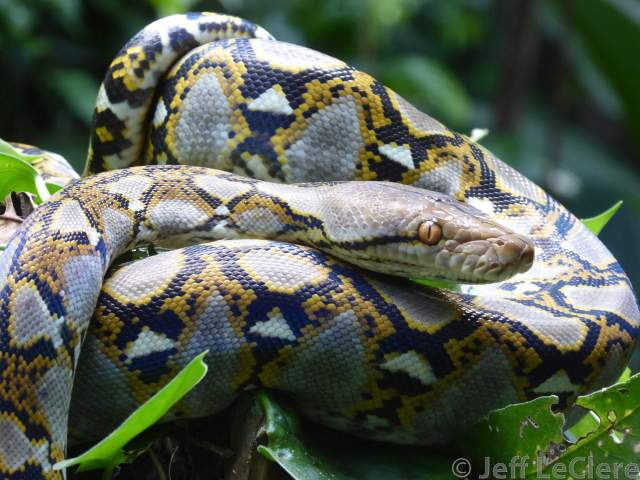
A large, heavy-bodied constrictor typically measuring 48–72 inches (122–183 cm) in total length, with some individuals exceeding 100 inches (254 cm), making it one of the longest snake species. Body is robust and muscular with a relatively small head that is somewhat flattened and only moderately distinct from the neck. Dorsal coloration is highly variable, ranging from golden yellow, tan, brown, or olive-green to darker shades, overlaid with an intricate reticulated (net-like) pattern of lighter diamond-shaped or hexagonal markings separated by darker lines. This distinctive reticulated pattern typically runs the entire length of the body and serves as the species' most recognizable feature. The pattern creates a three-dimensional appearance that provides cryptic coloration in forested environments. A series of small heat-sensing pits runs along the lip scales and lower jaw, allowing detection of warm-blooded prey. Scales are smooth and glossy. Ventral surface is cream to yellowish, often with dark mottling or bands. Juveniles resemble adults but often display more vivid coloration and stronger contrast in their reticulated patterns. Inhabits tropical rainforests, secondary growth forests, and occasionally agricultural areas throughout Southeast Asia, typically remaining in trees or on the ground in dense vegetation. Highly specialized ambush predator. Diet consists primarily of mammals, with larger individuals capable of consuming sizable prey such as small primates, flying lemurs, civets, and other mammals up to the size of a small cat, subdued via constriction.
Similar species: African Rock Python (Python sebae) lacks the distinctive reticulated pattern and instead displays diamond-shaped blotches with lighter borders; Green Tree Python (Morelia viridis) is primarily bright green, much smaller, and arboreal with a coiled resting posture; Burmese Python (Python bivittatus) has a more angular head pattern with two light lines along the crown and lacks the fine reticulated markings, instead showing larger diamond-shaped or blotched patterns.
Photos
Click any photo to expand · Photos via iNaturalist
Range
Introduced (non-native) in highlighted regions
Range data © iNaturalist contributors (CC BY 4.0)