European Glass Lizard
Pseudopus apodus
 LizardAnguidaelargeUncommon
Quick ID
Field Notes
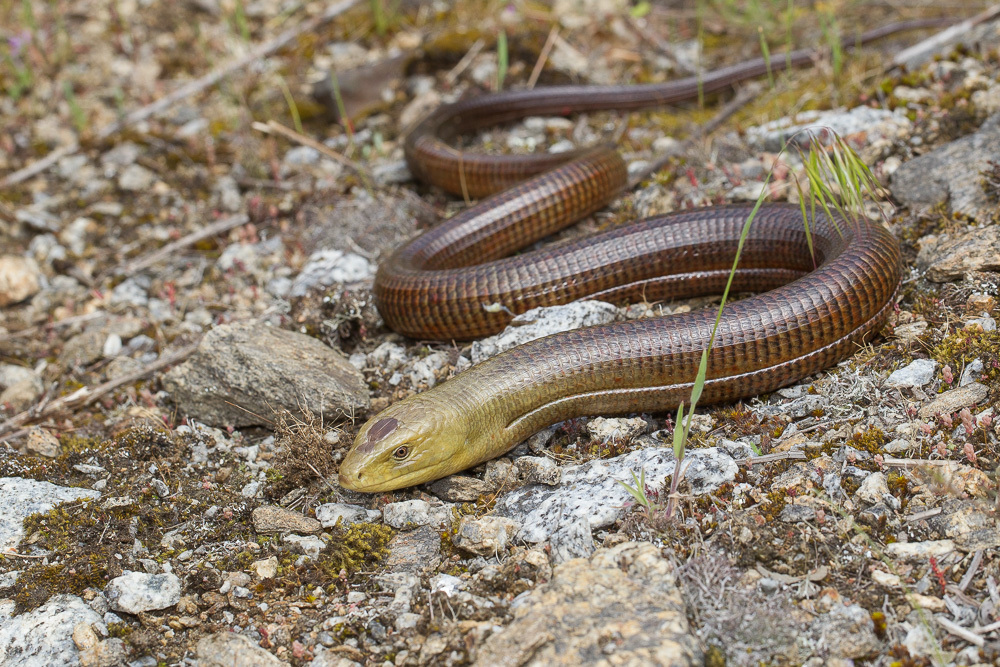
A large, limbless lizard typically measuring 20–39 inches (50–100 cm) in total length, with some individuals exceeding 48 inches (120 cm). Body is elongate, snake-like, and uniformly cylindrical with no external limbs, though vestigial hip bones and a specialized fracture plane in the tail distinguish it from true snakes. Dorsal coloration is typically uniform tan, yellowish-brown, or olive-gray, sometimes with faint longitudinal stripes or a darker vertebral line that may be visible in juveniles. A distinctive pale lateral stripe typically runs along each side of the body from the head to the tail. Scales are small, smooth, and arranged in regular rows, with a characteristic groove (lateral fold) running along the midline of each flank that separates dorsal and ventral scale rows. Head is slightly broader than the body and somewhat flattened. Eyes are prominent with moveable eyelids (a key feature distinguishing glass lizards from snakes). Ventral surface is pale yellow to cream, often unmarked or with faint mottling. The tail is extremely fragile and breaks readily when threatened, regenerating over time. Juveniles resemble adults but may have more contrasting coloration and clearer lateral stripes. Primarily inhabits open to semi-open habitats including grasslands, scrublands, dry fields, and sparse woodlands with sandy or loose soil. Often found in areas with scattered low vegetation and rocky outcrops. Diet consists primarily of insects, arthropods, snails, and other invertebrates, as well as small vertebrates including lizards, snakes, and small mammals.
Photos
Click any photo to expand · Photos via iNaturalist
Range
Range data © iNaturalist contributors (CC BY 4.0)