Black Tree Monitor
Varanus beccarii
 LizardVaranidaelargeVery Rare
Quick ID
Field Notes
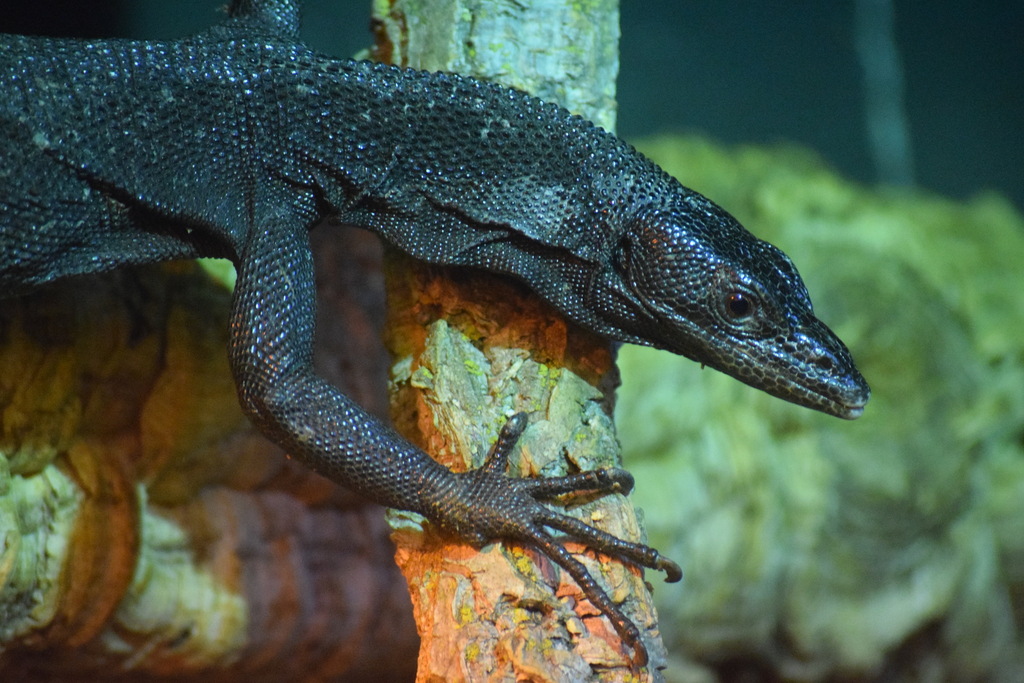
A medium-sized, arboreal monitor lizard typically measuring 24–32 inches (61–81 cm) in total length. Body is slender and elongated, with a prehensile tail that is notably longer than snout-to-vent length, comprising approximately 60% of total length. The tail is laterally compressed and used extensively for arboreal locomotion and balance. Head is relatively small and tapered with a pointed snout. Dorsal coloration is uniformly black or very dark brown, occasionally with subtle darker patterning or faint banding that may become more apparent with age or lighting conditions. Ventral surface is similarly dark, black to dark gray, with minimal contrast. Scales are small and granular dorsally, becoming slightly larger ventrally. The digits are elongated and equipped with sharp, curved claws well-adapted for climbing and gripping tree bark. Eyes are prominent with a vertical pupil. A distinct feature is the presence of a series of enlarged preanal pores in males. Primarily inhabits tropical rainforests, particularly arboreal zones in lowland and hill forests of New Guinea and nearby regions, where it is strictly arboreal and cryptic, spending most of its time in hollow trees, dense foliage, and tree crevices. Diet consists primarily of small vertebrates including other lizards, small snakes, and occasionally birds and small mammals, as well as large insects and invertebrates.
Similar species: Emerald Tree Monitor (Varanus prasinus) has bright green or yellow-green dorsal coloration and a similar arboreal lifestyle but is more conspicuous; Lemon Tree Monitor (Varanus salvadorii) exhibits yellow or pale coloration with black patterning and is similarly arboreal but larger and more patterned; Black Monitor (Varanus salvator) is larger, semi-aquatic, and lacks the distinctly arboreal adaptations and purely black coloration.
Photos
Click any photo to expand · Photos via iNaturalist